The Second Law of Thermodynamics explains why energy spreads out and why no process is perfectly efficient.
In simple terms:
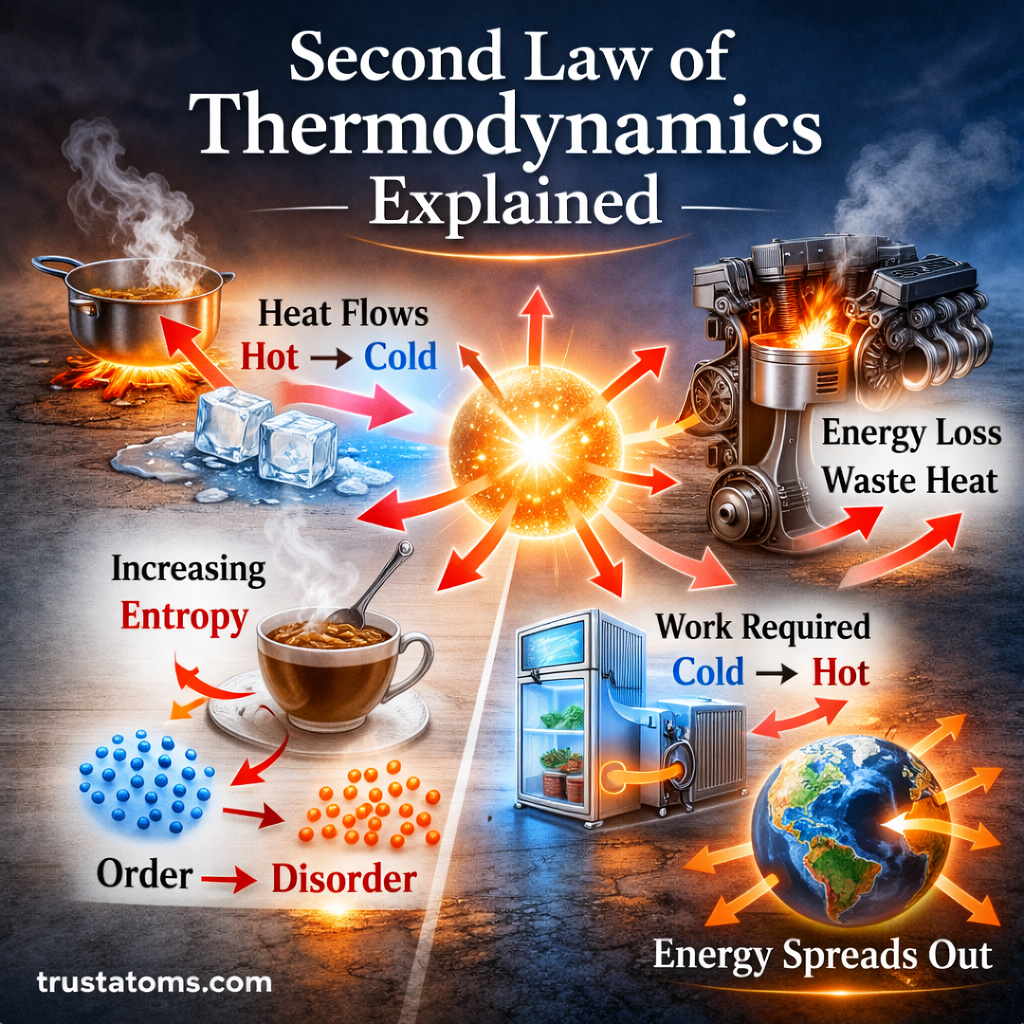
Heat flows naturally from hot to cold, and disorder (entropy) tends to increase over time.
While the First Law tells us energy is conserved, the Second Law tells us how energy behaves.
It explains:
- Why coffee cools down
- Why engines waste heat
- Why perpetual motion machines are impossible
- Why the universe moves toward greater disorder
This law shapes everything from power plants to the fate of the cosmos.
What Is the Second Law of Thermodynamics?
The Second Law states:
In any natural process, the total entropy of a system and its surroundings increases.
That may sound complex, but the idea is simple:
Energy becomes more spread out and less useful over time.
There are two key ideas in this law:
- Heat flows naturally from hot objects to cold ones.
- No energy conversion process is 100% efficient.
What Is Entropy?
Entropy is a measure of disorder or energy dispersal.
Higher entropy means:
- More randomness
- More spreading of energy
- Less available energy to do useful work
Lower entropy means:
- More order
- More concentrated energy
Think of it this way:
A neatly stacked pile of books has low entropy.
If the books are scattered across the floor, entropy is higher.
Nature tends toward the scattered state.
Heat Always Flows from Hot to Cold
One of the simplest expressions of the Second Law is:
Heat does not spontaneously flow from cold to hot.
Examples:
- A hot cup of tea cools down.
- Ice melts in a warm room.
- A warm object left outside eventually matches the air temperature.
The reverse does not happen without external work.
For instance, a refrigerator moves heat from cold to warm — but only because electricity powers it.
Why No Engine Is Perfectly Efficient
The Second Law explains why all engines waste energy.
When fuel burns in an engine:
- Chemical energy becomes heat.
- Heat pushes pistons or turns turbines.
- Some energy escapes as waste heat.
Even the most advanced engines lose energy.
That lost energy increases entropy.
This is why:
- Cars heat up
- Power plants release steam
- Machines require cooling systems
The Impossibility of Perpetual Motion Machines
A perpetual motion machine would:
- Run forever
- Produce more energy than it consumes
- Have no energy loss
The Second Law makes this impossible.
Some energy always spreads out as heat.
You cannot fully convert heat back into usable work without losses.
Entropy in Everyday Life
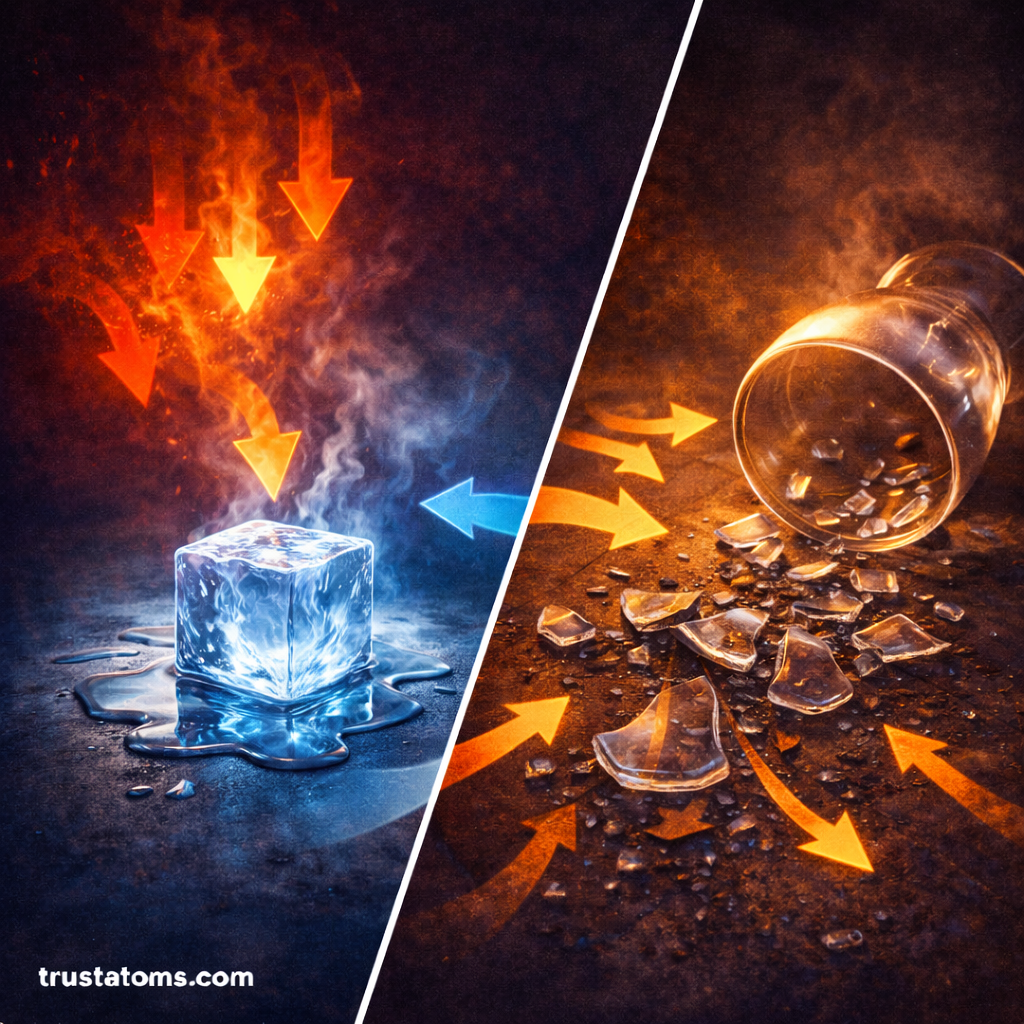
The Second Law is visible everywhere.
1. Melting Ice
Ice has ordered molecular structure.
When it melts:
- Molecules move more freely.
- Disorder increases.
- Entropy rises.
2. Mixing Cream into Coffee
At first, cream and coffee are separate.
After stirring:
- They mix.
- Order decreases.
- Entropy increases.
They will not spontaneously separate again.
3. A Messy Room
Left alone, a room becomes messy.
It does not organize itself.
Energy must be added (cleaning) to decrease local entropy.
Even then, total entropy increases elsewhere.
Local Order vs. Total Entropy
A common misconception is:
“If entropy always increases, how can life exist?”
The answer:
Entropy increases overall — not necessarily in small areas.
Living organisms:
- Build complex structures
- Maintain order
- Use energy from food or sunlight
But in doing so, they increase entropy in their surroundings.
The total entropy of the universe still increases.
The Second Law and the Universe
The Second Law has cosmic implications.
Over immense time scales:
- Stars burn fuel and radiate energy.
- Energy spreads into space.
- The universe becomes more uniform.
This idea leads to the concept of “heat death,” where energy becomes evenly distributed and no useful work can occur.
Different Statements of the Second Law
The law can be expressed in multiple equivalent ways.
Kelvin-Planck Statement
No engine can convert all heat into work without losses.
Clausius Statement
Heat cannot spontaneously flow from cold to hot.
Both describe the same fundamental principle.
Key Takeaways
- The Second Law of Thermodynamics introduces entropy.
- Entropy measures disorder or energy dispersal.
- Heat naturally flows from hot to cold.
- No engine is perfectly efficient.
- Perpetual motion machines are impossible.
- The total entropy of the universe increases over time.
This law explains the direction of natural processes.
Final Thoughts
The Second Law of Thermodynamics explains why energy spreads out and why perfect efficiency is impossible.
It governs:
- Engines
- Refrigeration
- Weather systems
- Biological processes
- The evolution of the universe
If the First Law tells us energy is conserved, the Second Law tells us energy becomes less useful over time.
Together, they define the limits of what is physically possible.