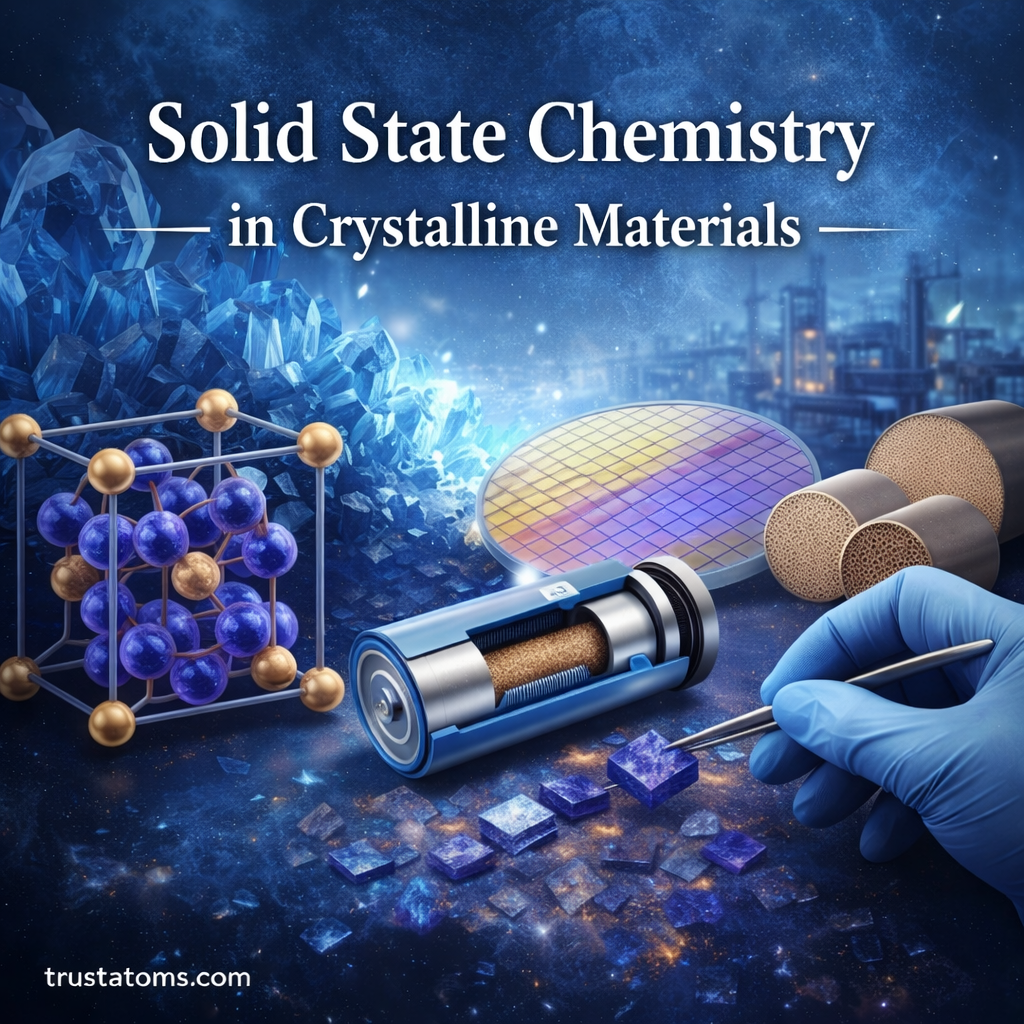
Solid state chemistry focuses on the structure, properties, and behavior of solid materials, particularly those with organized atomic arrangements. One of the most important areas within this field is the study of crystalline materials—solids in which atoms, ions, or molecules are arranged in highly ordered repeating patterns.
Understanding crystalline structures helps scientists explain why materials behave the way they do. From semiconductors used in electronics to minerals found in nature, crystalline materials play a vital role in chemistry, physics, engineering, and materials science.
This article explores the fundamentals of solid state chemistry and how crystalline structures influence the properties of materials.
What Is Solid State Chemistry?
Solid state chemistry is the branch of chemistry that studies solid materials and their atomic structures. Unlike gases or liquids, solids maintain a fixed shape because their particles are tightly packed together.
In many solids, these particles are arranged in a repeating three-dimensional pattern known as a crystal lattice.
Solid state chemistry investigates:
- Atomic arrangements within solids
- Chemical bonding in solid materials
- Electrical, optical, and magnetic properties
- Structural defects and their effects
Because the arrangement of atoms strongly influences material behavior, understanding crystal structures is essential for predicting and designing new materials.
Crystalline vs. Amorphous Solids
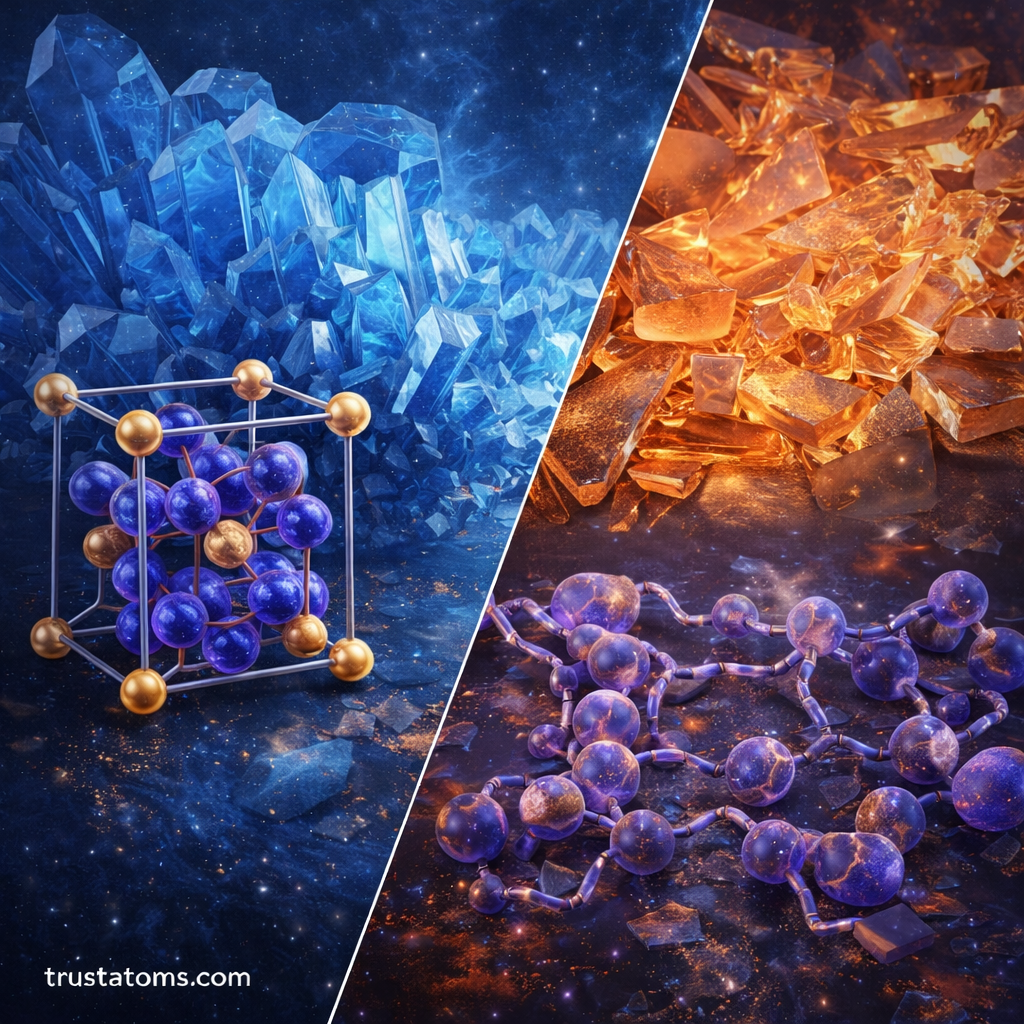
Not all solids have the same internal structure. Scientists typically classify solids into two main categories.
Crystalline Solids
Crystalline solids contain a regular, repeating arrangement of particles throughout the material.
Key characteristics include:
- Long-range atomic order
- Well-defined geometric shapes
- Sharp melting points
- Predictable physical properties
Examples of crystalline materials include:
- Salt crystals
- Quartz minerals
- Metals such as copper and aluminum
- Semiconductor crystals like silicon
Amorphous Solids
Amorphous solids lack long-range order. Their particles are arranged more randomly, similar to the structure of liquids.
Common examples include:
- Glass
- Plastics
- Rubber
- Certain polymers
Unlike crystalline solids, amorphous materials typically soften gradually rather than melting at a precise temperature.
Crystal Lattices and Unit Cells
The structure of crystalline materials can be understood by examining their crystal lattice.
A crystal lattice is a repeating three-dimensional pattern of points representing the positions of atoms or ions. The smallest repeating portion of this pattern is called the unit cell.
The unit cell acts as the building block of the entire crystal structure.
Important characteristics of unit cells include:
- Edge lengths
- Angles between edges
- Arrangement of particles inside the cell
When unit cells repeat in space, they form the larger crystalline structure observed in materials.
Types of Crystal Structures
Different crystalline materials form different geometric arrangements. Several common crystal structures appear frequently in solid state chemistry.
Cubic Crystal Systems
The cubic system is one of the most common crystal structures.
Its unit cell forms a cube, with atoms arranged in specific positions.
Examples include:
- Sodium chloride crystals
- Certain metal structures
- Many ionic compounds
Cubic systems often have high symmetry, which contributes to stable crystal structures.
Hexagonal Crystal Systems
In hexagonal systems, the unit cell has a six-sided symmetry.
These structures are common in:
- Zinc crystals
- Graphite layers
- Certain metallic compounds
Hexagonal arrangements can produce unique physical properties, especially in layered materials.
Tetragonal and Orthorhombic Systems
Some crystals form less symmetrical structures such as:
- Tetragonal systems
- Orthorhombic systems
These structures vary in edge lengths and angles but still maintain repeating lattice patterns.
Understanding these geometric systems allows scientists to classify crystalline materials and predict their behavior.
Chemical Bonding in Crystalline Materials
The properties of crystalline materials depend heavily on the types of chemical bonds that hold the structure together.
Common bonding types include:
Ionic Bonding
Ionic crystals form when positive and negative ions arrange themselves into a lattice.
Characteristics include:
- Strong electrostatic attractions
- High melting points
- Electrical conductivity when molten or dissolved
Common examples include:
- Sodium chloride
- Magnesium oxide
- Potassium bromide
Covalent Network Bonding
Some crystals form extensive networks of covalent bonds.
These structures are extremely strong and stable.
Examples include:
- Diamond
- Silicon crystals
- Quartz
Covalent network solids tend to be very hard and resistant to deformation.
Metallic Bonding
Metallic crystals consist of positive metal ions surrounded by mobile electrons.
This bonding explains why metals often have:
- High electrical conductivity
- Thermal conductivity
- Malleability and ductility
Metals such as copper, aluminum, and iron form crystalline metallic structures.
Defects in Crystal Structures
Although crystals are highly ordered, perfect structures rarely exist in real materials. Most crystals contain defects that influence their properties.
Common types of defects include:
Vacancies
A vacancy occurs when an atom or ion is missing from a lattice position.
These defects can affect:
- Diffusion rates
- Electrical conductivity
- Material strength
Interstitial Defects
In interstitial defects, extra atoms occupy spaces between normal lattice positions.
These additional atoms can distort the lattice and alter material behavior.
Substitutional Defects
Substitutional defects occur when a different type of atom replaces one in the lattice.
This process is widely used in materials engineering, particularly in semiconductor technology.
Applications of Solid State Chemistry
Solid state chemistry is essential for many modern technologies. By understanding how atoms arrange in solids, scientists can design materials with specific properties.
Key applications include:
Semiconductor Technology
Crystalline silicon is the foundation of modern electronics.
Solid state chemistry helps control electrical behavior in materials used for:
- Computer processors
- Solar cells
- Microchips
Energy Storage Materials
Battery technology relies heavily on solid state chemistry.
Researchers study crystalline materials to improve:
- Lithium-ion batteries
- Solid-state batteries
- Energy storage efficiency
Catalysts and Industrial Materials
Many industrial catalysts use crystalline materials with precise atomic structures.
These catalysts help accelerate chemical reactions in industries such as:
- Petroleum refining
- Chemical manufacturing
- Environmental cleanup
Advanced Materials
Solid state chemistry also contributes to the development of:
- Superconductors
- Magnetic materials
- Optical crystals
- Nanomaterials
These innovations continue to shape modern technology.
Solid State Chemistry and Materials Design
One of the most exciting aspects of solid state chemistry is the ability to design materials at the atomic level.
By adjusting crystal structures, chemical composition, and lattice defects, scientists can create materials with tailored properties.
This approach enables advances in:
- Renewable energy systems
- Electronic devices
- Aerospace materials
- Medical technologies
The field continues to grow as researchers discover new crystalline compounds and innovative ways to manipulate atomic structures.
Final Thoughts
Solid state chemistry plays a crucial role in understanding how materials behave at the atomic level. Crystalline materials, with their ordered structures and repeating patterns, reveal how atomic arrangement influences physical and chemical properties.
By studying crystal lattices, bonding types, and structural defects, scientists gain insight into everything from natural minerals to advanced technological materials. As research in solid state chemistry continues, it will remain a key driver in the development of new materials and future scientific breakthroughs.