Gravity feels simple.
Drop a ball, and it falls. Planets orbit the Sun. The Moon circles Earth.
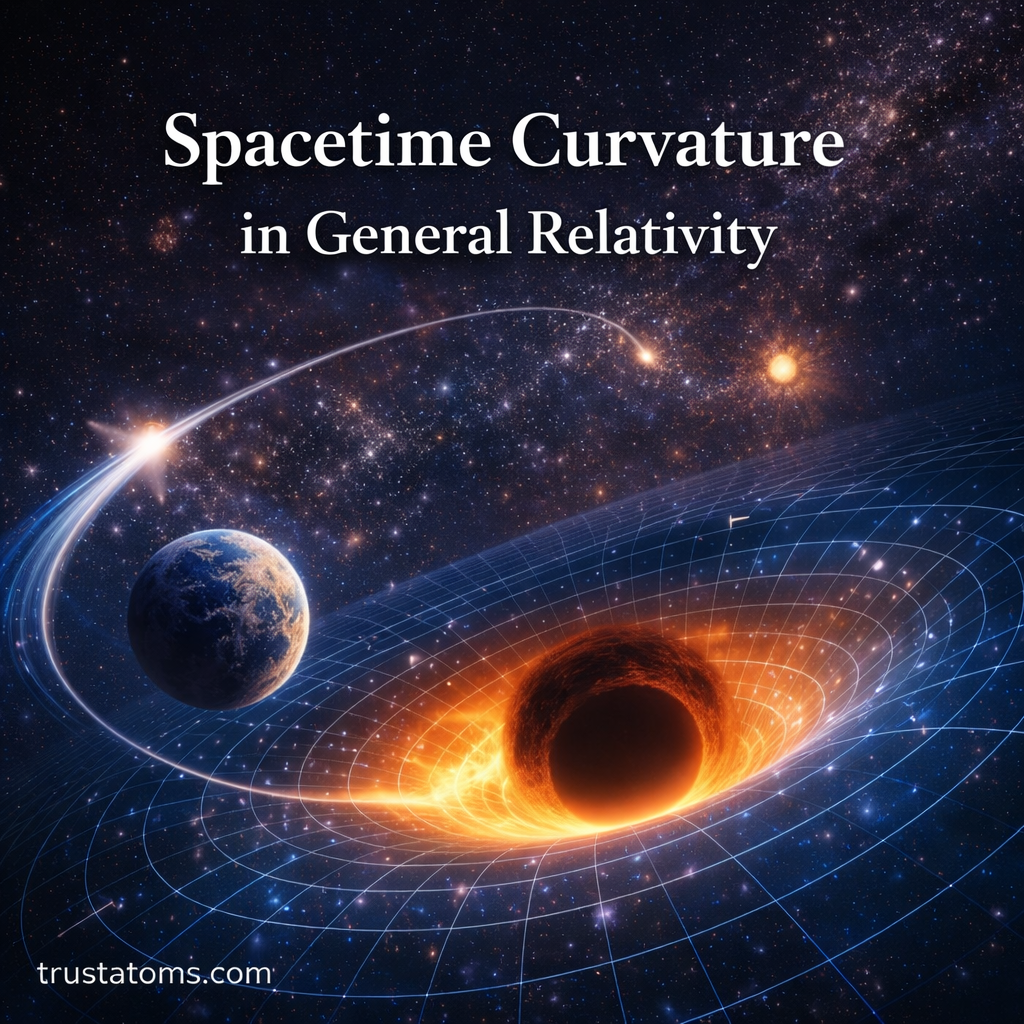
For centuries, gravity was described as a force pulling objects together. But in the early 20th century, Albert Einstein transformed our understanding completely. In his theory of general relativity, gravity is not a force — it is the curvature of spacetime itself.
This article explains what spacetime curvature is, how it works, and why it is one of the most profound ideas in modern physics.
What Is Spacetime?
Before understanding curvature, we must understand spacetime.
Spacetime combines:
- Three dimensions of space (length, width, height)
- One dimension of time
Instead of treating space and time separately, general relativity treats them as a single four-dimensional fabric.
Every object exists within this fabric.
From Newton’s Gravity to Einstein’s Insight
In classical physics:
- Gravity is a force between masses.
- The force increases with mass.
- The force decreases with distance.
This model works extremely well for:
- Everyday motion
- Planetary orbits
- Engineering calculations
But Newton’s theory cannot explain certain phenomena, including:
- The precise orbit of Mercury
- Gravitational lensing of light
- The behavior of extreme gravitational fields near black holes
Einstein proposed something radical:
Mass and energy tell spacetime how to curve.
Curved spacetime tells matter how to move.
What Does “Curvature” Mean?
Curvature does not mean objects are being pulled by an invisible force.
Instead:
- Massive objects warp the geometry of spacetime.
- Other objects follow the curved paths created by that warping.
A common analogy is a stretched rubber sheet:
- Place a heavy ball in the center.
- The sheet bends downward.
- Smaller balls roll toward the heavy ball because of the curvature.
While this analogy simplifies reality (true spacetime is four-dimensional), it captures the core idea:
Gravity is geometry.
How Mass and Energy Curve Spacetime
In general relativity:
- Mass curves spacetime.
- Energy curves spacetime.
- Pressure and momentum also contribute.
Even light, which has no rest mass, is affected by curvature because it travels through spacetime.
The more massive an object is:
- The stronger the curvature.
- The stronger the gravitational effects.
Extremely dense objects create extreme curvature.
Observable Evidence of Spacetime Curvature
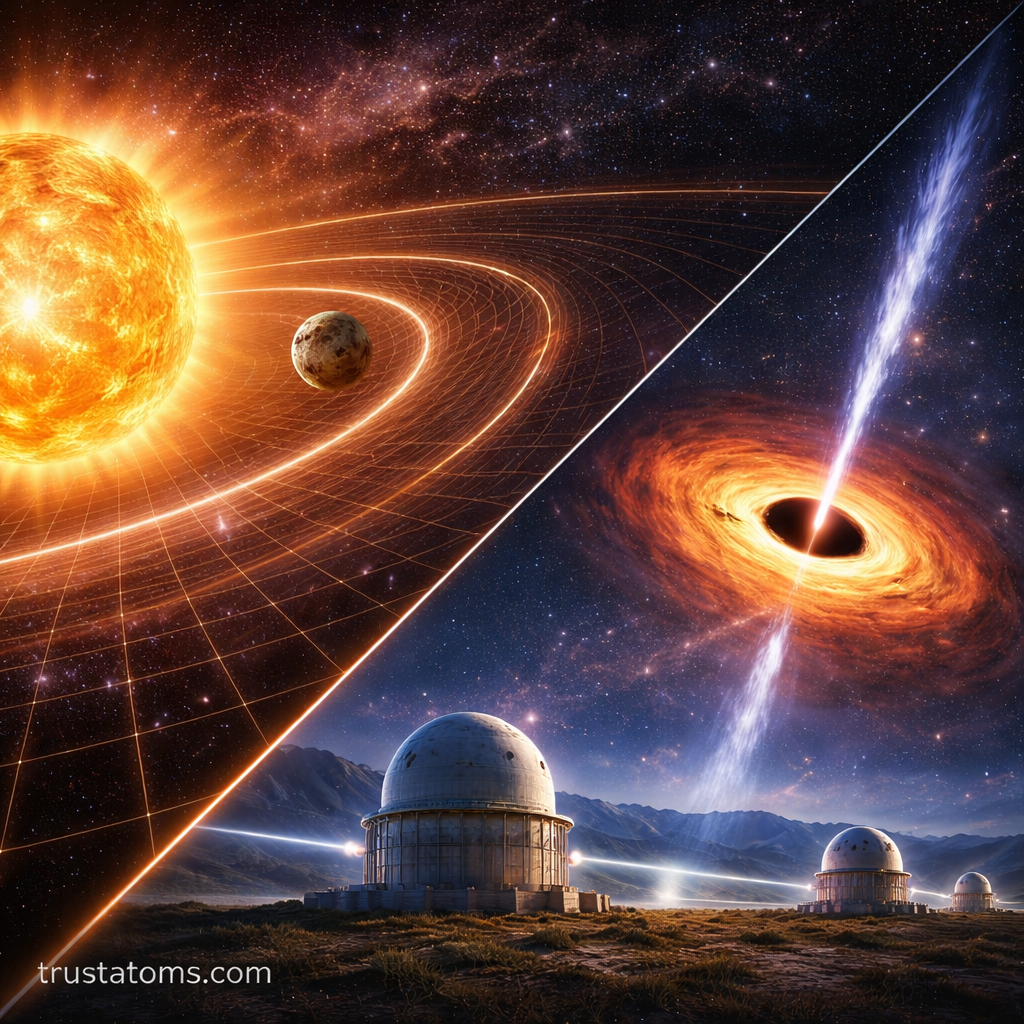
General relativity is not theoretical speculation. It has been tested repeatedly.
1. Gravitational Lensing
Light bends around massive objects.
When light from a distant galaxy passes near a massive cluster, it curves, producing distorted or multiple images.
This effect has been confirmed many times and matches Einstein’s predictions precisely.
2. Mercury’s Orbit
The planet Mercury’s orbit shifts slightly over time.
Newtonian gravity could not fully explain this shift.
General relativity predicts it exactly.
3. Gravitational Time Dilation
Time moves more slowly in stronger gravitational fields.
Clocks on Earth tick slightly slower than clocks in orbit.
This effect is so real that GPS satellites must correct for it.
4. Gravitational Waves
In 2015, the LIGO detected gravitational waves for the first time.
These waves are ripples in spacetime caused by:
- Colliding black holes
- Merging neutron stars
This confirmed one of Einstein’s most dramatic predictions.
Black Holes: Extreme Spacetime Curvature
Black holes are regions where spacetime curvature becomes extreme.
At the event horizon:
- Escape velocity equals the speed of light.
- Even light cannot escape.
The first image of a black hole was captured by the Event Horizon Telescope collaboration.
Black holes are not cosmic vacuum cleaners — they are regions of intense curvature where spacetime geometry becomes deeply distorted.
The Geometry of Gravity
In general relativity, motion follows the “straightest possible path” in curved spacetime.
These paths are called geodesics.
Objects in orbit are not being pulled by a force. They are:
- Following curved spacetime paths.
- Moving naturally along warped geometry.
This explains:
- Planetary orbits
- Falling objects
- Light bending around stars
Everything follows spacetime geometry.
Why Spacetime Curvature Matters
Spacetime curvature is essential for understanding:
- The expansion of the universe
- Black holes
- Neutron stars
- Cosmology
- Gravitational waves
Without general relativity, modern astrophysics would be impossible.
It is the framework used to model the large-scale structure of the universe.
Comparing Newton and Einstein
Newtonian Gravity:
- Gravity is a force.
- Works well for weak fields.
- Breaks down in extreme conditions.
General Relativity:
- Gravity is curvature of spacetime.
- Predicts time dilation and gravitational waves.
- Required for strong gravitational fields.
Newton remains incredibly useful.
Einstein extends physics into the extreme.
The Mathematical Foundation (Conceptual Overview)
The core of general relativity is expressed in Einstein’s field equations.
In simplified conceptual terms:
- Matter and energy determine curvature.
- Curvature determines motion.
These equations link geometry and physics into one unified framework.
They are among the most elegant equations in science.
Final Takeaways
- Spacetime combines space and time into one fabric.
- Mass and energy curve that fabric.
- Curved spacetime determines motion.
- Gravity is geometry, not a force.
- General relativity has been repeatedly confirmed by experiment.
Spacetime curvature reshaped physics by revealing that gravity is not something acting within space — it is a property of space and time themselves.
This insight transformed our understanding of the universe and remains one of the greatest scientific achievements in history.