Spectroscopy is one of the most powerful tools scientists use to understand the structure and composition of molecules. By studying how matter interacts with light and other electromagnetic radiation, researchers can identify substances, analyze chemical bonds, and determine molecular structures with remarkable precision.
From pharmaceutical research to environmental monitoring, spectroscopy plays a critical role in modern chemistry. It allows scientists to detect molecules that are invisible to the naked eye and reveal how atoms are arranged within compounds.
This guide explains how spectroscopy works, why it is important in molecular analysis, and the most common types used in chemical research.
What Is Spectroscopy?
Spectroscopy is the scientific study of how atoms and molecules interact with electromagnetic radiation.
When light or other forms of radiation interact with matter, energy can be:
- Absorbed
- Emitted
- Scattered
- Reflected
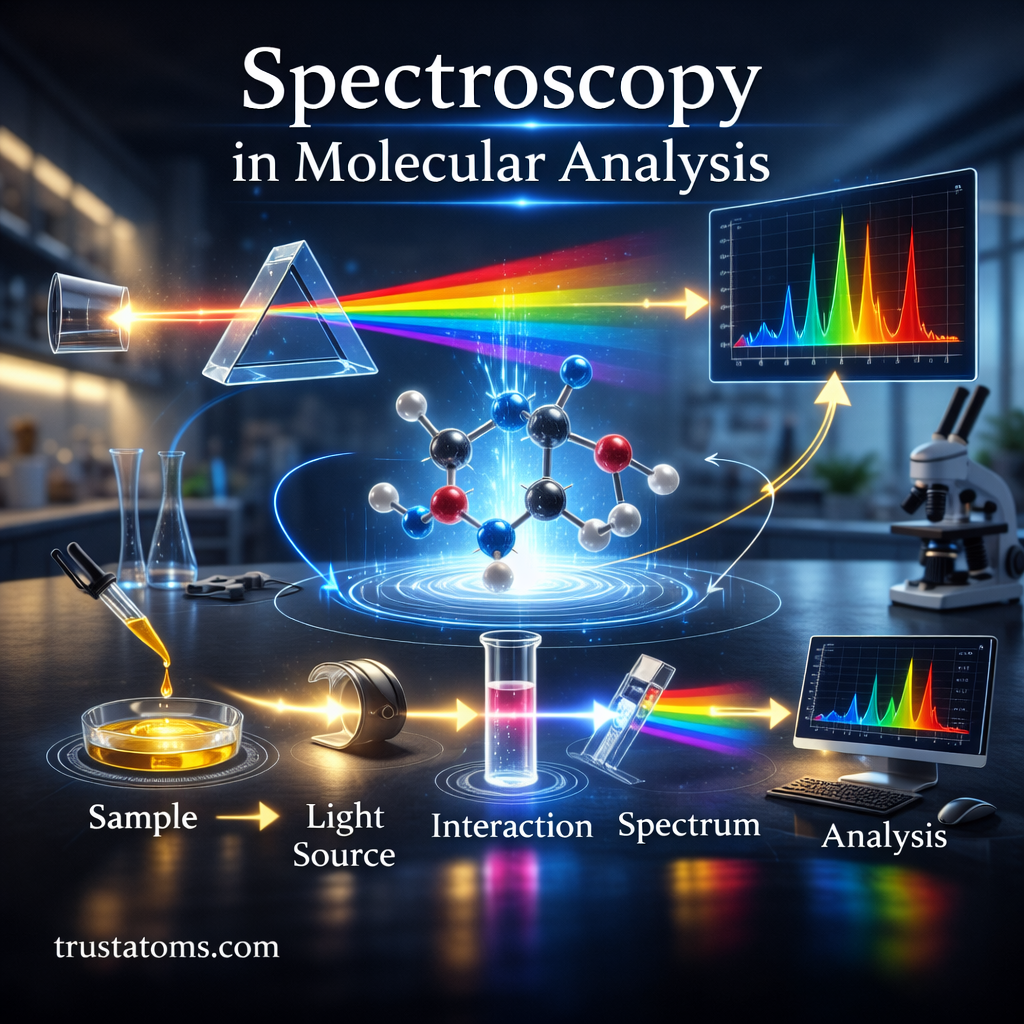
Each substance interacts with radiation in a unique way. These interactions create measurable signals called spectra, which act like fingerprints for different molecules.
By analyzing these patterns, scientists can determine:
- What elements are present
- The types of chemical bonds in a molecule
- The arrangement of atoms
- Molecular concentrations in a sample
Why Spectroscopy Is Important in Chemistry
Spectroscopy provides insight into the microscopic world of molecules. Instead of physically seeing atoms, scientists interpret the patterns of energy absorbed or emitted by substances.
Key benefits of spectroscopy include:
- Identifying unknown chemical compounds
- Determining molecular structure
- Monitoring chemical reactions
- Measuring trace amounts of substances
- Studying molecular interactions
Because spectroscopy can detect extremely small quantities, it is widely used in fields like medicine, materials science, and environmental chemistry.
How Spectroscopy Works
Spectroscopy relies on the interaction between electromagnetic radiation and matter.
Electromagnetic radiation includes:
- Radio waves
- Microwaves
- Infrared radiation
- Visible light
- Ultraviolet radiation
- X-rays
When radiation encounters a molecule, several things can occur:
- The molecule absorbs energy
- Electrons move to higher energy levels
- Vibrations or rotations within the molecule change
- The molecule releases energy
These energy changes create measurable signals that instruments convert into spectra.
Understanding Molecular Spectra
A spectrum is a graphical representation showing how a molecule interacts with radiation.
Scientists analyze spectra to identify specific molecular properties.
Spectra often display:
- Energy levels
- Wavelengths of absorbed radiation
- Intensity of signals
Different molecules produce unique spectral patterns because their atomic structures differ. This allows scientists to identify compounds with high accuracy.
Major Types of Spectroscopy Used in Molecular Analysis
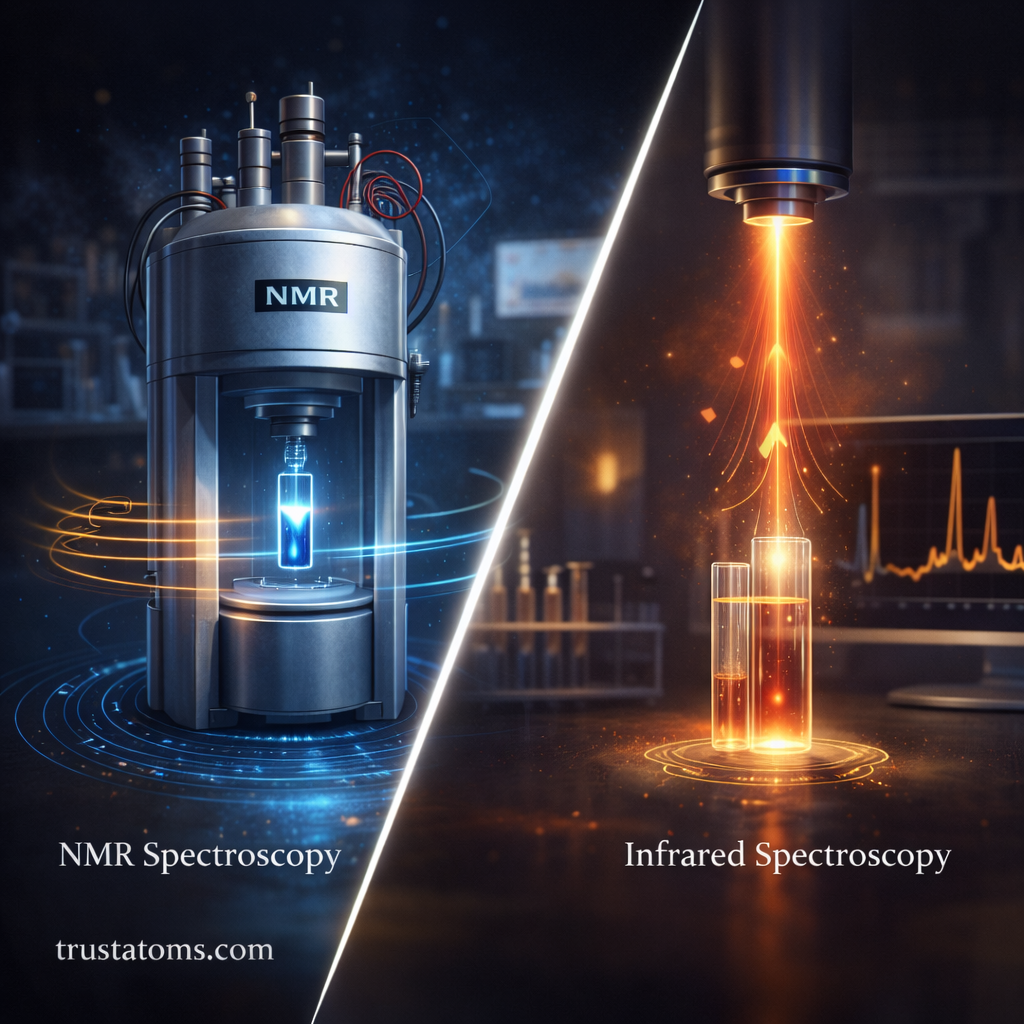
Several types of spectroscopy are commonly used in chemistry. Each technique focuses on different aspects of molecular behavior.
Infrared (IR) Spectroscopy
Infrared spectroscopy studies how molecules absorb infrared radiation.
When molecules absorb infrared light, their chemical bonds vibrate in characteristic ways.
IR spectroscopy is widely used to:
- Identify functional groups in organic molecules
- Study chemical bonding
- Analyze unknown compounds
For example, different bonds such as carbon–hydrogen or oxygen–hydrogen absorb infrared radiation at specific wavelengths.
Ultraviolet–Visible (UV-Vis) Spectroscopy
UV-Vis spectroscopy examines how molecules absorb ultraviolet and visible light.
This technique primarily studies electron transitions within molecules.
Common applications include:
- Measuring concentration of chemical solutions
- Studying reaction rates
- Analyzing pigments and dyes
- Monitoring biological molecules
Because many molecules absorb light in the UV or visible range, this method is widely used in laboratories.
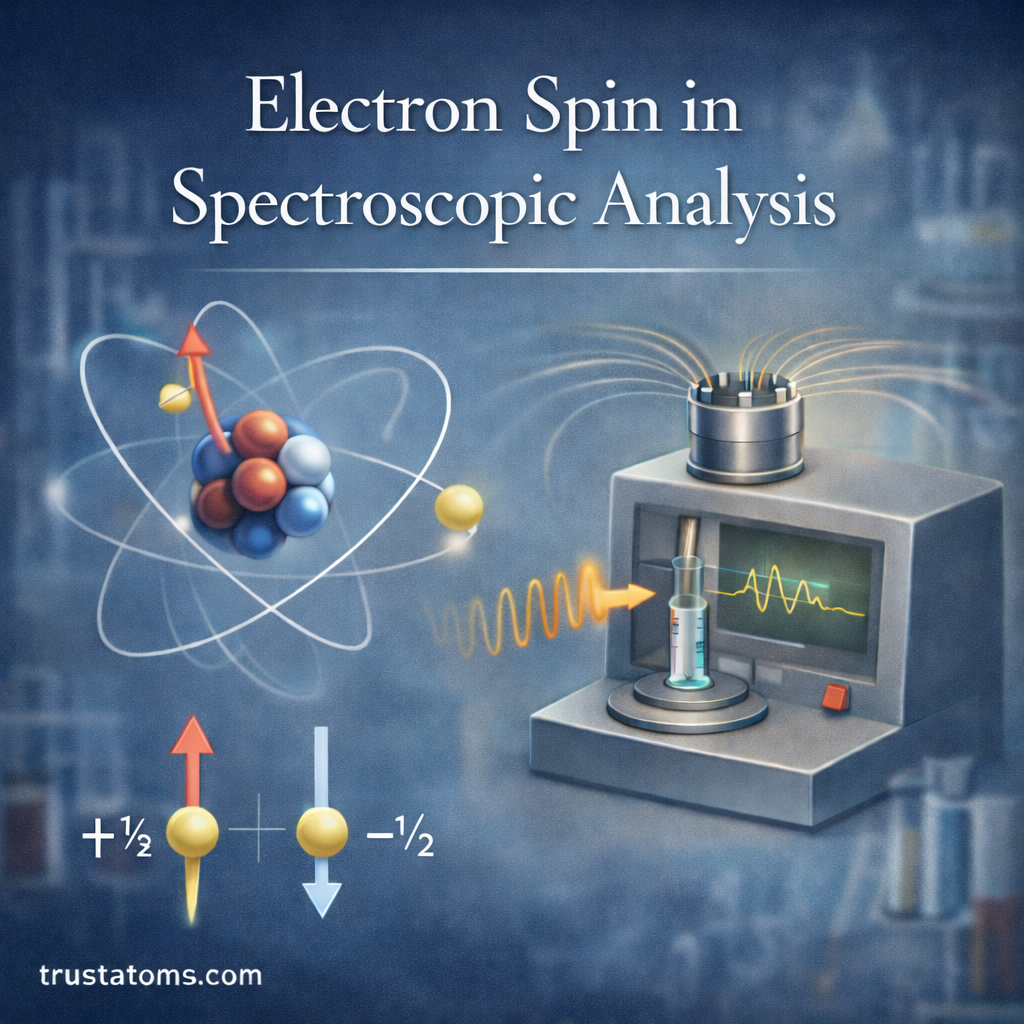
Nuclear Magnetic Resonance (NMR) Spectroscopy
NMR spectroscopy is one of the most powerful methods for determining molecular structure.
It works by observing how atomic nuclei respond to strong magnetic fields and radio-frequency radiation.
NMR can provide detailed information about:
- The arrangement of atoms in a molecule
- The chemical environment surrounding each atom
- Molecular connectivity
This technique is essential in organic chemistry and pharmaceutical research.
Mass Spectrometry (Often Used Alongside Spectroscopy)
Although technically a separate technique, mass spectrometry is frequently used together with spectroscopic methods.
Mass spectrometry measures the mass and charge of ionized particles.
It helps scientists determine:
- Molecular weight
- Chemical composition
- Fragmentation patterns of molecules
Combining spectroscopy with mass spectrometry allows researchers to identify compounds with high precision.
Applications of Spectroscopy in Molecular Analysis
Spectroscopy is used across many scientific disciplines because it allows scientists to study matter at the molecular level.
Important applications include:
Pharmaceutical Research
Drug development relies heavily on spectroscopy to verify molecular structures and purity.
Scientists use spectroscopic techniques to:
- Confirm chemical synthesis
- Identify impurities
- Analyze drug interactions
Environmental Monitoring
Spectroscopy helps detect pollutants in air, water, and soil.
For example:
- Identifying heavy metals
- Monitoring atmospheric gases
- Measuring water contamination
Even very small concentrations can be detected using advanced spectroscopic instruments.
Forensic Science
Forensic investigators use spectroscopy to analyze chemical evidence found at crime scenes.
Examples include:
- Identifying unknown powders or liquids
- Detecting drugs and toxins
- Analyzing trace materials
Spectroscopic analysis helps investigators obtain accurate chemical information quickly.
Astronomy and Space Science
Spectroscopy is also used to study distant stars and planets.
Astronomers analyze the light emitted or absorbed by celestial objects to determine:
- Chemical composition of stars
- Presence of elements in distant galaxies
- Temperature and motion of astronomical bodies
This technique allows scientists to study objects millions of light-years away.
Advantages of Spectroscopy in Chemical Analysis
Spectroscopy has several advantages that make it essential for molecular analysis.
Key benefits include:
- Highly sensitive detection of substances
- Non-destructive analysis of samples
- Rapid data collection
- Ability to identify unknown compounds
- Detailed information about molecular structure
These advantages make spectroscopy a standard tool in laboratories worldwide.
Limitations of Spectroscopic Techniques
Despite its many strengths, spectroscopy also has some limitations.
Challenges may include:
- Expensive equipment
- Need for specialized training
- Interpretation of complex spectra
- Sensitivity to sample preparation
However, advances in instrumentation and software continue to improve accuracy and accessibility.
The Future of Spectroscopy in Molecular Science
Spectroscopy continues to evolve as technology advances.
New developments include:
- High-resolution spectrometers
- Portable field instruments
- Automated spectral analysis software
- AI-assisted molecular identification
These innovations allow scientists to analyze molecules faster and more accurately than ever before.
As research progresses, spectroscopy will remain a central method for understanding the chemical world.
Final Thoughts
Spectroscopy is a cornerstone of modern molecular analysis. By examining how molecules interact with electromagnetic radiation, scientists can identify substances, determine molecular structures, and study chemical reactions.
From medicine and environmental science to astronomy and forensic investigations, spectroscopy provides powerful insights into the invisible world of atoms and molecules. As technology continues to improve, spectroscopic methods will remain essential tools for exploring the chemistry that shapes our universe.