Dynamical systems are everywhere — from planetary orbits and electrical circuits to ecosystems and financial markets. But one key question unites them all: Will the system remain stable, or will it spiral into chaos?
Stability analysis in dynamical systems helps physicists and engineers determine how systems respond to disturbances. Do they return to equilibrium? Drift away? Oscillate indefinitely?
In this guide, we’ll break down the core concepts of stability analysis in clear, practical terms — without heavy math — so you can understand how scientists predict system behavior over time.
What Is a Dynamical System?
A dynamical system is any system that evolves over time according to specific rules.
Examples include:
- A swinging pendulum
- A satellite orbiting Earth
- Population growth in biology
- A mass attached to a spring
- Climate temperature models
In physics, these systems are typically described using differential equations that track how variables change.
The central focus of stability analysis is understanding what happens near equilibrium points.
What Is Stability?
An equilibrium point is a state where the system doesn’t change unless disturbed.
Stability asks:
- If the system is slightly disturbed, does it return to equilibrium?
- Does it move further away?
- Does it oscillate around the equilibrium?
- Does it behave unpredictably?
There are three primary types of stability.
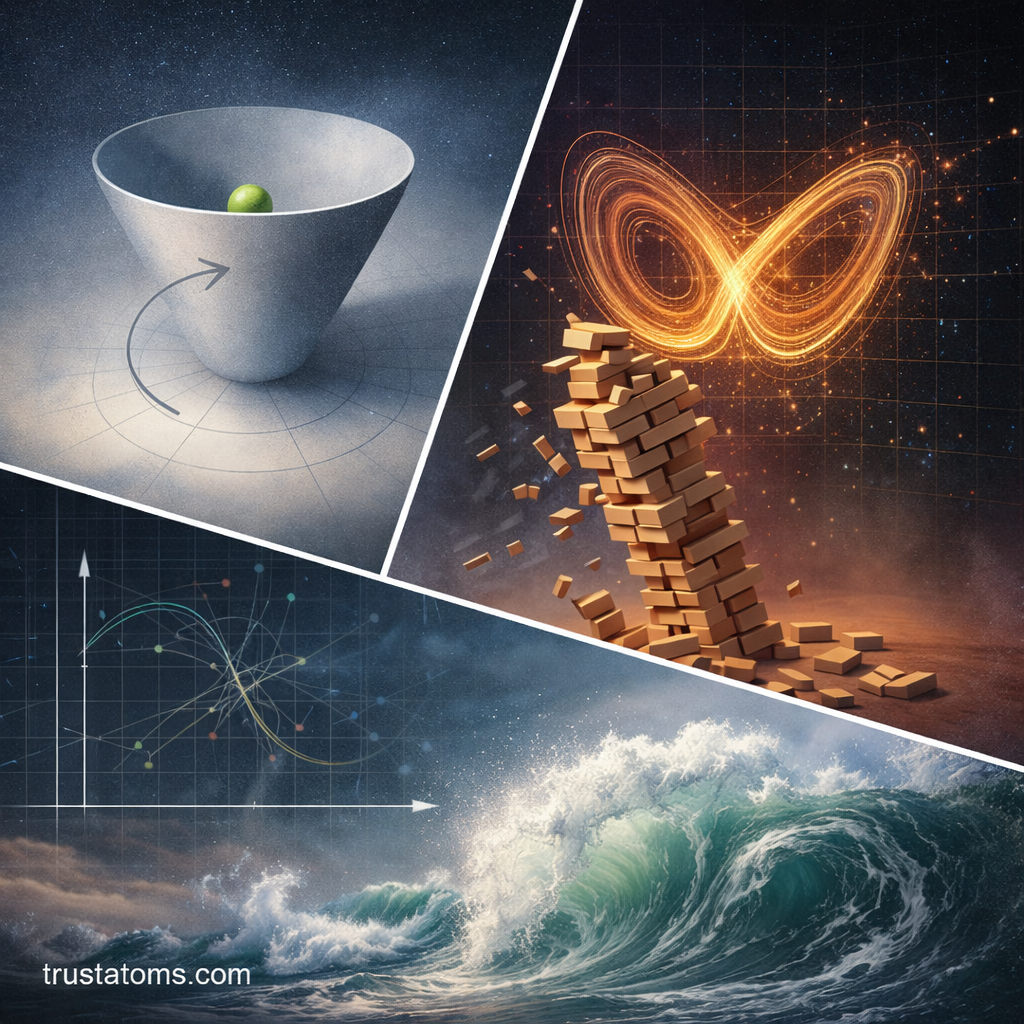
Stable Equilibrium
If a small disturbance causes the system to return to equilibrium, the system is stable.
Examples:
- A marble at the bottom of a bowl
- A damped spring returning to rest
Unstable Equilibrium
If a disturbance causes the system to move away from equilibrium, the system is unstable.
Examples:
- A marble balanced on top of a hill
- A pencil standing perfectly upright
Neutral (Marginal) Stability
If a disturbance neither restores nor amplifies motion, the system is neutrally stable.
Example:
- A marble on a flat surface
Why Stability Analysis Matters
Stability determines whether a system is:
- Safe (bridges, aircraft, reactors)
- Predictable (orbits, control systems)
- Sustainable (ecosystems, climate systems)
- Efficient (power grids, engines)
Without stability analysis, engineers and physicists cannot confidently design real-world systems.
Types of Stability in Physics
Stability analysis can be categorized more precisely depending on context.
Linear Stability
This examines small disturbances around equilibrium.
If small deviations shrink over time, the system is linearly stable.
This method works well when disturbances are small.
Nonlinear Stability
Many real systems are nonlinear.
Small disturbances may behave differently than large ones. Nonlinear stability analysis studies how the system behaves beyond small approximations.
This is common in:
- Fluid turbulence
- Climate models
- Plasma physics
- Mechanical oscillators
Asymptotic Stability
If disturbances not only shrink but eventually disappear completely, the system is asymptotically stable.
This is common in damped systems where energy is lost over time.
The Role of Eigenvalues in Stability
In linear systems, stability is often determined by analyzing eigenvalues of the system matrix.
In simplified terms:
- Negative real parts → stable
- Positive real parts → unstable
- Zero real part → neutral or marginal stability
Eigenvalues describe how perturbations grow or decay over time.
They are one of the most powerful tools in dynamical systems analysis.
Phase Space and Stability
A useful way to visualize stability is through phase space.
Phase space represents:
- Position
- Velocity
- Or other system variables
Each point in phase space represents a complete state of the system.
Stable systems show trajectories that move toward equilibrium points.
Unstable systems show trajectories moving away.
Chaotic systems show complex, unpredictable patterns.
Lyapunov Stability
Lyapunov stability is a more general framework that works even for nonlinear systems.
Instead of solving the full equations, physicists look for a Lyapunov function — a quantity that behaves like an energy measure.
If this function always decreases over time:
- The system is stable
If it increases:
- The system is unstable
Lyapunov methods are widely used in:
- Robotics
- Aerospace engineering
- Control systems
- Power grid stability
Real-World Applications of Stability Analysis
Stability analysis is essential across scientific and engineering fields.
Mechanical Systems
- Suspension bridges
- Spacecraft orientation
- Vehicle suspension systems
Electrical Systems
- Power grid synchronization
- Oscillator circuits
- Signal processing
Astrophysics
- Orbital dynamics
- Planetary motion
- Stellar systems
Climate and Environmental Systems
- Ice sheet stability
- Ocean circulation patterns
- Atmospheric oscillations
Stability vs. Chaos
Not all unstable systems are chaotic.
Chaos occurs when systems:
- Are deterministic
- Are highly sensitive to initial conditions
- Exhibit complex, non-repeating behavior
Some systems can transition from stable to chaotic behavior as parameters change. This process is known as a bifurcation.
Understanding stability helps scientists predict when such transitions may occur.
Common Methods in Stability Analysis
Physicists use several tools to analyze stability:
- Linearization around equilibrium
- Eigenvalue analysis
- Phase portraits
- Energy methods
- Lyapunov functions
- Numerical simulations
Each method provides different insights depending on system complexity.
Key Takeaways
- Stability analysis determines how systems respond to disturbances.
- Stable systems return to equilibrium.
- Unstable systems move away from equilibrium.
- Eigenvalues help determine stability in linear systems.
- Lyapunov methods allow stability analysis in nonlinear systems.
- Stability analysis is critical in engineering, physics, climate science, and space exploration.
Understanding stability gives scientists the power to predict long-term behavior — and design systems that won’t fail under stress.
Final Thoughts
Stability analysis in dynamical systems bridges abstract mathematics and real-world physics.
From ensuring that aircraft remain controllable to predicting planetary motion, stability determines whether systems behave predictably or catastrophically.
As systems grow more complex — especially in climate modeling, artificial intelligence, and space exploration — stability analysis remains one of the most essential tools in modern physics.