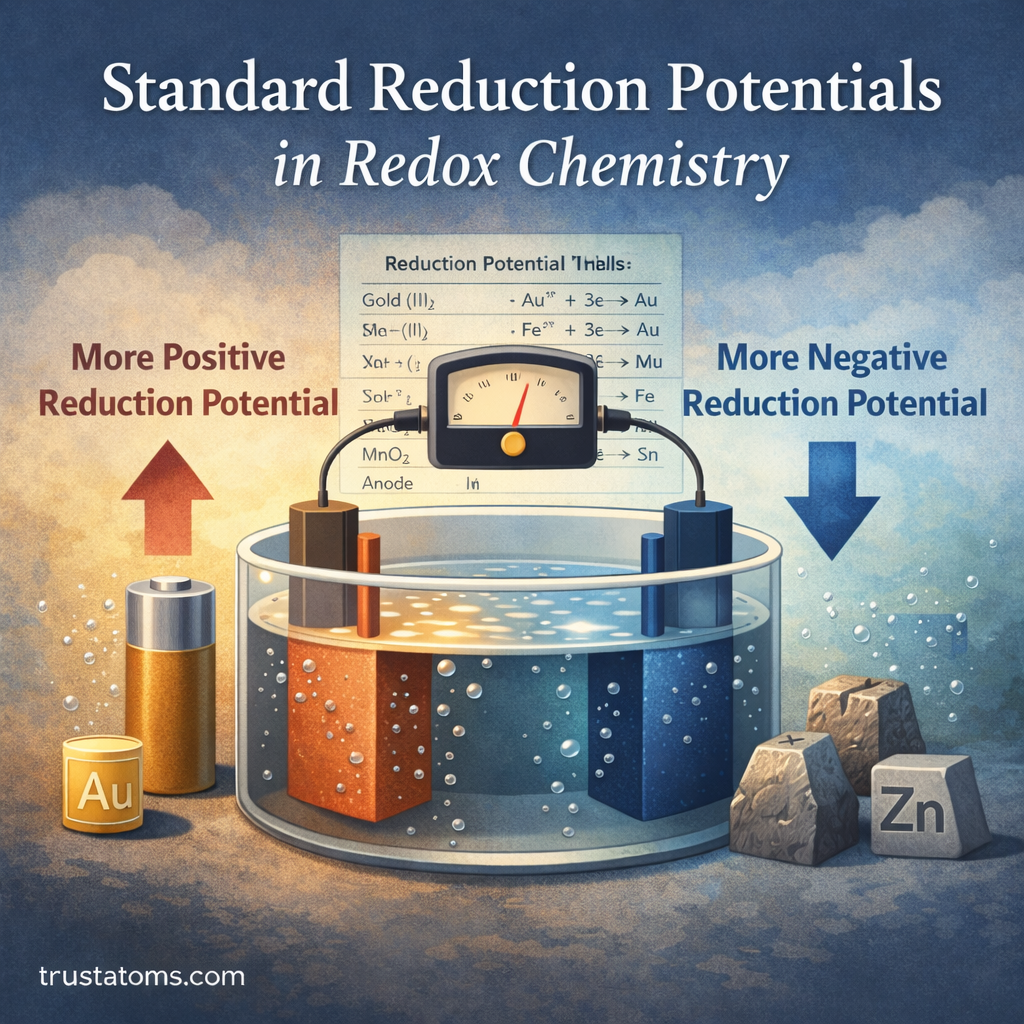
Standard reduction potentials are a fundamental concept in redox chemistry. They allow scientists to predict how easily a substance will gain electrons during a chemical reaction and help determine whether a redox reaction will occur spontaneously.
This concept is especially important in electrochemistry, where chemical reactions are used to generate electricity in batteries, fuel cells, and other energy systems. By comparing reduction potentials, chemists can determine the direction of electron flow and estimate the voltage produced by electrochemical cells.
What Are Standard Reduction Potentials?
A standard reduction potential measures the tendency of a chemical species to gain electrons and be reduced.
These potentials are measured under standardized conditions:
- Temperature of 25°C (298 K)
- Pressure of 1 atmosphere
- Concentration of 1 molar (1 M) for aqueous solutions
Each reduction reaction is compared against a reference electrode known as the standard hydrogen electrode (SHE).
The standard hydrogen electrode is assigned a potential value of:
0.00 volts
All other reduction potentials are measured relative to this reference point.
Reduction and Oxidation in Redox Reactions
Redox reactions involve two simultaneous processes:
- Reduction – gain of electrons
- Oxidation – loss of electrons
Because electrons cannot exist freely in a reaction system, oxidation and reduction always occur together.
For example:
- One substance loses electrons (oxidation).
- Another substance gains those electrons (reduction).
Standard reduction potentials help identify which substances are more likely to gain electrons during these reactions.
Understanding the Reduction Potential Table
Chemists compile reduction potentials in a standard reduction potential table, which ranks chemical species by their tendency to be reduced.
The table lists half-reactions in their reduction form.
Important interpretations include:
More Positive Reduction Potential

A more positive value means the substance is more likely to gain electrons and act as an oxidizing agent.
These substances are strong oxidizers.
More Negative Reduction Potential
A more negative value indicates the substance is less likely to gain electrons and more likely to lose electrons.
These substances tend to act as reducing agents.
Comparing Two Half-Reactions
When two half-reactions are paired in a redox system:
- The reaction with the higher reduction potential undergoes reduction.
- The reaction with the lower reduction potential undergoes oxidation.
This difference determines the direction of electron flow.
Calculating Cell Potential
Standard reduction potentials are used to calculate the voltage produced by electrochemical cells.
The cell potential is determined using the equation:
Cell Potential = Cathode Potential − Anode Potential
Where:
- Cathode is where reduction occurs
- Anode is where oxidation occurs
Steps for calculating cell potential:
- Identify the two half-reactions.
- Determine which has the higher reduction potential.
- Assign that reaction to the cathode.
- Subtract the anode potential from the cathode potential.
If the calculated cell potential is positive, the reaction is spontaneous under standard conditions.
Why Standard Reduction Potentials Matter
Standard reduction potentials are used widely across chemistry, engineering, and materials science.
They help scientists:
- Predict the direction of redox reactions
- Calculate battery voltage
- Understand corrosion processes
- Design electrochemical systems
- Analyze chemical reactivity
These values provide a consistent framework for comparing the electron-accepting ability of different substances.
Standard Reduction Potentials in Electrochemical Cells
Electrochemical cells rely on differences in reduction potentials to generate electrical energy.
When two different electrodes are connected:
- Electrons flow from the electrode with the lower reduction potential.
- They travel through the external circuit.
- They reach the electrode with the higher reduction potential.
This movement of electrons creates an electric current.
Common electrochemical technologies using this principle include:
- Batteries
- Fuel cells
- Electrolysis systems
- Corrosion prevention methods
The larger the difference in reduction potentials between two electrodes, the greater the possible cell voltage.
Relationship Between Reduction Potential and Reactivity
Reduction potentials help explain why some metals react more easily than others.
For example:
- Metals with very negative reduction potentials tend to lose electrons easily.
- Metals with positive reduction potentials tend to resist oxidation.
This is why reactive metals like sodium and potassium corrode quickly, while metals like gold and platinum remain relatively stable.
Understanding these values allows chemists to predict how metals behave in different environments.
Applications in Real-World Chemistry
Standard reduction potentials are used in many practical chemical systems.
Battery Design
Battery engineers choose electrode materials based on their reduction potentials to maximize voltage and efficiency.
Corrosion Prevention
Engineers use sacrificial anodes with lower reduction potentials to protect metal structures such as pipelines and ships.
Environmental Chemistry
Redox reactions influenced by reduction potentials affect water purification, soil chemistry, and pollutant breakdown.
Industrial Electrochemistry
Processes such as metal extraction, electroplating, and chemical manufacturing depend on controlled redox reactions guided by reduction potentials.
Limitations of Standard Reduction Potentials
Although reduction potential tables are useful, they have some limitations.
Standard values assume ideal conditions, including:
- Specific concentrations
- Standard temperature
- Standard pressure
In real-world systems, these conditions may vary.
Changes in concentration, temperature, or pH can alter reaction behavior. In such cases, chemists use additional calculations, such as the Nernst equation, to determine actual cell potentials.
Final Thoughts
Standard reduction potentials provide a powerful tool for understanding and predicting redox reactions. By comparing the tendency of substances to gain electrons, chemists can determine reaction direction, calculate electrochemical cell voltage, and design efficient energy systems.
From batteries and fuel cells to corrosion prevention and environmental chemistry, reduction potentials play a crucial role in both theoretical chemistry and practical applications. As electrochemical technologies continue to evolve, understanding these fundamental concepts remains essential for advancing energy and materials science.