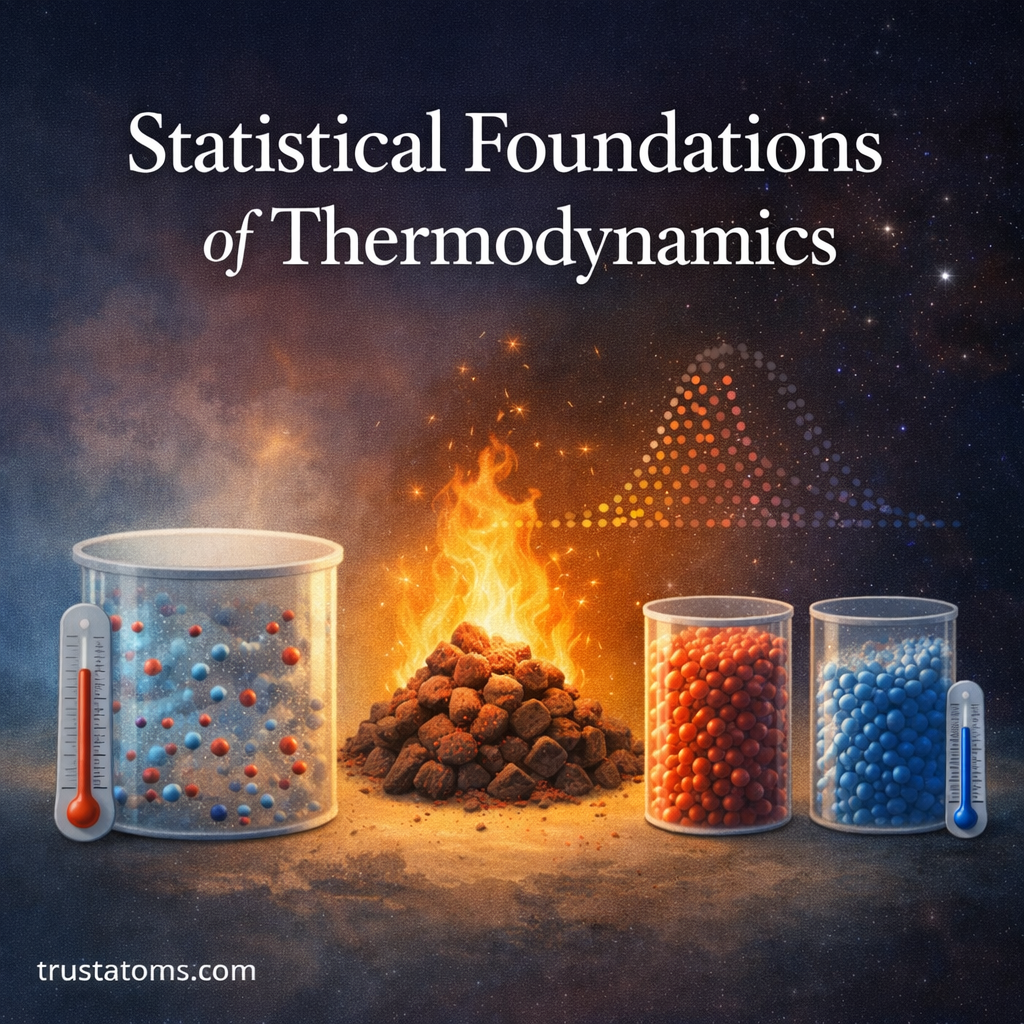
Thermodynamics describes heat, work, temperature, and energy at the macroscopic level. But what gives rise to these laws?
The answer lies in the statistical foundations of thermodynamics — the idea that macroscopic properties emerge from the collective behavior of microscopic particles.
Instead of tracking every atom individually (which would be impossible for systems with ~10²³ particles), statistical mechanics uses probability and averages to explain why thermodynamic laws work so reliably.
This article explores the core ideas that connect microscopic motion to macroscopic physics.
Why Thermodynamics Needs Statistics
A typical glass of water contains roughly:
- 10²³ molecules
- Constant random motion
- Collisions happening billions of times per second
Tracking each molecule’s position and velocity is impossible.
Instead, physicists ask:
- What is the most probable behavior of the system?
- How do averages produce stable macroscopic quantities?
Thermodynamics works because, in very large systems, random microscopic fluctuations average out.
Microstates and Macrostates
A central concept in statistical thermodynamics is the distinction between microstates and macrostates.
Microstate
A microstate describes:
- The exact position of every particle
- The exact momentum of every particle
It is a complete microscopic description.
Macrostate
A macrostate describes measurable bulk properties such as:
- Temperature
- Pressure
- Volume
- Total energy
Many different microstates can correspond to the same macrostate.
The Role of Probability
Statistical thermodynamics is built on probability.
For a given macrostate:
- Some configurations (microstates) are far more numerous than others.
- Systems naturally evolve toward the most probable macrostate.
This explains why systems spontaneously move toward equilibrium.
Not because of “intent,” but because equilibrium corresponds to the largest number of possible microscopic arrangements.
Entropy as a Statistical Quantity
One of the most important results in physics is the statistical definition of entropy:
S = k ln W
Where:
- S = entropy
- k = Boltzmann constant
- W = number of microstates
Entropy measures how many microscopic arrangements are consistent with a macrostate.
Key Insight
- Low entropy → few possible microstates
- High entropy → many possible microstates
Systems evolve toward higher entropy because those states are overwhelmingly more probable.
The Boltzmann Distribution
In thermal equilibrium, particle energies follow a predictable probability pattern known as the Boltzmann distribution.
This distribution tells us:
- Higher-energy states are less likely
- Lower-energy states are more populated
- Probability decreases exponentially with energy
This statistical rule explains:
- Why hotter systems have more energetic particles
- Why chemical reactions depend on temperature
- Why thermal radiation follows predictable patterns
The Partition Function: The Statistical Engine
The partition function (Z) is a central mathematical tool in statistical thermodynamics.
It allows physicists to calculate:
- Average energy
- Entropy
- Free energy
- Heat capacity
In simple terms, the partition function summarizes all possible microstates and their probabilities.
Once Z is known, nearly all thermodynamic quantities can be derived from it.
Connecting Microscopic Motion to Temperature
Temperature emerges statistically.
At the microscopic level:
- Particles move randomly
- They possess kinetic energy
The average kinetic energy of particles is directly related to temperature.
For ideal gases:
- Higher temperature → higher average particle speed
- Lower temperature → slower motion
Temperature is not about individual particles — it is about averages across huge numbers of them.
Statistical Interpretation of the Laws of Thermodynamics
Zeroth Law
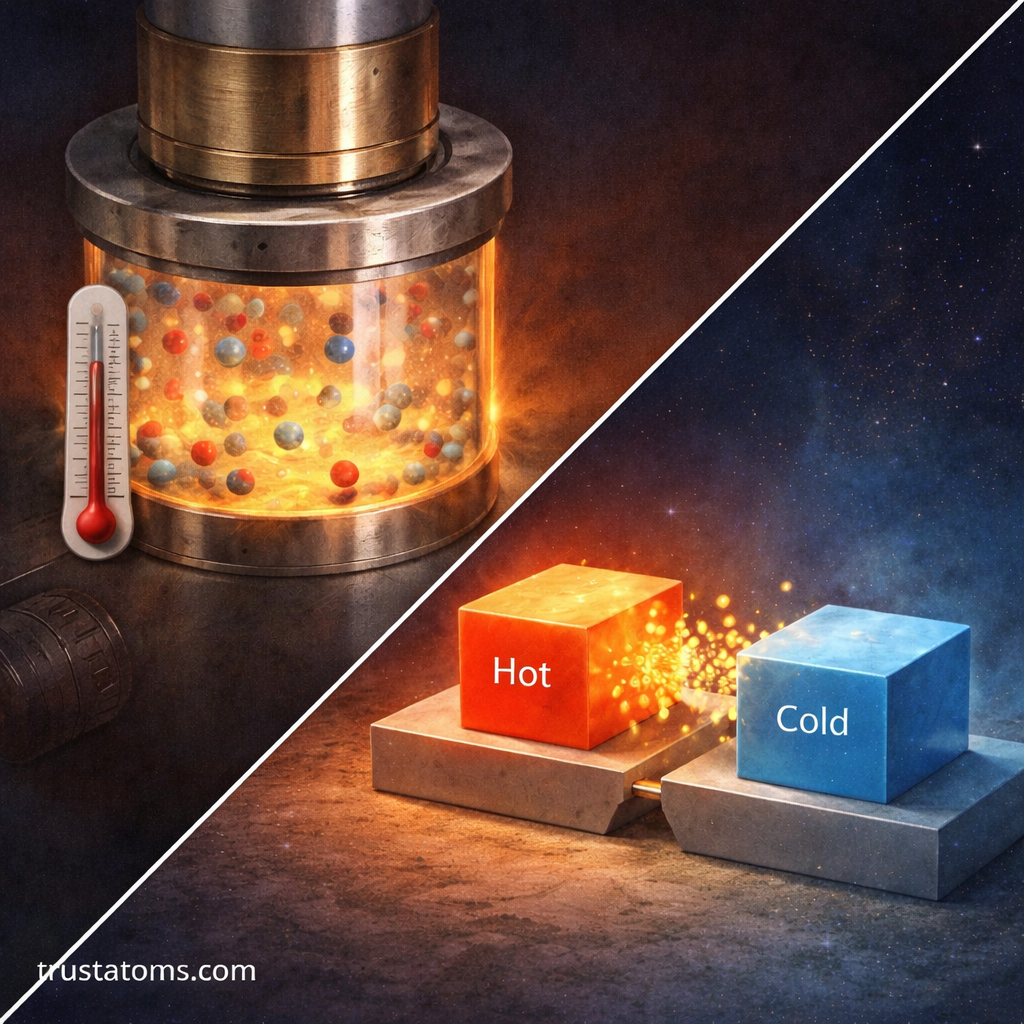
Thermal equilibrium corresponds to equal probability distributions of energy.
First Law
Energy conservation still applies at the microscopic level — it is simply distributed across many particles.
Second Law
Entropy increases because systems move toward more probable macrostates.
Third Law
As temperature approaches absolute zero, the number of accessible microstates decreases.
The macroscopic laws arise naturally from probability theory.
Ensembles in Statistical Thermodynamics
Physicists use idealized collections of systems called ensembles to simplify analysis.
Microcanonical Ensemble
- Fixed energy
- Fixed volume
- Fixed number of particles
Used for isolated systems.
Canonical Ensemble
- Fixed temperature
- System can exchange energy with surroundings
Common in laboratory situations.
Grand Canonical Ensemble
- Fixed temperature
- Can exchange both energy and particles
Used in advanced thermodynamics and quantum systems.
Each ensemble corresponds to different physical constraints.
Why Large Numbers Matter
Statistical thermodynamics works because of enormous particle counts.
In systems with ~10²³ particles:
- Fluctuations are tiny relative to averages
- Equilibrium is extremely stable
- Predictions are highly accurate
If systems were small (like only a few particles), thermodynamics would appear less predictable.
This is why nanoscale systems require special treatment.
Real-World Applications
The statistical foundation of thermodynamics explains:
- Heat engines and power plants
- Refrigerators and air conditioning
- Chemical reaction rates
- Phase transitions (melting, boiling)
- Semiconductor physics
- Blackbody radiation
It also underpins modern physics fields such as:
- Quantum mechanics
- Cosmology
- Condensed matter physics
The Arrow of Time
One of the most profound consequences of statistical thermodynamics is the arrow of time.
Microscopic laws of motion are time-reversible.
Yet macroscopic processes are not.
Why?
Because:
- Low-entropy states are rare
- High-entropy states are overwhelmingly probable
Time appears to move forward because systems move from less probable to more probable states.
Common Misconceptions
- Entropy does not mean “disorder” in a vague sense — it measures multiplicity of microstates.
- Thermodynamics is not separate from mechanics — it emerges from it.
- Random motion does not imply randomness in outcomes — probability produces predictable averages.
- Temperature is not about one particle — it’s about collective behavior.
Understanding these clarifies many conceptual confusions.
Final Thoughts
The statistical foundations of thermodynamics reveal something remarkable:
The familiar laws governing heat and energy are not fundamental rules imposed from above — they are natural consequences of probability applied to enormous numbers of particles.
By connecting microscopic motion to macroscopic order, statistical thermodynamics provides one of the deepest unifications in physics.
It shows that certainty at large scales emerges from randomness at small scales — a powerful idea that shapes modern science.