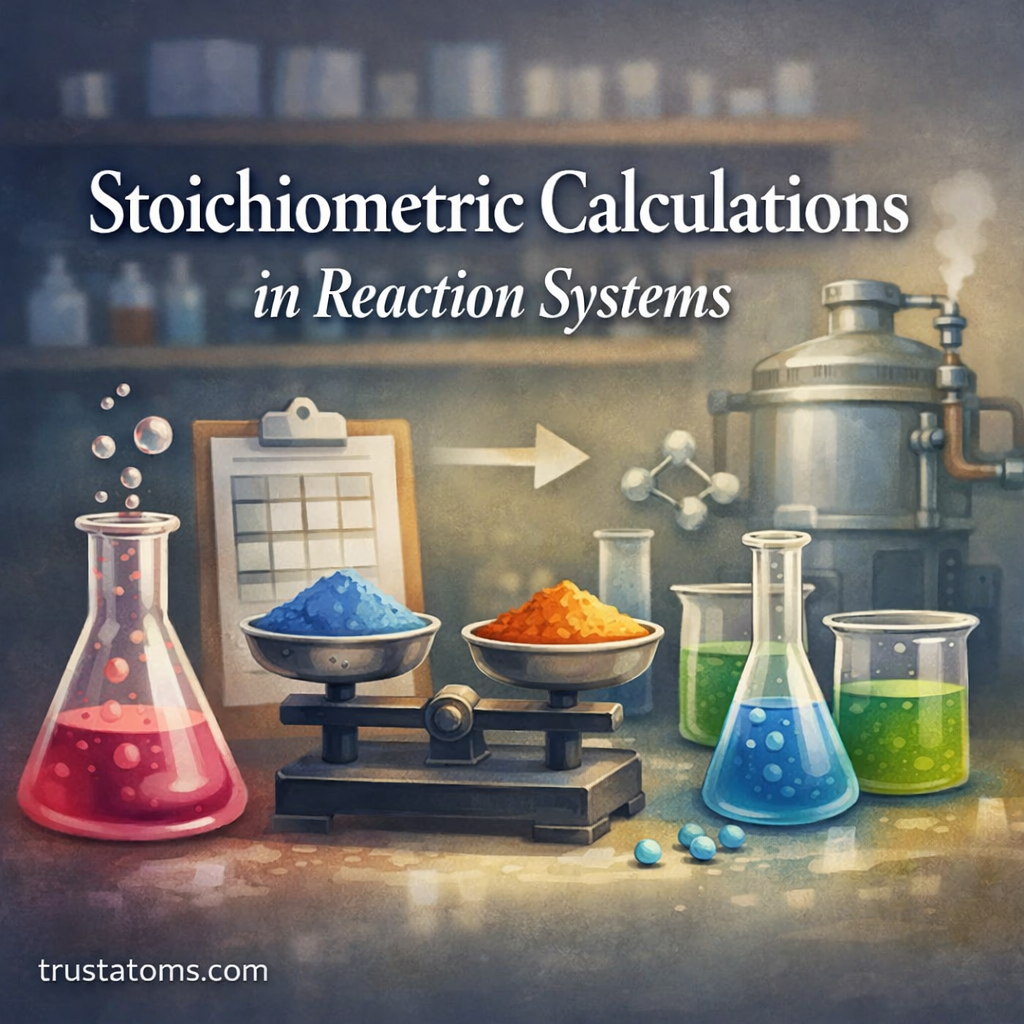
Stoichiometry is one of the foundational tools in chemistry for understanding how substances react and how much product a reaction can produce. In any chemical reaction system—whether it occurs in a laboratory flask, an industrial reactor, or inside living organisms—stoichiometric calculations help chemists determine the exact proportions of reactants and products.
By using balanced chemical equations and simple mathematical relationships, stoichiometry allows scientists and engineers to predict quantities, optimize reactions, reduce waste, and design efficient chemical processes.
What Is Stoichiometry?
Stoichiometry refers to the quantitative relationships between substances in a chemical reaction. These relationships come directly from the balanced chemical equation, which shows how atoms rearrange during a reaction.
For example, consider a simple reaction:
Hydrogen + Oxygen → Water
A balanced equation tells us the precise ratios of reactants and products. These ratios allow chemists to calculate:
- How much reactant is required
- How much product will form
- Which reactant limits the reaction
- How efficient the reaction is
Stoichiometry essentially connects chemical formulas to measurable quantities like grams, moles, and liters.
The Importance of Balanced Chemical Equations
Before any stoichiometric calculation can begin, the chemical equation must be balanced. A balanced equation ensures that the law of conservation of mass is satisfied—meaning the same number of atoms appears on both sides of the equation.
For example:
2H₂ + O₂ → 2H₂O
This equation tells us that:
- 2 molecules (or moles) of hydrogen react
- 1 molecule (or mole) of oxygen reacts
- 2 molecules (or moles) of water are produced
These coefficients create the mole ratios used in stoichiometric calculations.
Understanding Mole Ratios
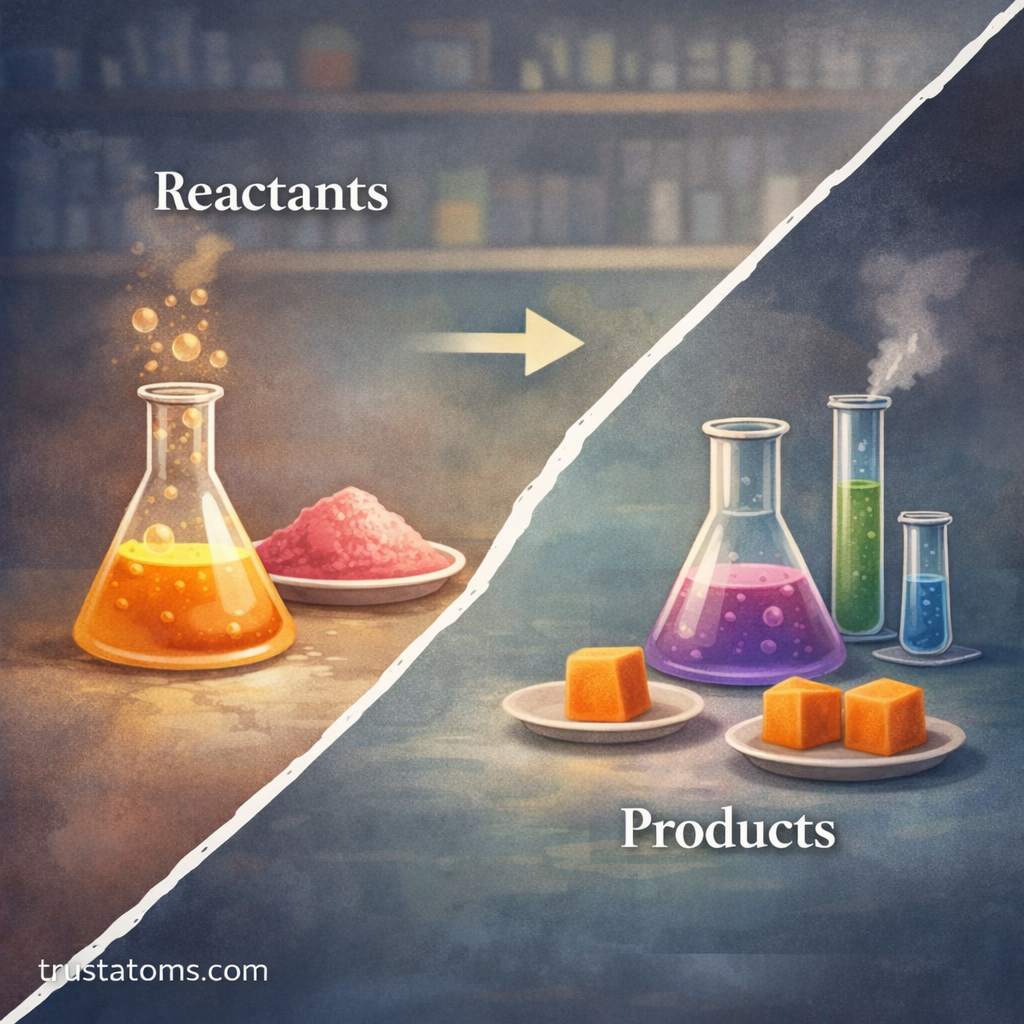
The mole ratio is the key bridge between substances in a reaction.
From the equation:
2H₂ + O₂ → 2H₂O
We can derive the following mole relationships:
- 2 moles H₂ react with 1 mole O₂
- 2 moles H₂ produce 2 moles H₂O
- 1 mole O₂ produces 2 moles H₂O
These ratios allow chemists to convert between different substances in the reaction.
For instance, if you know the amount of hydrogen used, you can determine how much oxygen is required or how much water will form.
The Basic Steps of Stoichiometric Calculations
Stoichiometric problems typically follow a consistent step-by-step process.
Step 1: Write and Balance the Chemical Equation
Always begin by ensuring the equation is balanced.
Example:
N₂ + 3H₂ → 2NH₃
Step 2: Convert Given Quantities to Moles
Because mole ratios come from the balanced equation, calculations must be done in moles.
Common conversions include:
- Grams → moles using molar mass
- Liters of gas → moles using gas laws
- Solution concentration → moles using molarity
Example formula:
moles = mass ÷ molar mass
Step 3: Use the Mole Ratio
Use the coefficients from the balanced equation to convert between substances.
Example ratio from the ammonia reaction:
3 moles H₂ : 2 moles NH₃
Step 4: Convert Moles to the Desired Unit
Finally, convert the resulting moles into the unit requested in the problem, such as:
- grams
- liters
- molecules
- molarity
Limiting Reactants in Reaction Systems
In real chemical systems, reactants are not always present in the exact stoichiometric ratios. The reactant that is used up first is called the limiting reactant.
Once the limiting reactant is consumed, the reaction stops—even if other reactants remain.
Why Limiting Reactants Matter
Identifying the limiting reactant helps determine:
- Maximum product formation
- Remaining excess reactants
- Reaction efficiency
Example Concept
If a reaction requires:
2 moles A + 1 mole B → product
But the system contains:
- 5 moles A
- 1 mole B
Reactant B becomes the limiting reactant, because there is not enough of it to react with all of A.
Theoretical Yield vs. Actual Yield
Stoichiometric calculations can predict the maximum amount of product that can form from given reactants. This value is known as the theoretical yield.
However, real reactions rarely achieve perfect efficiency.
Reasons for Lower Actual Yield
Several factors can reduce the amount of product obtained:
- Side reactions
- Incomplete reactions
- Loss of material during purification
- Measurement errors
Percent Yield Formula
Percent yield compares real experimental results to theoretical predictions.
Percent Yield = (Actual Yield ÷ Theoretical Yield) × 100
A high percent yield indicates a more efficient reaction system.
Stoichiometry in Industrial Chemical Processes
Stoichiometric calculations are essential in large-scale chemical production. Industries rely on these calculations to control reactant ratios and minimize waste.
Examples include:
- Fertilizer manufacturing
- Pharmaceutical synthesis
- Fuel production
- Polymer manufacturing
- Environmental emissions control
Engineers use stoichiometric models to determine:
- Raw material requirements
- Reactor efficiency
- Waste byproducts
- Energy consumption
Precise stoichiometric control can significantly reduce production costs and environmental impact.
Stoichiometry in Environmental Chemistry
Stoichiometric principles also help scientists understand environmental processes such as:
- Combustion emissions
- Atmospheric reactions
- Water treatment chemistry
- Nutrient cycling in ecosystems
For example, calculating the amount of oxygen required for combustion reactions helps predict air pollution levels and design cleaner energy systems.
Similarly, stoichiometric analysis helps wastewater treatment plants determine how much chemical treatment is needed to remove contaminants.
Common Mistakes in Stoichiometric Calculations
Students and practitioners sometimes encounter errors when performing stoichiometric calculations. Recognizing these mistakes can improve accuracy.
Frequent Errors
- Using an unbalanced equation
- Skipping the mole conversion step
- Confusing mole ratios
- Incorrect unit conversions
- Ignoring the limiting reactant
Careful attention to each step in the calculation process helps prevent these issues.
Why Stoichiometry Is Fundamental to Chemistry
Stoichiometry connects chemical theory with measurable outcomes. By understanding reaction ratios and quantities, chemists can predict results before conducting experiments.
This capability is essential for:
- Designing experiments
- Scaling reactions for industry
- Optimizing chemical efficiency
- Understanding reaction systems
From classroom laboratories to global industrial processes, stoichiometric calculations remain one of the most powerful tools in chemical science.
Final Thoughts
Stoichiometric calculations allow chemists to translate balanced chemical equations into meaningful numerical predictions. By converting between masses, moles, and reaction ratios, scientists can determine how much material is needed and how much product will form.
In reaction systems ranging from small laboratory experiments to massive industrial reactors, stoichiometry ensures reactions proceed efficiently, economically, and safely. Understanding these quantitative relationships is therefore essential for anyone studying or working with chemical reactions.