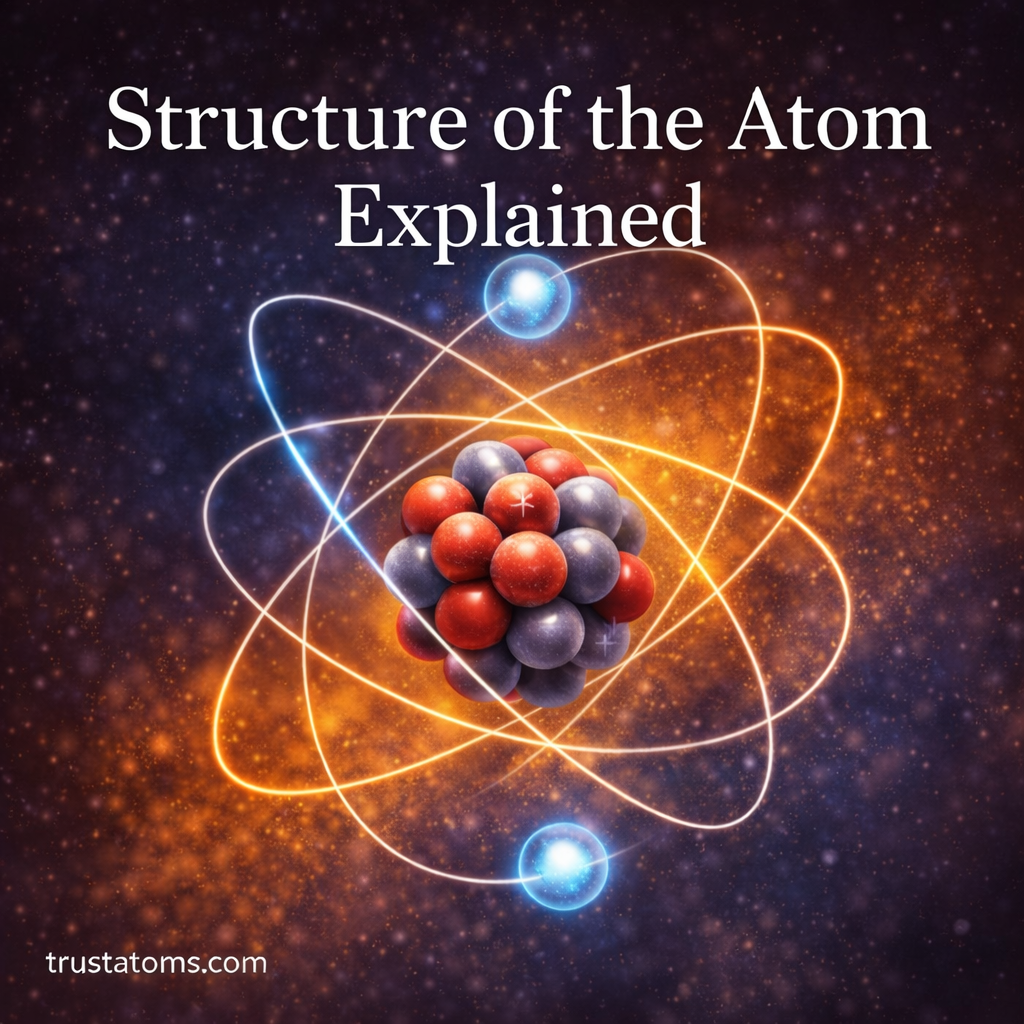
Understanding the structure of the atom is one of the most important foundations in chemistry. Every substance — from water and air to metals and living cells — is made of atoms. But atoms aren’t solid, indivisible particles. They have internal structure.
In this guide, we’ll break down the structure of the atom in simple terms, explain how its parts work together, and show why atomic structure matters in chemistry.
The Basic Parts of an Atom
Atoms are made of three primary subatomic particles:
- Protons
- Neutrons
- Electrons
Each plays a specific role in determining the atom’s identity, mass, and chemical behavior.
The Nucleus: The Atom’s Dense Core
At the center of every atom is the nucleus.
The nucleus contains:
- Protons (positively charged)
- Neutrons (neutral charge)
Although the nucleus is extremely small compared to the entire atom, it holds nearly all of the atom’s mass.
Protons
Protons are positively charged particles located in the nucleus.
Key facts about protons:
- The number of protons determines the element.
- This number is called the atomic number.
- Changing the number of protons changes the element entirely.
For example:
- Hydrogen has 1 proton.
- Carbon has 6 protons.
- Oxygen has 8 protons.
Neutrons
Neutrons are neutral particles found in the nucleus alongside protons.
They:
- Add mass to the atom
- Help stabilize the nucleus
- Do not affect the atom’s charge
Atoms of the same element can have different numbers of neutrons. These variations are called isotopes.
Electrons: The Outer Region
Electrons are negatively charged particles that exist outside the nucleus.
They:
- Move in regions called energy levels or electron shells
- Are much smaller and lighter than protons and neutrons
- Determine how atoms bond with one another
Electrons don’t orbit the nucleus like planets around the sun in fixed circular paths. Instead, they exist in probability regions known as orbitals, described by quantum mechanics.
Energy Levels and Electron Shells
Electrons are arranged in energy levels around the nucleus.
These levels:
- Represent different amounts of energy
- Can only hold a certain number of electrons
- Influence how atoms interact chemically
The outermost energy level is called the valence shell. The electrons in this shell are known as valence electrons.
Valence electrons are especially important because:
- They participate in chemical bonding
- They determine how reactive an element is
- They explain patterns in the periodic table
Atomic Number and Mass Number
Two important numbers describe atomic structure:
Atomic Number
- Equals the number of protons
- Identifies the element
- Determines position on the periodic table
Mass Number
- Equals protons + neutrons
- Represents the total mass of the nucleus
For example, if an atom has:
- 6 protons
- 6 neutrons
Its mass number is 12.
How Atomic Structure Affects Chemical Behavior
The structure of the atom explains why elements behave differently.
Here’s how:
- The number of protons determines the element.
- The arrangement of electrons determines reactivity.
- The number of valence electrons determines bonding patterns.
For example:
- Noble gases have full outer shells, making them stable and unreactive.
- Alkali metals have one valence electron, making them highly reactive.
- Oxygen has six valence electrons and tends to form two bonds.
These predictable patterns come directly from atomic structure.
The Modern Atomic Model
Over time, scientists developed increasingly accurate models of atomic structure.
Early Models
Early scientists believed atoms were solid spheres.
Later discoveries revealed:
- The existence of electrons
- A dense central nucleus
- Mostly empty space inside the atom
Quantum Mechanical Model
Today’s model describes electrons as probability clouds rather than fixed orbits.
Key ideas include:
- Electrons behave as both particles and waves.
- Their exact position cannot be known with certainty.
- Energy levels are quantized (they exist in specific amounts).
This modern model provides the most accurate explanation of atomic structure.
How Small Is the Atom’s Structure?
Atoms are incredibly small:
- The nucleus is about 100,000 times smaller than the entire atom.
- Most of the atom is empty space.
- If the nucleus were the size of a marble, the atom would be the size of a stadium.
This surprising structure explains many physical and chemical properties of matter.
Why Understanding Atomic Structure Matters
Atomic structure explains:
- Why elements combine in specific ratios
- Why chemical reactions release or absorb energy
- Why metals conduct electricity
- Why some substances are gases while others are solids
Without understanding atomic structure, chemistry would simply be memorization. With it, patterns become logical and predictable.
Key Takeaways
- The atom consists of a nucleus and surrounding electrons.
- The nucleus contains protons and neutrons.
- Protons determine the element.
- Electrons determine chemical behavior.
- The modern atomic model is based on quantum mechanics.
- Most of the atom is empty space.
Understanding the structure of the atom provides the foundation for all of chemistry — from simple reactions to advanced materials science.