Superconductivity is one of the most fascinating phenomena in condensed matter physics. It describes a state in which certain materials conduct electricity with zero electrical resistance and expel magnetic fields when cooled below a critical temperature.
Discovered over a century ago, superconductivity continues to reshape our understanding of matter and promises transformative applications in energy, medicine, and transportation.
In this article, we’ll explore what superconductivity is, how it works at the atomic level, why it only occurs under special conditions, and where it’s already changing the world.
What Is Superconductivity?
Superconductivity is a quantum mechanical phenomenon that occurs in certain materials when they are cooled below a specific temperature known as the critical temperature (Tc).
When a material becomes superconducting:
- Electrical resistance drops to exactly zero.
- Electric current can flow indefinitely without energy loss.
- Magnetic fields are expelled from the interior of the material.
This behavior is fundamentally different from normal electrical conduction in metals.
Electrical Resistance in Normal Conductors
To understand superconductivity, it helps to review how ordinary conductors work.
In metals:
- Electrons move through a lattice of positively charged ions.
- As electrons move, they collide with vibrating atoms.
- These collisions create resistance.
- Energy is lost as heat.
This is why:
- Power lines lose energy over long distances.
- Electronics heat up during operation.
- Batteries drain over time.
Superconductors eliminate this resistance entirely — but only under specific conditions.
The Meissner Effect: Magnetic Field Expulsion
One of the defining properties of superconductivity is the Meissner effect.
When a material enters the superconducting state:
- It expels magnetic fields from its interior.
- Magnetic field lines bend around the material.
- The material becomes perfectly diamagnetic.
This effect leads to magnetic levitation (maglev), where a magnet can float above a superconducting surface.
The Meissner effect proves that superconductivity is not just perfect conductivity — it’s a distinct quantum state of matter.
How Superconductivity Works: Cooper Pairs
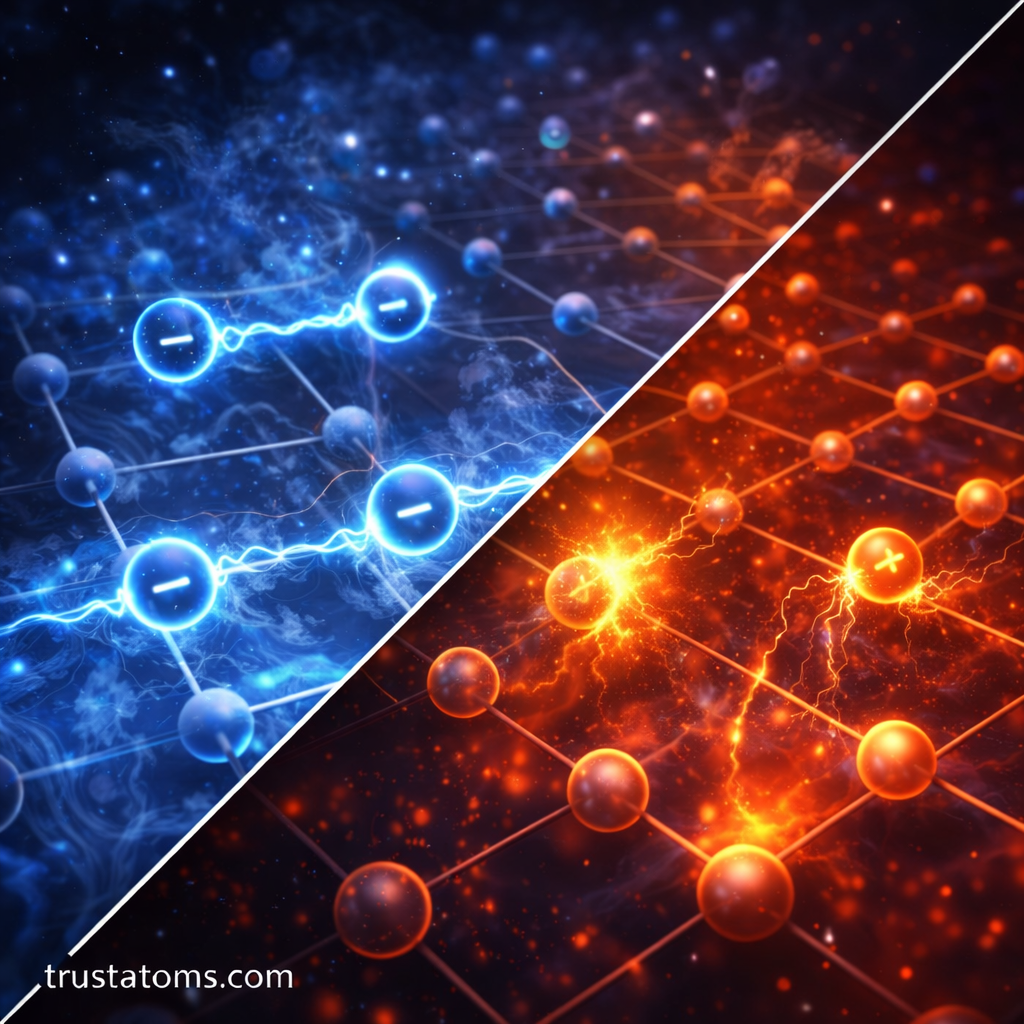
The microscopic explanation of superconductivity was developed in 1957 through the BCS theory (named after Bardeen, Cooper, and Schrieffer).
Here’s the core idea:
- At very low temperatures, atomic vibrations decrease.
- Electrons begin to interact through lattice distortions.
- Electrons form bound pairs called Cooper pairs.
- These pairs move through the lattice without scattering.
Because Cooper pairs behave collectively as a quantum state:
- They do not lose energy through collisions.
- They move in a synchronized, wave-like manner.
- Resistance disappears.
This collective quantum behavior is what makes superconductivity possible.
Types of Superconductors
Superconductors are generally divided into two main categories.
Type I Superconductors
- Usually pure metals (like mercury or lead).
- Exhibit complete magnetic field expulsion.
- Lose superconductivity at relatively low magnetic fields.
- Typically have very low critical temperatures.
Type II Superconductors
- Often alloys or ceramic compounds.
- Allow partial magnetic field penetration.
- Remain superconducting under higher magnetic fields.
- Used in practical applications like MRI machines.
Most modern technological superconductors are Type II.
Critical Conditions for Superconductivity
Superconductivity only occurs under specific conditions.
Three key thresholds define the superconducting state:
- Critical temperature (Tc) — Below this temperature, superconductivity begins.
- Critical magnetic field — Above this strength, superconductivity is destroyed.
- Critical current — Excess current can break Cooper pairs.
If any of these limits are exceeded, the material returns to its normal resistive state.
High-Temperature Superconductors
For decades, superconductivity required extremely low temperatures — often close to absolute zero.
In 1986, scientists discovered high-temperature superconductors made of copper-oxide ceramics (cuprates).
These materials:
- Superconduct at higher temperatures than traditional metals.
- Still require cooling, but often with liquid nitrogen instead of liquid helium.
- Have complex and not fully understood mechanisms.
High-temperature superconductivity remains an active area of research in condensed matter physics.
Applications of Superconductivity
Although cooling costs remain a limitation, superconductivity already plays a vital role in several technologies.
1. Medical Imaging
MRI machines use powerful superconducting magnets to produce detailed internal body images.
Without superconductors, such strong magnetic fields would require enormous energy.
2. Particle Accelerators
Superconducting magnets guide high-energy particles in accelerators like those used in fundamental physics research.
3. Maglev Trains
Magnetic levitation systems use superconductors to reduce friction and enable high-speed transportation.
4. Power Transmission
Superconducting cables could:
- Reduce energy loss in transmission lines.
- Improve grid efficiency.
- Enable compact urban infrastructure.
While still limited in scale, pilot projects are underway.
Why Superconductivity Matters
Superconductivity challenges classical physics and demonstrates the importance of quantum mechanics in condensed matter systems.
It also has profound implications for:
- Clean energy distribution
- Quantum computing
- Advanced electronics
- Magnetic storage systems
If room-temperature superconductors are ever discovered, they could revolutionize global energy infrastructure and transportation systems.
The Search for Room-Temperature Superconductors
One of the biggest goals in physics today is achieving superconductivity at room temperature and normal atmospheric pressure.
A practical room-temperature superconductor would:
- Eliminate transmission losses in power grids.
- Enable ultra-efficient electric motors.
- Transform computing systems.
- Reduce global energy waste.
While some experimental materials show promising behavior under extreme pressures, stable room-temperature superconductivity remains an open challenge.
Superconductivity as a Quantum State of Matter
Superconductivity is not simply an electrical improvement — it is a new state of matter governed by quantum mechanics.
In this state:
- Particles act collectively.
- Macroscopic quantum effects become visible.
- Classical resistance disappears.
It reveals how matter behaves when thermal motion is minimized and quantum coherence dominates.
Final Thoughts
Superconductivity in condensed matter is one of the most remarkable discoveries in modern physics.
By eliminating electrical resistance and expelling magnetic fields, superconductors offer a glimpse into a future of highly efficient energy systems and advanced technology.
Although challenges remain — particularly in achieving higher operating temperatures — superconductivity continues to push the boundaries of science and engineering.
It stands as a powerful reminder that even familiar materials can reveal extraordinary properties under the right conditions.