Surface chemistry plays a central role in catalytic reactions. Catalysts accelerate chemical reactions without being consumed, and most catalytic processes occur at the surface of a solid material. Understanding how molecules interact with these surfaces is essential in fields ranging from industrial manufacturing to environmental technology and energy production.
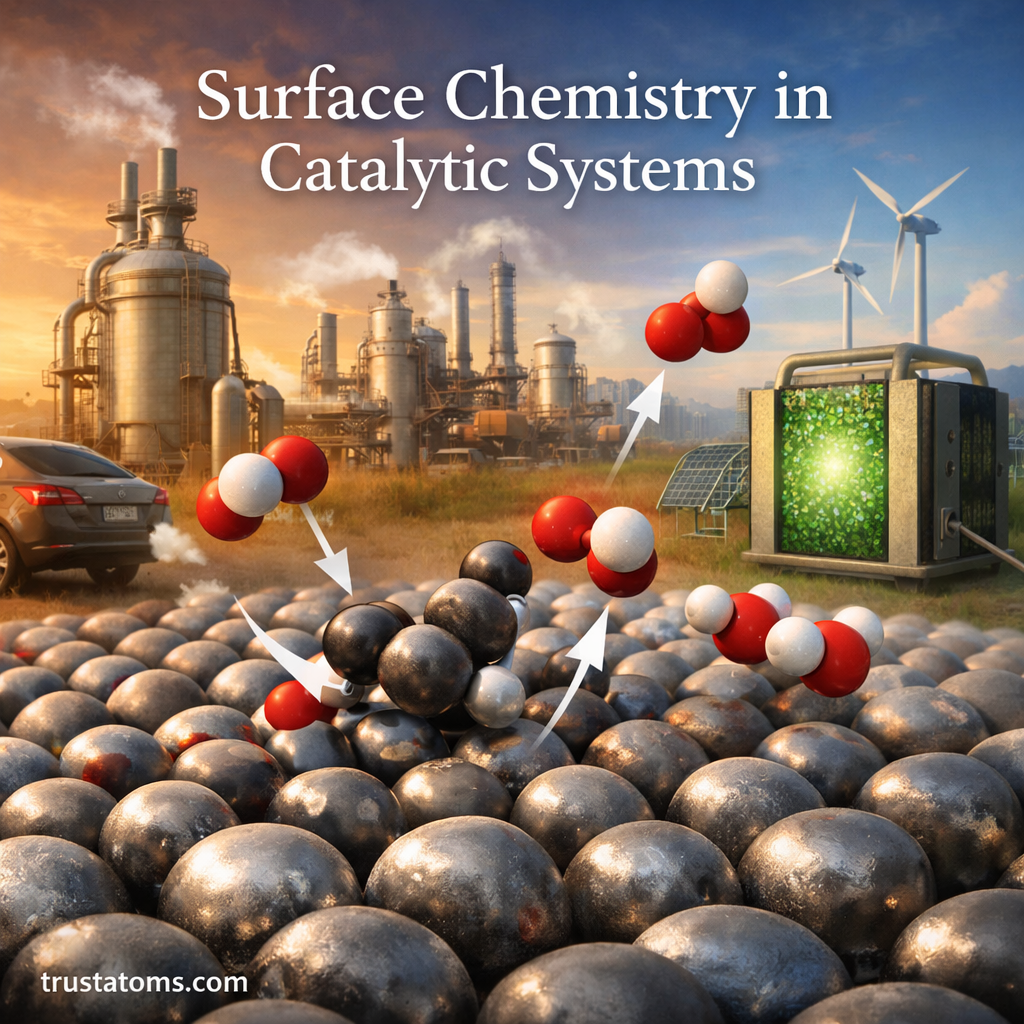
In catalytic systems, the surface of a material provides the active sites where reactant molecules attach, react, and form products. Because reactions occur at the interface between phases—typically solid catalysts and gaseous or liquid reactants—surface chemistry determines how efficient a catalyst can be.
What Is Surface Chemistry?
Surface chemistry studies the chemical and physical processes that occur at the boundary between two phases, such as solid–gas, solid–liquid, or liquid–gas interfaces.
In catalysis, the most common scenario involves:
- A solid catalyst surface
- Reactant molecules in gas or liquid form
- A reaction that takes place at the surface interface
Unlike reactions in bulk solutions, catalytic reactions depend heavily on the properties of the catalyst’s surface, including its structure, composition, and available active sites.
Key surface-related properties include:
- Surface area
- Surface energy
- Surface defects
- Adsorption capacity
- Surface atomic arrangement
These factors control how easily molecules attach to the surface and how effectively reactions proceed.
Why Surface Chemistry Matters in Catalysis
Catalysts work because their surfaces provide sites where reactants can interact more easily than they would in the bulk phase.
Several advantages occur at catalytic surfaces:
- Reactant molecules are brought close together
- Chemical bonds are weakened or activated
- Reaction pathways require less energy
This leads to a lower activation energy, allowing reactions to occur faster and at lower temperatures.
Surface chemistry also determines:
- Reaction selectivity
- Catalyst lifespan
- Reaction efficiency
- Product distribution
For many industrial processes, optimizing surface properties can significantly improve production efficiency and reduce energy consumption.
Adsorption: The First Step in Catalysis
The catalytic process typically begins with adsorption, where reactant molecules attach to the catalyst surface.
Two main types of adsorption occur in catalytic systems.
Physisorption
Physisorption involves weak interactions between molecules and the catalyst surface.
Characteristics include:
- Weak van der Waals forces
- Reversible interactions
- Low heat of adsorption
- Minimal change in molecular structure
Physisorption usually occurs at lower temperatures and can serve as a preliminary step before stronger interactions develop.
Chemisorption
Chemisorption involves the formation of chemical bonds between the molecule and the surface.
Important features include:
- Strong bonding interactions
- Specific surface sites
- Activation of reactant molecules
- Often irreversible under reaction conditions
Chemisorption is critical for catalytic reactions because it can weaken bonds within reactant molecules, making them more reactive.
Active Sites on Catalyst Surfaces
Not every part of a catalyst surface participates equally in chemical reactions. Catalysis occurs primarily at active sites.
Active sites are specific surface locations where reactions are most likely to occur. These may include:
- Surface defects
- Edges and corners of crystals
- Atomic vacancies
- Metal clusters
- Step sites on crystal surfaces
These locations often have higher chemical reactivity because atoms at these positions have unsatisfied bonds or unusual electronic environments.
The density and distribution of active sites directly affect catalyst performance.
Reaction Steps on Catalyst Surfaces
Surface catalytic reactions typically follow a sequence of steps.
1. Diffusion of Reactants
Reactant molecules move from the bulk phase toward the catalyst surface.
This can occur through:
- Gas diffusion
- Liquid diffusion
- Transport through pores in porous catalysts
2. Adsorption
Reactant molecules attach to the catalyst surface through physisorption or chemisorption.
This step positions molecules close to each other and often activates them chemically.
3. Surface Reaction
Once adsorbed, molecules react with each other on the catalyst surface. Chemical bonds may break and new bonds form.
This stage represents the core transformation step in catalytic systems.
4. Desorption
Reaction products detach from the surface and move back into the surrounding phase.
Efficient catalysts allow products to desorb quickly so that active sites become available for new reactions.
5. Surface Regeneration
The catalyst surface returns to its original state, allowing the cycle to repeat many times.
Surface Area and Catalyst Efficiency
Catalytic reactions depend heavily on the available surface area.
Because reactions occur at surfaces rather than within the bulk material, catalysts are often designed with extremely large surface areas.
Common strategies include:
- Using nanoparticles
- Creating porous materials
- Supporting catalysts on high-surface-area substrates
- Engineering microporous and mesoporous structures
Examples of high-surface-area materials used in catalysis include:
- Activated carbon
- Zeolites
- Alumina
- Silica
- Metal nanoparticles
Greater surface area increases the number of available active sites and enhances catalytic efficiency.
Surface Structure and Catalytic Selectivity
Surface chemistry does not only influence reaction speed—it also determines which products form.
Catalysts can guide reactions toward specific products by controlling how molecules bind and orient on the surface.
Factors affecting selectivity include:
- Surface crystal structure
- Atomic arrangement
- Electronic properties
- Surface functional groups
For example, small changes in surface structure can alter how molecules adsorb, which may favor one reaction pathway over another.
This is especially important in industries where producing the correct product is crucial.
Catalyst Deactivation and Surface Poisoning
Over time, catalysts may lose effectiveness due to changes occurring at their surfaces.
Common causes of catalyst deactivation include:
Surface Poisoning
Certain molecules bind strongly to active sites and block them from participating in reactions.
Examples include:
- Sulfur compounds
- Carbon monoxide
- Heavy metals
These substances reduce the number of available active sites.
Surface Fouling
Accumulation of reaction byproducts can form deposits on the surface, reducing accessibility.
Structural Changes
High temperatures or harsh reaction conditions can alter the catalyst’s surface structure, reducing activity.
Preventing or reversing these processes is an important aspect of catalyst design and maintenance.
Applications of Surface Chemistry in Catalytic Systems
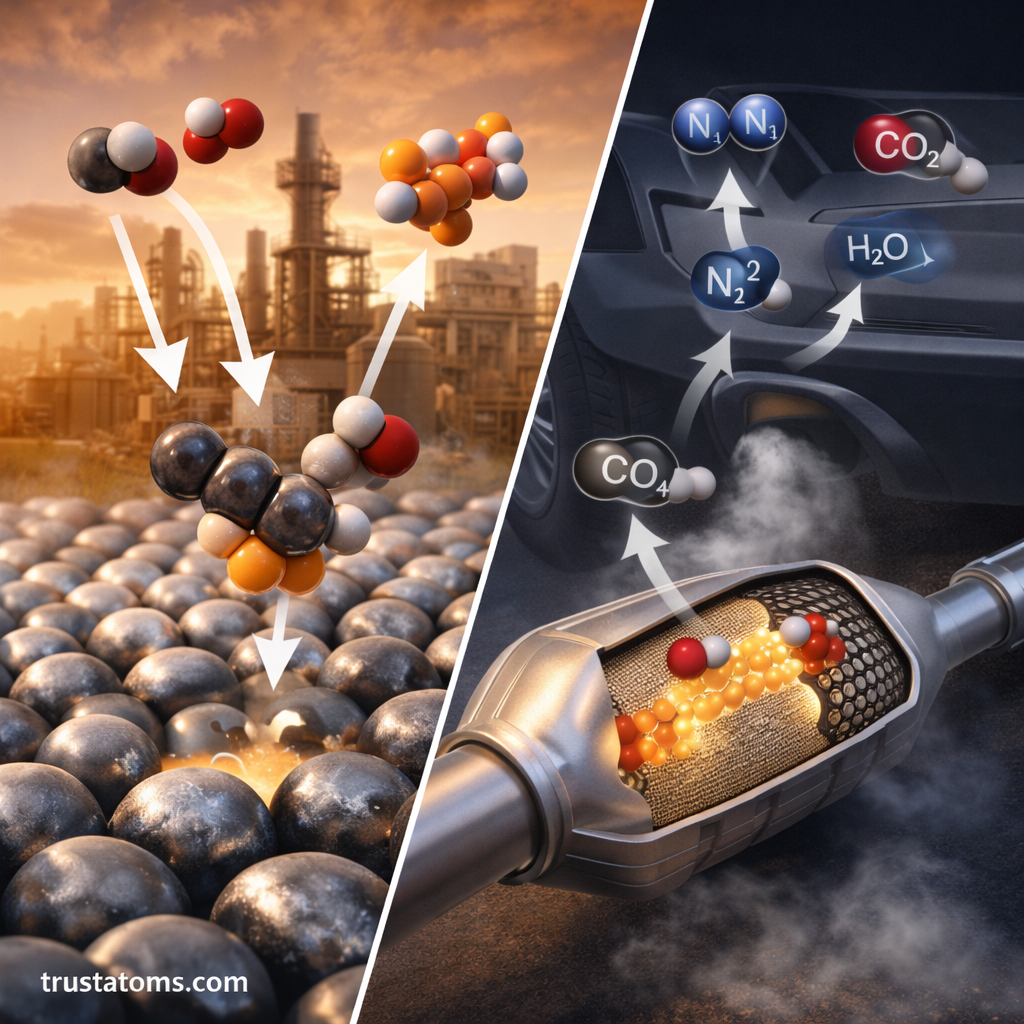
Surface chemistry plays a crucial role in many technologies used in modern society.
Industrial Chemical Production
Many large-scale industrial reactions rely on surface catalysts, including:
- Ammonia production
- Petroleum refining
- Polymer manufacturing
- Hydrogen production
Environmental Catalysis
Catalysts help reduce harmful emissions and pollutants.
Examples include:
- Automotive catalytic converters
- Air purification systems
- Water treatment catalysts
Energy Technologies
Surface catalytic systems are essential in energy-related processes such as:
- Fuel cells
- Hydrogen generation
- Renewable fuel production
- Carbon dioxide conversion
Understanding surface chemistry helps scientists design catalysts that are more efficient, selective, and durable.
Final Thoughts
Surface chemistry is the foundation of catalytic systems. Because most catalytic reactions occur at surfaces, the structure and properties of these interfaces determine how effectively reactions proceed.
Processes such as adsorption, surface reactions, and desorption all depend on the arrangement of atoms and molecules at the catalyst interface. By carefully designing catalyst surfaces—controlling active sites, surface area, and chemical composition—scientists can significantly improve catalytic performance.
Advances in surface chemistry continue to drive innovation in industrial chemistry, environmental protection, and energy technologies, making catalytic systems one of the most important applications of modern chemical science.