Surface energy plays a critical role in catalytic processes. In many chemical reactions, especially those occurring in heterogeneous catalysis, reactions take place at the interface between a catalyst surface and reacting molecules. The energy associated with these surfaces strongly influences how molecules adsorb, react, and detach.
Understanding surface energy helps chemists design catalysts that are more efficient, selective, and stable. From industrial chemical production to environmental applications and energy technologies, surface energy is a key factor in catalytic performance.
What Is Surface Energy?
Surface energy refers to the excess energy present at the surface of a material compared to its interior.
Atoms within the bulk of a solid are surrounded by neighboring atoms in all directions, creating a stable energy state. However, atoms at the surface lack neighboring atoms on one side, which results in unsatisfied bonding forces and higher energy.
Because of this imbalance:
- Surface atoms are more reactive
- Molecules can easily interact with the surface
- Chemical reactions often occur at these sites
Surface energy therefore plays an important role in catalysis, adsorption, and material behavior.
Catalytic Interfaces Explained
A catalytic interface is the boundary where reactant molecules interact with a catalyst surface. This interface determines how effectively molecules bind, react, and release products.
Catalytic interfaces typically involve interactions between:
- Solid catalyst surfaces
- Gas or liquid reactants
- Reaction intermediates
At these interfaces, surface energy influences:
- Adsorption strength
- Reaction pathways
- Product formation
- Catalyst stability
Understanding these interactions helps scientists optimize catalytic systems for industrial and environmental applications.
Adsorption and Surface Energy
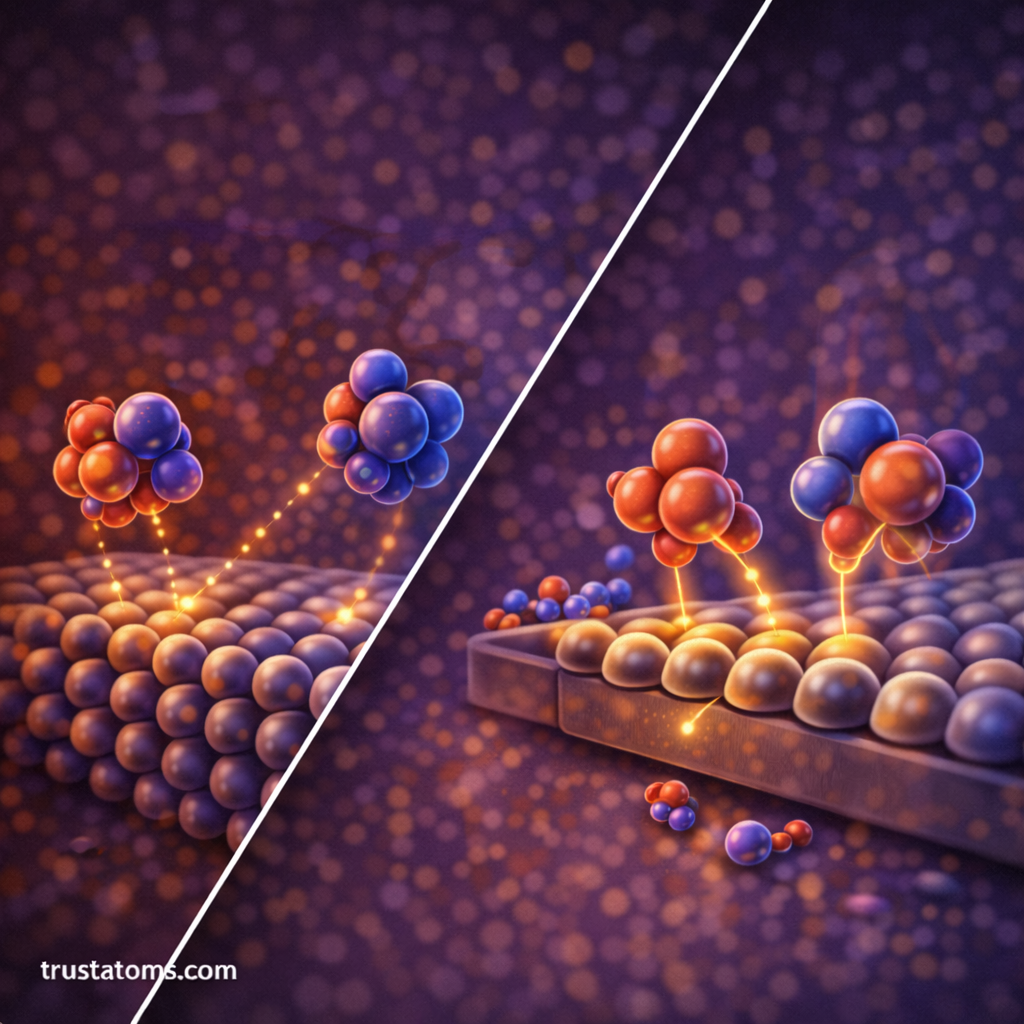
Adsorption is the process by which molecules attach to a surface. This is often the first step in catalytic reactions.
Two main types of adsorption occur on catalytic surfaces:
Physisorption
Physisorption involves weak intermolecular forces such as van der Waals interactions.
Characteristics include:
- Weak attraction between molecules and surfaces
- Reversible binding
- Minimal change to molecular structure
Chemisorption
Chemisorption involves the formation of stronger chemical bonds between the molecule and the catalyst surface.
Characteristics include:
- Strong surface bonding
- Activation of reactant molecules
- Greater influence on reaction mechanisms
Surface energy determines how strongly molecules adsorb and how easily reactions proceed.
Surface Sites and Catalytic Activity
Not all areas of a catalyst surface are equally reactive. Catalytic activity often occurs at specific surface sites where atoms have unique geometric or electronic environments.
Important types of catalytic sites include:
- Edge sites – atoms located at the edges of crystal structures
- Corner sites – highly reactive atoms with fewer neighboring atoms
- Defect sites – irregularities or vacancies in the surface structure
- Terrace sites – flat areas of a crystal surface
Atoms at edges and defects typically have higher surface energy, making them more reactive.
Surface Energy and Reaction Mechanisms
Surface energy influences how molecules approach and react at catalytic interfaces.
In heterogeneous catalysis, reactions often follow several basic steps:
- Reactant molecules adsorb onto the catalyst surface
- The molecules become activated through surface interactions
- Chemical reactions occur between adsorbed species
- Products detach from the surface
Surface energy affects each of these steps by controlling:
- Adsorption strength
- Molecular orientation
- Reaction energy barriers
- Product desorption
If adsorption is too weak, molecules may not remain on the surface long enough to react. If it is too strong, products may become trapped on the catalyst surface.
Surface Energy in Nanocatalysts
Nanomaterials have extremely high surface-area-to-volume ratios. This means a large fraction of their atoms are located at surfaces rather than within the bulk material.
As a result, nanocatalysts often exhibit:
- Higher surface energy
- Greater catalytic activity
- More reactive surface sites
For example, metal nanoparticles used in catalytic converters or fuel cells can dramatically increase reaction efficiency due to their enhanced surface properties.
Measuring Surface Energy
Scientists use several techniques to measure and analyze surface energy in catalytic systems.
Common methods include:
Contact Angle Measurement
This technique measures how liquids spread across a surface, which reflects surface energy and surface interactions.
Surface Spectroscopy
Spectroscopic methods help analyze chemical bonding and molecular adsorption at surfaces.
Examples include:
- X-ray photoelectron spectroscopy (XPS)
- Infrared spectroscopy (IR)
- Raman spectroscopy
Scanning Probe Microscopy
Microscopy methods such as atomic force microscopy (AFM) and scanning tunneling microscopy (STM) allow scientists to observe surface structure at the atomic scale.
These techniques provide valuable insights into how catalytic surfaces interact with molecules.
Applications of Surface Energy in Catalysis
Surface energy plays a major role in many industrial and environmental processes.
Industrial Chemical Production
Catalysts used in large-scale chemical manufacturing rely on optimized surface energy to increase reaction rates.
Examples include:
- Ammonia production in the Haber process
- Petroleum refining reactions
- Polymer production
Environmental Catalysis
Surface energy influences catalysts used to remove pollutants and reduce harmful emissions.
Examples include:
- Automotive catalytic converters
- Air purification systems
- Water treatment catalysts
Energy Technologies
Catalysts are essential in many renewable energy technologies.
Applications include:
- Hydrogen production
- Fuel cells
- Electrochemical energy storage
Optimizing surface energy helps improve the efficiency of these technologies.
Challenges in Controlling Surface Energy
Although surface energy is crucial for catalytic performance, controlling it precisely can be challenging.
Key difficulties include:
- Surface reconstruction under reaction conditions
- Catalyst deactivation over time
- Changes in surface composition
- Environmental effects such as temperature and pressure
Researchers often modify catalyst surfaces using techniques such as alloying, doping, or nanostructuring to optimize surface energy.
The Future of Catalytic Interface Research
Advances in computational chemistry, nanotechnology, and surface science are helping scientists better understand catalytic interfaces.
Emerging research areas include:
- Atomic-scale catalyst design
- Machine-learning-driven catalyst discovery
- Artificial catalytic systems inspired by enzymes
- Advanced nanostructured catalysts
These developments may lead to more efficient chemical processes and cleaner energy technologies.
Conclusion
Surface energy plays a fundamental role in catalytic interfaces by influencing how molecules interact with catalyst surfaces. From adsorption and reaction mechanisms to catalyst stability and efficiency, surface energy determines how catalytic reactions proceed.
By understanding and controlling surface energy, scientists can design better catalysts for industrial chemistry, environmental protection, and energy technologies. As research continues to advance, the study of catalytic interfaces will remain essential for developing sustainable and efficient chemical processes.