Symmetry is one of the most powerful ideas in physics. It doesn’t just describe beauty or balance — it explains why certain physical quantities never change.
From the conservation of energy to the conservation of momentum, many of the universe’s most important laws exist because nature has built-in symmetries. In this article, we’ll break down what symmetry means in physics, how it leads directly to conservation laws, and why this connection is one of the deepest insights in modern science.
What Is Symmetry in Physics?
In everyday language, symmetry often means visual balance — like a butterfly’s wings.
In physics, symmetry has a more precise meaning:
A system has symmetry if it remains unchanged under a specific transformation.
A transformation could be:
- Moving something in space
- Shifting something in time
- Rotating an object
- Changing perspective
If the underlying physical laws remain the same after that transformation, the system has symmetry.
Simple Example: Rotational Symmetry
Imagine a perfect sphere floating in space.
If you rotate it:
- Its appearance doesn’t change.
- The physical laws governing it don’t change.
That invariance under rotation is called rotational symmetry.
What Is a Conservation Law?
A conservation law states that a specific physical quantity remains constant over time in an isolated system.
Some of the most important conservation laws are:
- Conservation of energy
- Conservation of momentum
- Conservation of angular momentum
- Conservation of electric charge
These laws are not arbitrary. They arise directly from symmetries in nature.
The Deep Connection: Noether’s Theorem
In 1918, mathematician Emmy Noether discovered one of the most profound results in theoretical physics.
Her theorem states:
Every continuous symmetry of a physical system corresponds to a conservation law.
This idea reshaped physics. It revealed that conservation laws are not just observed patterns — they are mathematically required by symmetry.
Let’s explore how this works.
Time Symmetry → Conservation of Energy
If the laws of physics today are the same as they were yesterday — and will be tomorrow — then the universe has time translation symmetry.
In other words:
- Shifting an experiment forward or backward in time does not change the laws.
Because of this symmetry:
- Energy must be conserved.
If energy were not conserved, physics would depend on when something happens — breaking time symmetry.
Space Symmetry → Conservation of Momentum
If the laws of physics are the same everywhere in space, we have spatial translation symmetry.
This means:
- An experiment in New York works the same way as it does on Mars (ignoring local conditions like gravity).
Because of this symmetry:
- Linear momentum is conserved.
If momentum were not conserved, physics would depend on location — which would violate spatial symmetry.
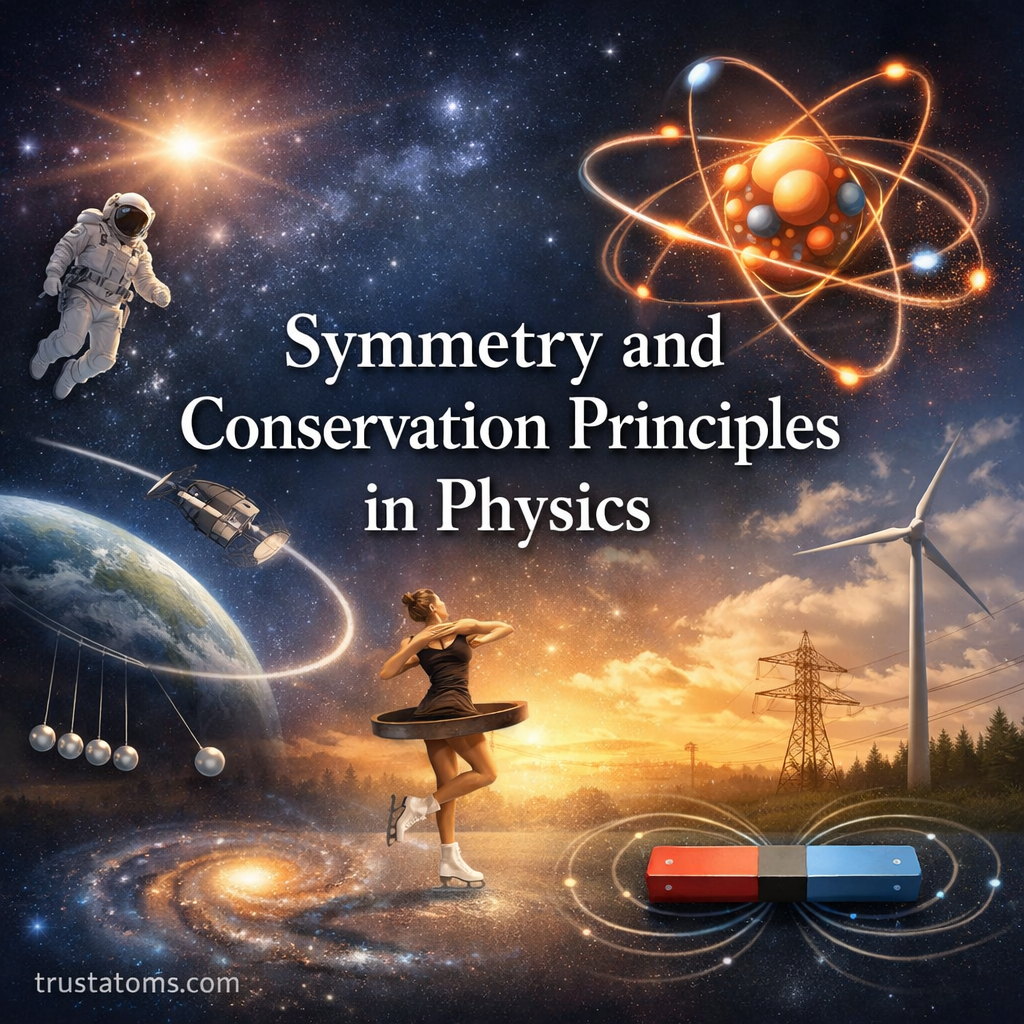
Rotational Symmetry → Conservation of Angular Momentum
If the laws of physics don’t change when you rotate your system, then rotational symmetry exists.
Because of this symmetry:
- Angular momentum is conserved.
This explains why:
- Ice skaters spin faster when pulling in their arms.
- Planets maintain stable orbital motion.
- Spinning objects resist changes to their axis of rotation.
Gauge Symmetry → Conservation of Charge
Gauge symmetry is more abstract but equally important.
In electromagnetism, certain internal mathematical transformations leave the equations unchanged. Because of this symmetry:
- Electric charge is conserved.
This is why charge never mysteriously appears or disappears.
Why Symmetry Matters So Much
Symmetry principles:
- Reduce complexity in physical laws
- Predict conservation laws automatically
- Guide the development of new theories
- Help physicists unify forces
For example:
- Einstein’s theory of relativity relies on symmetry in spacetime.
- The Standard Model of particle physics is built on gauge symmetries.
Without symmetry, modern physics would not exist in its current form.
Discrete vs Continuous Symmetry
Not all symmetries are the same.
Continuous Symmetry
- Can change smoothly and infinitely
- Example: rotating an object by any angle
- Leads to conservation laws (via Noether’s theorem)
Discrete Symmetry
- Only certain specific transformations
- Example: mirror reflection
- Does not directly produce conservation laws in the same way
Both types are important, but continuous symmetry is what directly generates conservation principles.
Symmetry Breaking
Interestingly, not all symmetries are visible.
Sometimes symmetry exists in the laws but not in the outcome.
For example:
- A perfectly upright pencil has rotational symmetry.
- Once it falls, it chooses a direction — breaking symmetry.
This concept, called spontaneous symmetry breaking, plays a central role in:
- Particle physics
- Phase transitions
- Early-universe cosmology
It explains how structured complexity can emerge from symmetric beginnings.
Real-World Examples of Conservation from Symmetry

Here are a few everyday consequences:
- A moving car keeps moving unless acted on (momentum conservation).
- Energy changes form but never disappears.
- Satellites stay in orbit due to angular momentum conservation.
- Electric charge remains constant in chemical reactions.
These aren’t isolated rules — they are reflections of deeper symmetries built into the universe.
Why This Is One of Physics’ Greatest Insights
The connection between symmetry and conservation is powerful because it reveals:
- Conservation laws are not accidents.
- They are mathematically necessary.
- The structure of the universe is deeply ordered.
Instead of asking, “Why is energy conserved?”
We can ask a deeper question:
“Why are the laws of physics the same over time?”
That symmetry answers the original question automatically.
Final Thoughts
Symmetry in physics is far more than aesthetic balance — it is the foundation of conservation laws.
Through Emmy Noether’s insight, we now understand that:
- Time symmetry gives us energy conservation.
- Space symmetry gives us momentum conservation.
- Rotational symmetry gives us angular momentum conservation.
- Gauge symmetry gives us charge conservation.
These principles shape everything from planetary motion to quantum fields.
In many ways, symmetry is the hidden architecture of reality — and conservation laws are its visible fingerprints.