Symmetry breaking is one of the most powerful ideas in modern physics. It explains why perfectly uniform systems suddenly develop structure, why forces in nature appear different at low energies, and why matter behaves differently as temperature changes.
From ice forming out of liquid water to the behavior of fundamental particles in the early universe, symmetry breaking in phase transitions helps us understand how order emerges from uniformity.
In this guide, we’ll explore what symmetry means in physics, how it breaks during phase transitions, and why this concept connects condensed matter physics to cosmology.
What Is Symmetry in Physics?
In physics, symmetry means that a system remains unchanged under certain transformations.
Examples include:
- Rotational symmetry (looks the same after rotation)
- Translational symmetry (looks the same if shifted in space)
- Reflection symmetry (mirror symmetry)
A perfectly round ball has rotational symmetry. A uniform liquid in a container looks the same in every horizontal direction — it has directional symmetry.
Symmetry often implies simplicity and uniformity.
But nature frequently starts symmetrical and ends up asymmetrical.
That’s where symmetry breaking comes in.
What Is a Phase Transition?
A phase transition occurs when a substance changes from one state of matter to another, such as:
- Solid ↔ Liquid
- Liquid ↔ Gas
- Magnetic ↔ Non-magnetic
- Superconducting ↔ Normal conducting
Phase transitions are typically driven by changes in:
- Temperature
- Pressure
- External fields
Some transitions are gradual. Others involve sudden structural changes.
Symmetry breaking usually occurs during certain types of phase transitions.
Spontaneous Symmetry Breaking
Spontaneous symmetry breaking happens when:
- The laws governing a system are symmetric
- The system’s lowest-energy state is not symmetric
In other words, the rules allow symmetry — but the outcome does not preserve it.
The system “chooses” one of many possible asymmetric states.
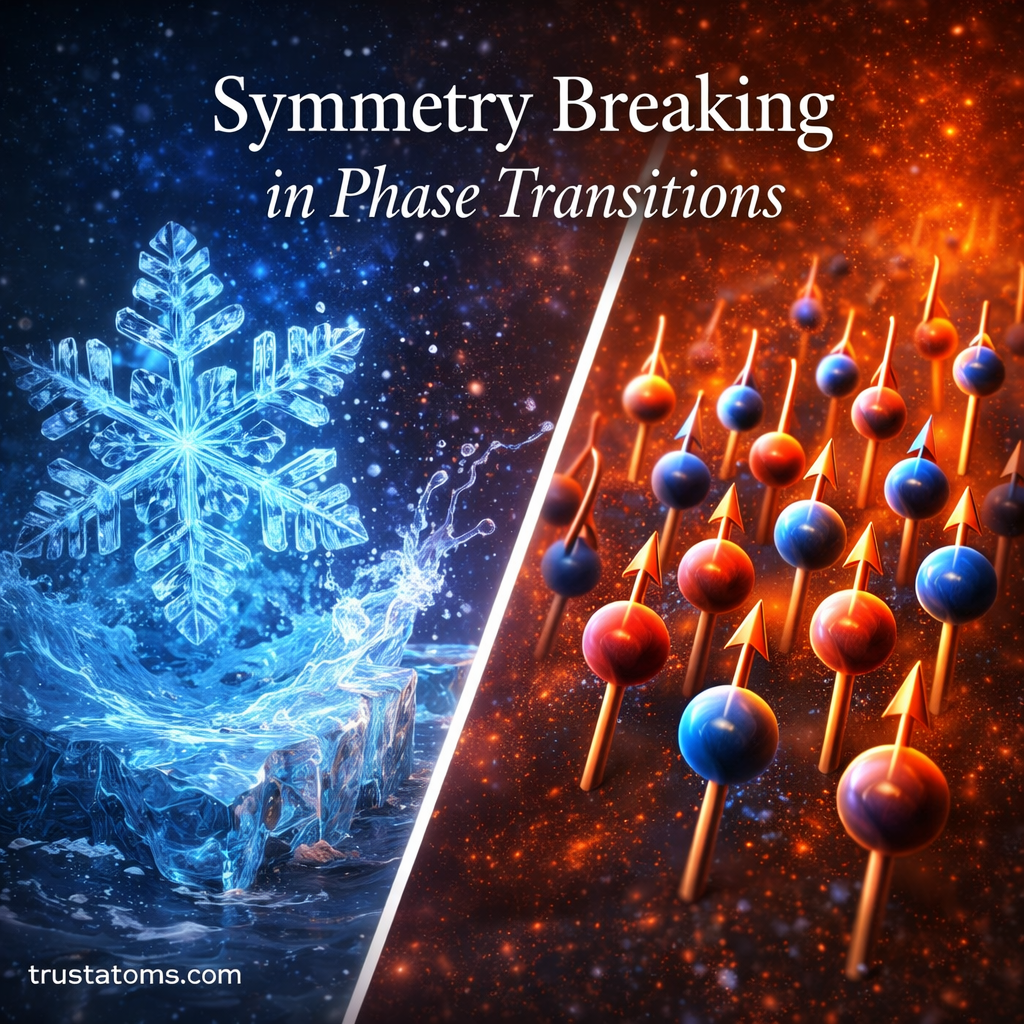
Classic Example: Liquid to Solid
Consider liquid water.
In liquid form:
- Molecules move freely
- The system looks the same in every direction
- It has rotational symmetry
When water freezes into ice:
- Molecules arrange into a crystal lattice
- Specific spatial directions are preferred
- Symmetry is reduced
The liquid phase is highly symmetric.
The solid phase is more ordered but less symmetric.
This reduction in symmetry is symmetry breaking.
Example: Ferromagnetism
A powerful example occurs in magnets.
At high temperature:
- Atomic spins point in random directions
- No overall magnetization
- System has rotational symmetry
Below a critical temperature:
- Spins align in one direction
- A magnet forms
- Rotational symmetry is broken
The laws don’t prefer any specific direction.
But the material “chooses” one direction when cooled.
This is spontaneous symmetry breaking in action.
Order Parameters
To describe symmetry breaking mathematically, physicists use something called an order parameter.
An order parameter:
- Is zero in the symmetric phase
- Becomes non-zero in the broken symmetry phase
Examples:
- Magnetization in a ferromagnet
- Density difference in liquid-gas transition
- Superconducting electron pair density
The order parameter tells us how much symmetry has been broken.
Types of Phase Transitions
Symmetry breaking commonly occurs in second-order (continuous) phase transitions.
These transitions are characterized by:
- No latent heat
- Continuous change in order parameter
- Diverging correlation length
First-order transitions, like melting ice, may involve symmetry change but occur with discontinuities in energy.
Second-order transitions are especially important in theoretical physics.
Symmetry Breaking in Particle Physics
Symmetry breaking isn’t limited to materials.
It also plays a central role in fundamental physics.
In the early universe:
- Forces may have been unified
- Symmetry between forces existed
As the universe cooled:
- Symmetry broke
- Forces separated into distinct interactions
One famous example is the Higgs mechanism.
In this process:
- A symmetric field acquires a non-zero value
- Certain particles gain mass
- The symmetry of the underlying equations remains
This explains why particles have mass while fundamental laws remain symmetric.
Energy Landscapes and Stability

Symmetry breaking can be visualized using an energy landscape.
Imagine:
- A perfectly symmetrical hilltop
- A ball balanced at the peak
The peak is symmetric.
But the ball is unstable.
If it rolls down:
- It chooses one direction
- The symmetry is broken
The valley represents a lower-energy, stable state.
This analogy explains how systems naturally settle into less symmetric configurations.
Why Symmetry Breaking Matters
Symmetry breaking explains:
- The formation of crystals
- The emergence of magnetism
- Superconductivity
- Particle masses
- Structure formation in the universe
It provides a unifying framework across:
- Condensed matter physics
- Quantum field theory
- Cosmology
Few concepts connect as many areas of physics.
Symmetry, Simplicity, and Complexity
Interestingly:
- High symmetry often means simplicity
- Broken symmetry often creates complexity
When symmetry breaks:
- New structures form
- New behaviors emerge
- New physical properties appear
Complexity arises not from more complicated laws, but from the breaking of symmetry in simple systems.
The Big Picture
Symmetry breaking in phase transitions shows how order and structure emerge from uniform conditions.
A symmetric system governed by elegant laws can evolve into an asymmetric state with rich physical properties.
From freezing water to the mass of elementary particles, symmetry breaking shapes the world at every scale.
Understanding symmetry breaking is not just about phase transitions — it is about understanding how the universe organizes itself.
Key Takeaways
- Symmetry means invariance under transformation.
- Phase transitions can reduce symmetry.
- Spontaneous symmetry breaking occurs when the lowest-energy state lacks the symmetry of the laws.
- Order parameters measure the degree of symmetry breaking.
- The concept applies from materials to fundamental physics.
Symmetry may define the laws — but broken symmetry defines the world we observe.