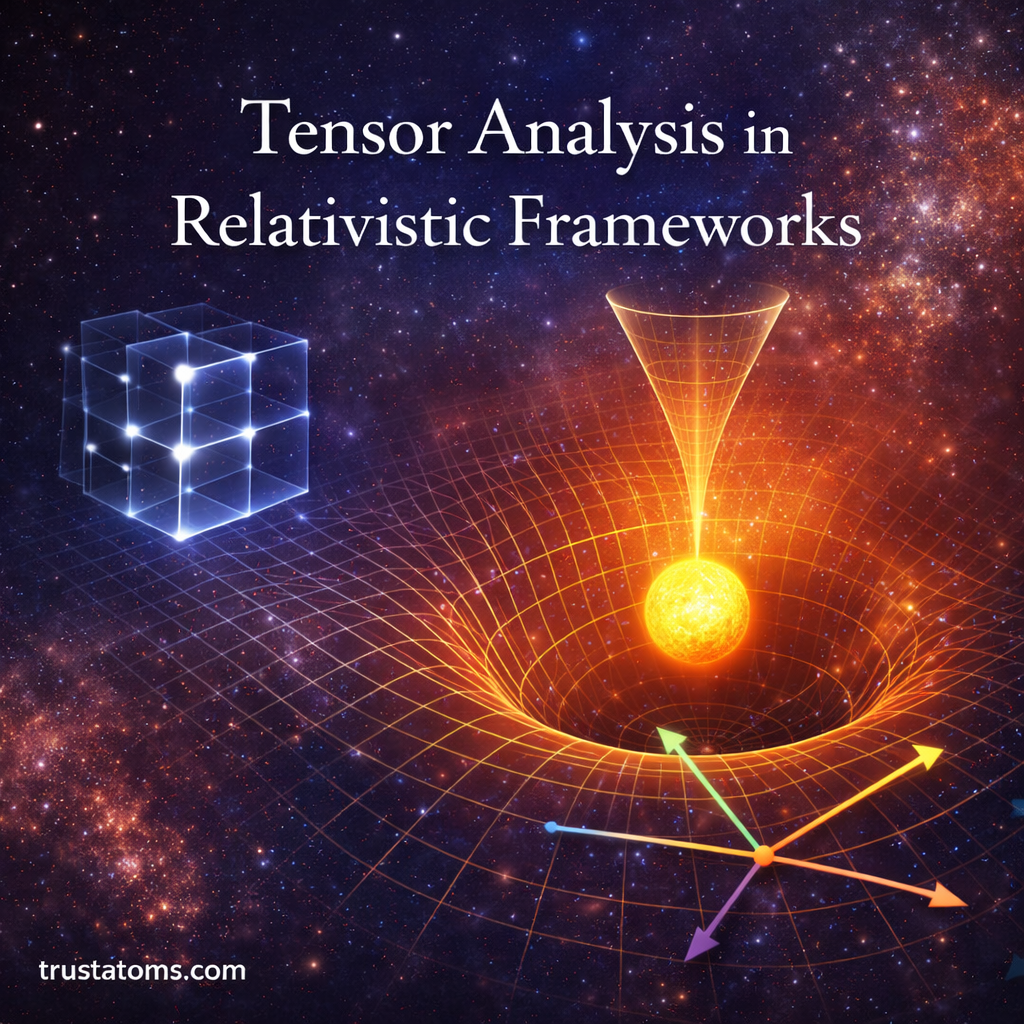
When physics moved from Newton’s absolute space and time to Einstein’s curved spacetime, the mathematics had to evolve too.
Ordinary vectors were no longer enough.
To describe gravity, spacetime curvature, and high-speed motion consistently, physicists use tensor analysis — a mathematical framework that works naturally in relativistic physics.
This article explains what tensors are, why they are essential in relativity, and how tensor analysis forms the backbone of modern gravitational theory.
Why Relativity Requires Tensors
In classical mechanics:
- Space and time are separate.
- Coordinates transform simply.
- Vectors are usually sufficient.
But in relativity:
- Space and time merge into spacetime.
- Observers move relative to each other at high speeds.
- Gravity curves spacetime itself.
Equations must remain valid under any coordinate transformation.
Tensors provide that invariance.
They ensure:
The laws of physics look the same in all coordinate systems.
This principle is central to both special and general relativity.
What Is a Tensor?
A tensor is a mathematical object that:
- Generalizes scalars and vectors
- Has components that transform in a precise way
- Maintains physical meaning under coordinate changes
Think of it as a multi-dimensional array with strict transformation rules.
Examples:
- Scalar → temperature (rank 0 tensor)
- Vector → velocity (rank 1 tensor)
- Matrix-like object → stress or curvature (rank 2 tensor)
The rank of a tensor tells you how many indices it has.
Tensor Transformation: The Key Idea
The defining feature of a tensor is not how it looks — but how it transforms.
When coordinates change:
- Scalars remain unchanged.
- Vectors transform linearly.
- Tensors follow specific transformation laws that preserve physical relationships.
If an object does not transform properly, it is not a tensor.
This transformation rule is what makes tensor equations coordinate-independent.
Special Relativity and the Minkowski Metric
In special relativity, introduced by Albert Einstein, spacetime combines space and time into a four-dimensional structure.
The geometry of this spacetime is described by the Minkowski metric tensor.
This tensor:
- Encodes the spacetime interval
- Determines how distances and times relate between observers
- Preserves the speed of light as constant
The spacetime interval remains invariant because it is built from a tensor structure.
Without tensors, Lorentz invariance would be difficult to express cleanly.
General Relativity: Gravity as Geometry
In general relativity, gravity is not a force.
Instead:
- Mass and energy curve spacetime.
- Objects follow curved paths (geodesics).
The mathematics of this curvature is entirely tensor-based.
The central equation of general relativity relates:
- The Einstein tensor (describing curvature)
- The stress-energy tensor (describing matter and energy)
Both sides of the equation are tensors.
This guarantees that the equation holds in any coordinate system.
The Stress-Energy Tensor
One of the most important tensors in relativistic physics is the stress-energy tensor.
It encodes:
- Energy density
- Momentum density
- Pressure
- Stress
It describes how matter and energy influence spacetime curvature.
Instead of separate equations for energy and momentum, relativity unifies them into one tensor object.
This reflects the deep unity of space and time.
The Metric Tensor
The metric tensor is the fundamental object describing spacetime geometry.
It determines:
- Distances
- Angles
- Time intervals
- Curvature properties
In curved spacetime:
- The metric varies from point to point.
- It encodes gravitational effects directly.
All geometric properties derive from the metric.
Curvature Tensors
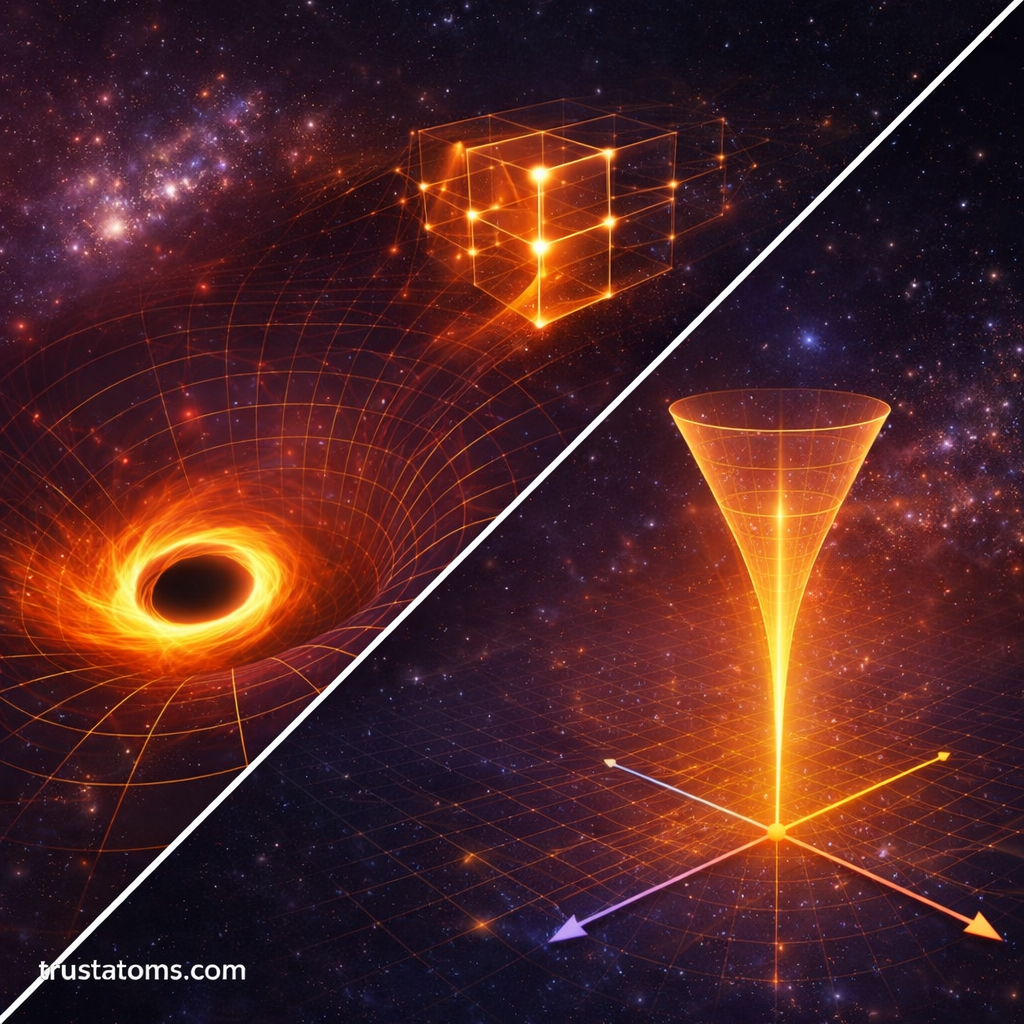
To measure spacetime curvature, physicists use additional tensors:
- Riemann curvature tensor
- Ricci tensor
- Scalar curvature
These tensors quantify:
- How spacetime bends
- How geodesics converge or diverge
- How gravity influences motion
Curvature tensors are essential in describing black holes, cosmology, and gravitational waves.
Covariant Derivatives and Parallel Transport
Ordinary derivatives do not work well in curved spacetime.
Instead, relativity uses the covariant derivative.
The covariant derivative:
- Accounts for curvature
- Preserves tensor structure
- Ensures equations remain coordinate-independent
Closely related is parallel transport:
- Moving a vector along a curved surface
- Comparing vectors at different points
These operations rely entirely on tensor calculus.
Why Tensor Analysis Is Essential in Relativity
Tensor analysis ensures:
- Coordinate independence
- Lorentz invariance
- Geometric consistency
- Proper handling of curvature
- Unified treatment of space and time
Without tensors:
- General relativity cannot be formulated cleanly.
- Field equations lose invariance.
- Physical predictions become coordinate-dependent.
Tensors provide mathematical consistency and physical clarity.
Applications in Modern Physics
Tensor analysis is used in:
- Black hole physics
- Cosmology
- Gravitational wave research
- Quantum field theory in curved spacetime
- High-energy particle physics
Every major relativistic framework relies on tensors.
Even advanced gauge theories and modern unified models use tensor structures.
Common Misconceptions
Tensors Are Just Complicated Matrices
Not exactly.
While some tensors look like matrices, their defining property is how they transform.
Transformation laws matter more than appearance.
Tensors Are Only for General Relativity
False.
They appear in:
- Fluid mechanics
- Electromagnetism
- Elasticity theory
- Continuum mechanics
Relativity simply makes their importance unavoidable.
Intuitive Perspective
If classical mechanics describes motion with forces and vectors, relativity describes reality through geometry.
Tensors are the language of geometry.
They allow:
- Curved spacetime to be quantified
- Energy and momentum to be unified
- Physical laws to remain universal
They do not complicate physics.
They make it consistent.
Final Takeaway
Tensor analysis is not just advanced mathematics.
It is the natural language of relativistic physics.
From special relativity’s spacetime intervals to general relativity’s curvature equations, tensors provide:
- Structure
- Invariance
- Geometric clarity
If you want to understand how spacetime bends, how gravity works, or how modern theoretical physics is built, tensor analysis is the essential framework that makes it all possible.