Every object around you is emitting radiation.
From a glowing stove burner to your own body, all matter with temperature above absolute zero releases electromagnetic energy. This emission is known as thermal radiation, and its behavior is described by the concept of a blackbody spectrum.
Understanding thermal radiation and blackbody spectra is fundamental in physics, astronomy, climate science, and modern technology.
In this guide, we’ll explore what thermal radiation is, what makes a perfect blackbody, and how temperature determines the color and intensity of emitted light.
What Is Thermal Radiation?
Thermal radiation is electromagnetic radiation produced by the motion of charged particles inside matter due to temperature.
Unlike conduction or convection, thermal radiation:
- Does not require a medium
- Travels through empty space
- Moves at the speed of light
This is how energy from the Sun reaches Earth.
What Is a Blackbody?
A blackbody is an idealized object that:
- Absorbs all incoming radiation
- Reflects none
- Emits radiation purely based on its temperature
It is called “black” because it absorbs everything.
However, when heated, it glows.
A blackbody does not depend on material type — only on temperature.
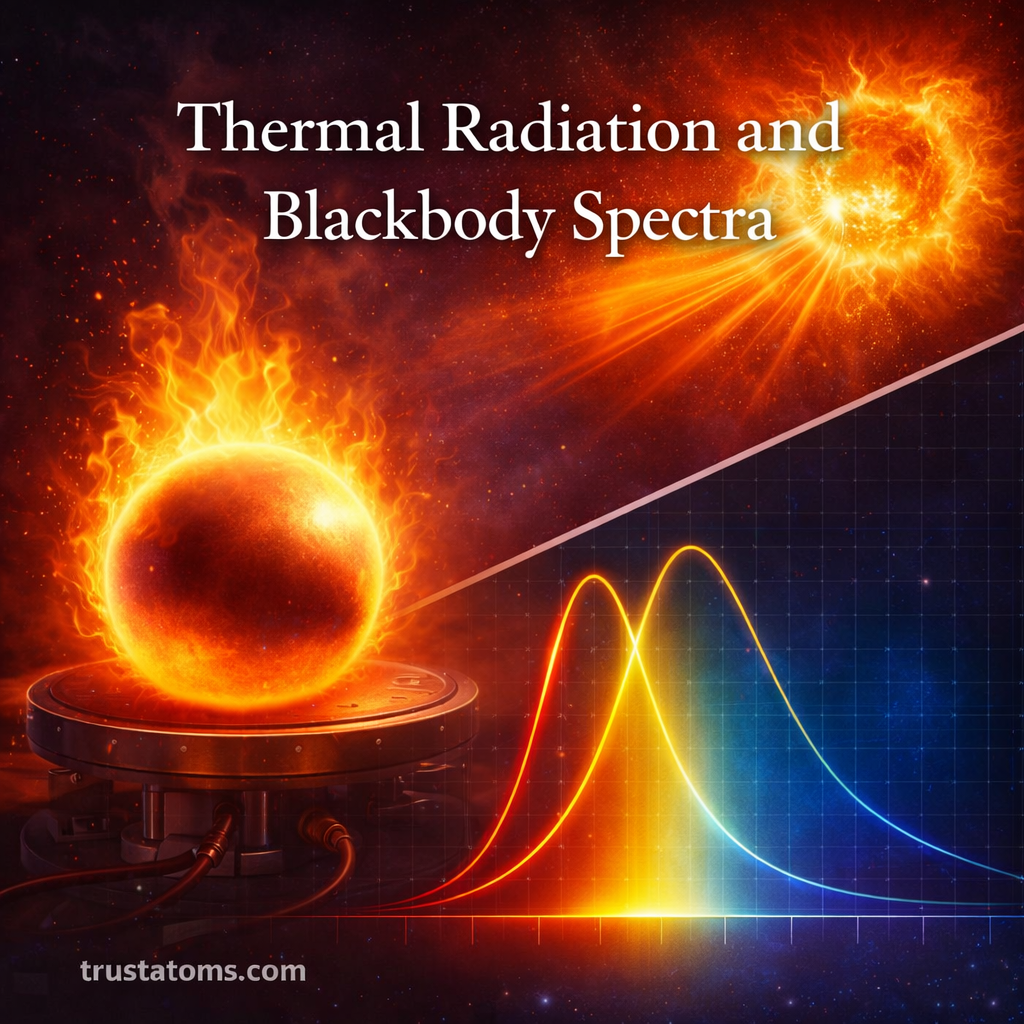
Blackbody Radiation Spectrum
When a blackbody emits radiation, it does not emit a single wavelength.
Instead, it produces a continuous spectrum of wavelengths.
Key characteristics of a blackbody spectrum:
- It has a smooth curve shape.
- It peaks at a specific wavelength.
- The peak shifts depending on temperature.
- Total energy emitted increases with temperature.
This distribution of energy across wavelengths is called the blackbody spectrum.
How Temperature Affects Radiation
Temperature controls two major features of blackbody radiation:
1. Total Energy Emitted
Hotter objects emit more energy overall.
As temperature increases:
- The curve rises.
- The area under the curve increases.
- Energy output grows rapidly.
This relationship is described by the Stefan–Boltzmann law, which states that emitted energy increases dramatically with temperature.
2. Peak Wavelength
Hotter objects also emit radiation at shorter wavelengths.
This shift is described by Wien’s displacement principle.
Examples:
- Cool objects → infrared radiation
- Warm objects → red glow
- Very hot objects → white or blue light
That’s why:
- A heated metal first glows red.
- As it gets hotter, it becomes orange, then white.
Why Blackbody Radiation Was Revolutionary
In the late 19th century, classical physics could not explain blackbody radiation correctly.
Predictions suggested infinite energy at short wavelengths — a problem known as the “ultraviolet catastrophe.”
The solution came from Max Planck, who proposed that energy is emitted in discrete packets (quanta).
This idea marked the beginning of quantum mechanics.
Blackbody radiation played a central role in transforming modern physics.
Real-World Examples of Thermal Radiation
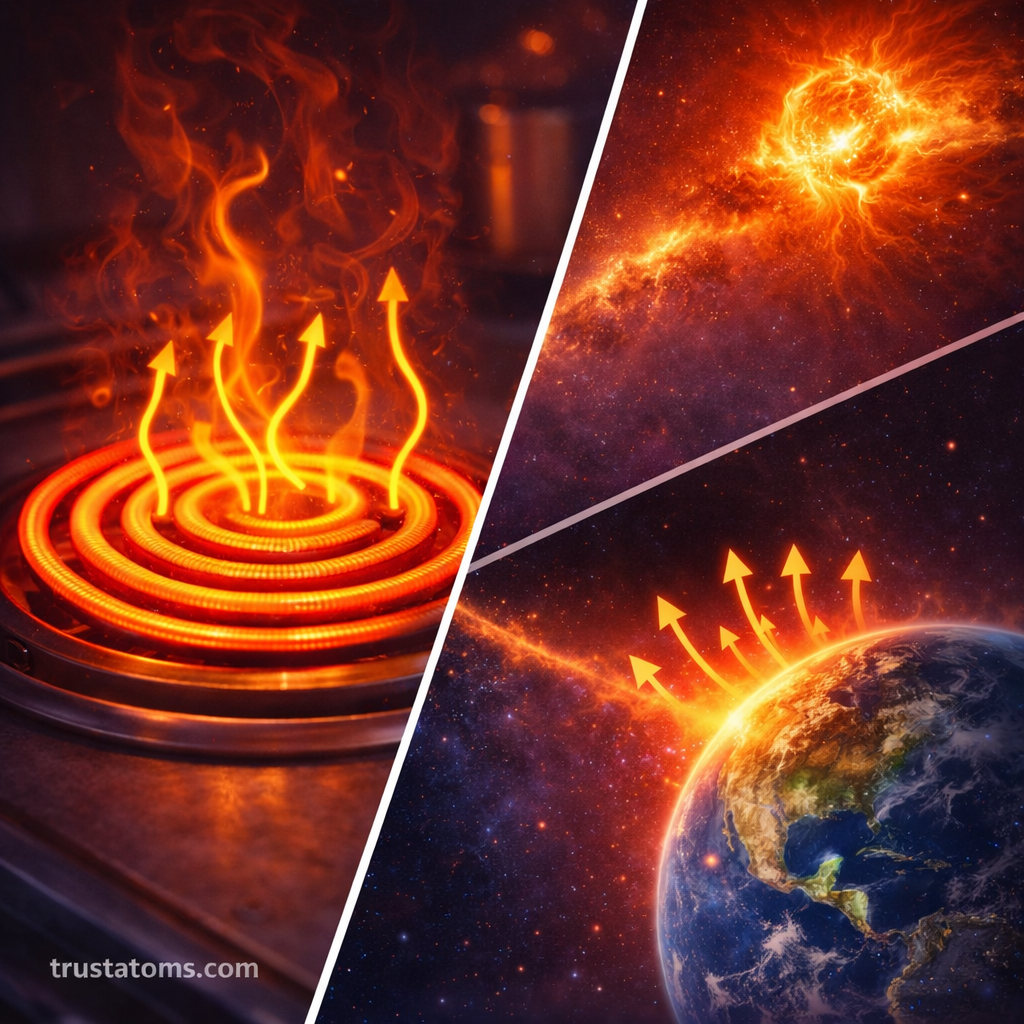
Thermal radiation appears everywhere.
1. The Sun
The Sun behaves approximately like a blackbody.
Its temperature determines the peak of its emission in the visible range.
2. Stars
Different stars have different temperatures.
- Cooler stars appear red.
- Hotter stars appear blue.
Astronomers estimate star temperature by analyzing blackbody spectra.
3. Human Body
The human body emits mostly infrared radiation.
This is why thermal cameras can detect body heat in darkness.
4. Cosmic Microwave Background
The afterglow of the Big Bang closely matches a nearly perfect blackbody spectrum.
This radiation provides strong evidence for cosmological models.
Intensity Distribution Across Wavelengths
The shape of the blackbody curve has three important features:
- Rapid rise at shorter wavelengths
- A single peak
- Gradual decline at longer wavelengths
As temperature increases:
- The peak shifts left (shorter wavelength)
- The curve grows taller
- The total emitted power increases significantly
This predictable behavior allows scientists to determine temperature from emitted light.
Emissivity and Real Objects
Real objects are not perfect blackbodies.
They have a property called emissivity, which measures how efficiently they emit radiation compared to an ideal blackbody.
Emissivity ranges between:
- 0 (no emission)
- 1 (perfect blackbody)
Dark, matte surfaces often have higher emissivity than shiny, reflective ones.
Applications of Blackbody Radiation
Understanding blackbody spectra is essential in:
- Astronomy (measuring star temperatures)
- Climate science (Earth’s radiation balance)
- Infrared imaging
- Thermal engineering
- Material science
- Spacecraft heat shielding
It also laid the foundation for quantum theory and modern physics.
Key Differences Between Thermal Radiation and Other Heat Transfer
Thermal radiation differs from conduction and convection.
Conduction:
- Requires direct contact
Convection:
- Requires fluid motion
Radiation:
- Requires no medium
- Travels through vacuum
This makes radiation the dominant heat transfer mechanism in space.
Why Thermal Radiation Matters in Physics
Thermal radiation connects:
- Thermodynamics
- Electromagnetism
- Quantum mechanics
- Astrophysics
It reveals how temperature determines electromagnetic emission.
It explains:
- Why stars shine
- Why hot objects glow
- How energy moves through space
Most importantly, it reshaped physics by introducing quantized energy.
Final Thoughts
Thermal radiation and blackbody spectra show how temperature governs light and energy emission.
Every object emits radiation.
Hotter objects emit more.
Hotter objects also glow at shorter wavelengths.
From glowing metal to distant galaxies, blackbody radiation provides a universal rule for how matter radiates energy.
Understanding this principle unlocks insight into everything from household heating to the origin of the universe.