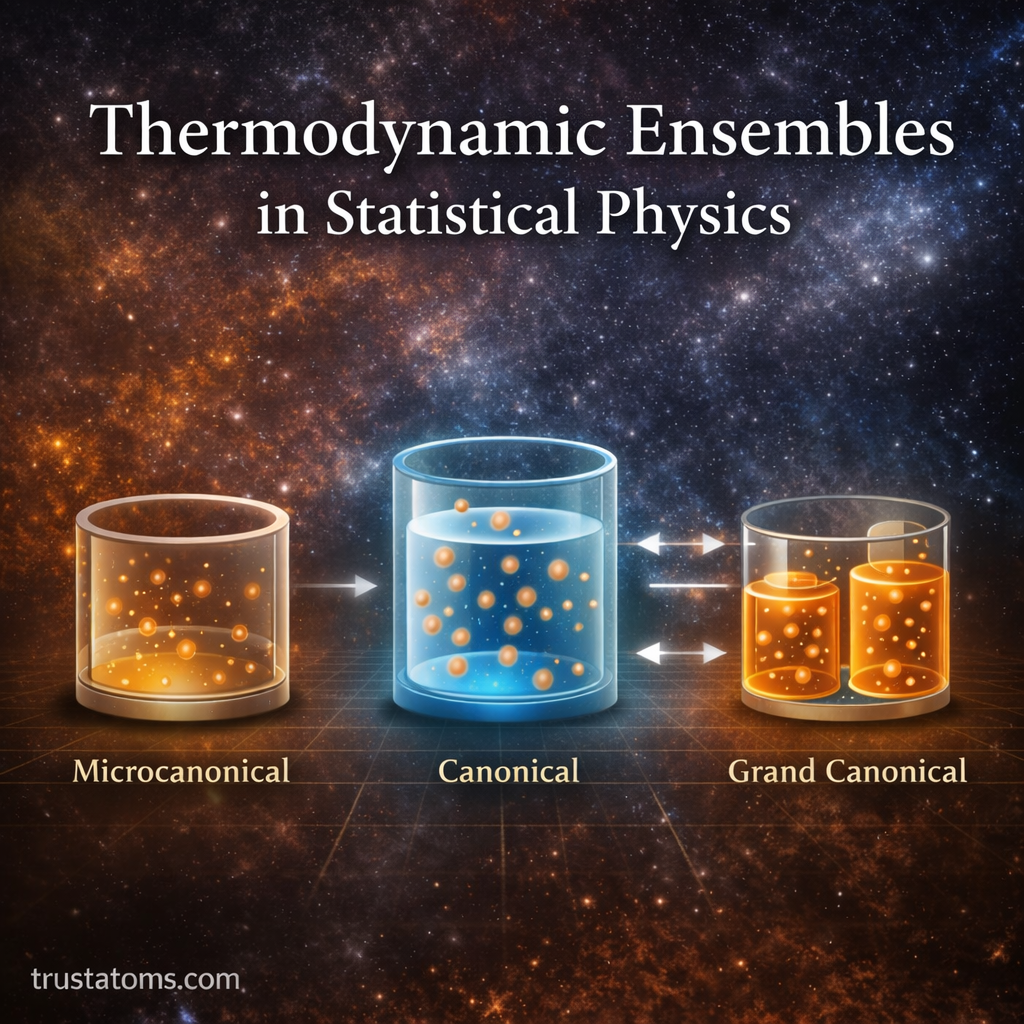
Thermodynamic ensembles are one of the most powerful tools in statistical physics. They allow physicists to connect microscopic particle behavior with macroscopic thermodynamic laws such as temperature, pressure, and entropy.
Instead of tracking every particle individually — which is practically impossible for systems containing trillions upon trillions of particles — statistical physics uses ensembles: large collections of possible system states that obey certain constraints.
In this guide, we’ll explore what thermodynamic ensembles are, why they matter, and how the three main types — microcanonical, canonical, and grand canonical — differ.
Why Statistical Physics Needs Ensembles
A gas in a box may contain more particles than there are stars in the observable universe. Describing each particle’s position and velocity is impossible in practice.
Statistical physics solves this by asking a different question:
What are the probabilities of different microscopic configurations?
Instead of focusing on one exact state, we imagine many possible systems consistent with certain conditions. This collection is called an ensemble.
Each ensemble represents:
- A large set of hypothetical copies of a system
- All satisfying specific macroscopic constraints
- Each copy in a different microscopic state
By averaging over these states, we calculate measurable quantities such as:
- Temperature
- Energy
- Entropy
- Pressure
What Is a Thermodynamic Ensemble?
A thermodynamic ensemble is a mathematical construction that represents all possible microstates consistent with certain macroscopic constraints.
A microstate describes:
- Exact particle positions
- Exact particle momenta
- Full microscopic configuration
A macrostate describes:
- Total energy
- Volume
- Particle number
- Temperature
An ensemble bridges the two.
Instead of solving equations for one configuration, we compute averages across many allowed microstates.
The Three Main Thermodynamic Ensembles
In classical statistical mechanics, there are three fundamental ensembles.
Each corresponds to different physical conditions.
1. Microcanonical Ensemble (N, V, E Fixed)
The microcanonical ensemble describes an isolated system.
Its defining constraints are:
- Fixed number of particles (N)
- Fixed volume (V)
- Fixed total energy (E)
No energy or particles can enter or leave.
Physical Interpretation
Imagine:
- A perfectly insulated box
- No heat exchange
- No particle exchange
The total energy remains constant.
All accessible microstates with that exact energy are considered equally probable.
When It’s Used
- Ideal theoretical systems
- Fundamental derivations of entropy
- Closed, isolated systems
The entropy in this ensemble is directly related to the number of accessible microstates.
2. Canonical Ensemble (N, V, T Fixed)
The canonical ensemble describes a system in thermal contact with a heat reservoir.
Its defining constraints are:
- Fixed number of particles (N)
- Fixed volume (V)
- Fixed temperature (T)
Energy can fluctuate because the system exchanges heat with its surroundings.
Physical Interpretation
Imagine:
- A box of gas touching a large thermal reservoir
- Temperature remains constant
- Energy fluctuates slightly
The probability of a microstate depends on its energy.
Lower-energy states are more likely than higher-energy states, according to a probability distribution that depends on temperature.
Why It’s Important
The canonical ensemble:
- Is widely used in physics and chemistry
- Leads to the definition of the partition function
- Connects directly to free energy
Most laboratory systems are effectively described by this ensemble.
3. Grand Canonical Ensemble (μ, V, T Fixed)
The grand canonical ensemble describes systems that exchange both energy and particles with a reservoir.
Its defining constraints are:
- Fixed temperature (T)
- Fixed volume (V)
- Fixed chemical potential (μ)
Both energy and particle number can fluctuate.
Physical Interpretation
Imagine:
- A small system connected to a large reservoir
- Heat and particles flow freely
- Particle number is not fixed
This ensemble is especially useful for:
- Quantum gases
- Particle physics
- Open systems
It is essential when dealing with systems where particle number is not conserved in the subsystem being studied.
Comparing the Three Ensembles

Here’s a conceptual summary:
Microcanonical
- Fixed energy
- No exchange
- Isolated systems
Canonical
- Fixed temperature
- Energy exchange allowed
- Most common practical scenario
Grand Canonical
- Fixed temperature and chemical potential
- Energy and particle exchange allowed
- Best for open systems
Although they differ in constraints, all three ensembles produce equivalent results in the thermodynamic limit — when the system becomes very large.
This is known as ensemble equivalence.
Why Ensembles Work
At first glance, imagining thousands of hypothetical systems may seem artificial.
However, ensembles work because:
- Real systems constantly fluctuate
- Macroscopic measurements average over microscopic motion
- Large systems smooth out statistical variations
In the thermodynamic limit:
- Relative fluctuations become negligible
- Different ensembles predict the same observable quantities
This explains why thermodynamics works so reliably in everyday life.
The Role of the Partition Function
In both canonical and grand canonical ensembles, a key quantity appears: the partition function.
The partition function:
- Encodes all thermodynamic information
- Allows calculation of energy, entropy, and pressure
- Connects microscopic probabilities to macroscopic laws
Once the partition function is known, nearly every thermodynamic quantity can be derived from it.
This is why it is often considered the central object in statistical mechanics.
Applications of Thermodynamic Ensembles
Thermodynamic ensembles are used in many areas of physics:
- Modeling gases and liquids
- Understanding phase transitions
- Describing magnetic systems
- Studying blackbody radiation
- Analyzing quantum statistics
They are also foundational in:
- Condensed matter physics
- Quantum field theory
- Cosmology
Without ensemble theory, connecting atomic behavior to temperature and entropy would not be possible.
Common Misconceptions
It’s helpful to clarify a few misunderstandings.
Ensembles are not:
- Physical copies of a system
- Multiple real universes
- Experimental replicas
They are mathematical tools.
They help calculate averages in systems where direct microscopic tracking is impossible.
Key Takeaways
Thermodynamic ensembles are central to statistical physics because they:
- Connect microscopic particle behavior to macroscopic laws
- Allow probability-based descriptions of physical systems
- Provide multiple frameworks for different physical constraints
- Become equivalent in the thermodynamic limit
The three primary ensembles — microcanonical, canonical, and grand canonical — differ in what is allowed to fluctuate:
- Energy
- Particle number
- Both
Together, they form the backbone of statistical mechanics and explain how order emerges from microscopic randomness.
Understanding ensembles reveals a profound truth about nature:
Macroscopic laws arise from statistical behavior at the microscopic scale.