Thermodynamic potentials are powerful tools that help physicists and engineers predict how energy systems behave under different conditions.
From chemical reactions and power plants to batteries and phase transitions, thermodynamic potentials determine:
- Whether a process will occur spontaneously
- How energy is exchanged
- What equilibrium state a system will reach
In this article, we’ll break down the major thermodynamic potentials, explain when each one is used, and explore their role in real-world energy systems.
What Are Thermodynamic Potentials?
Thermodynamic potentials are energy-like quantities that describe a system under specific constraints.
They allow us to answer questions such as:
- Will this reaction occur?
- What is the most stable configuration?
- How much usable work can be extracted?
Each potential applies under different physical conditions, such as:
- Constant temperature
- Constant pressure
- Constant volume
Choosing the correct potential simplifies the analysis of complex systems.
The Four Major Thermodynamic Potentials
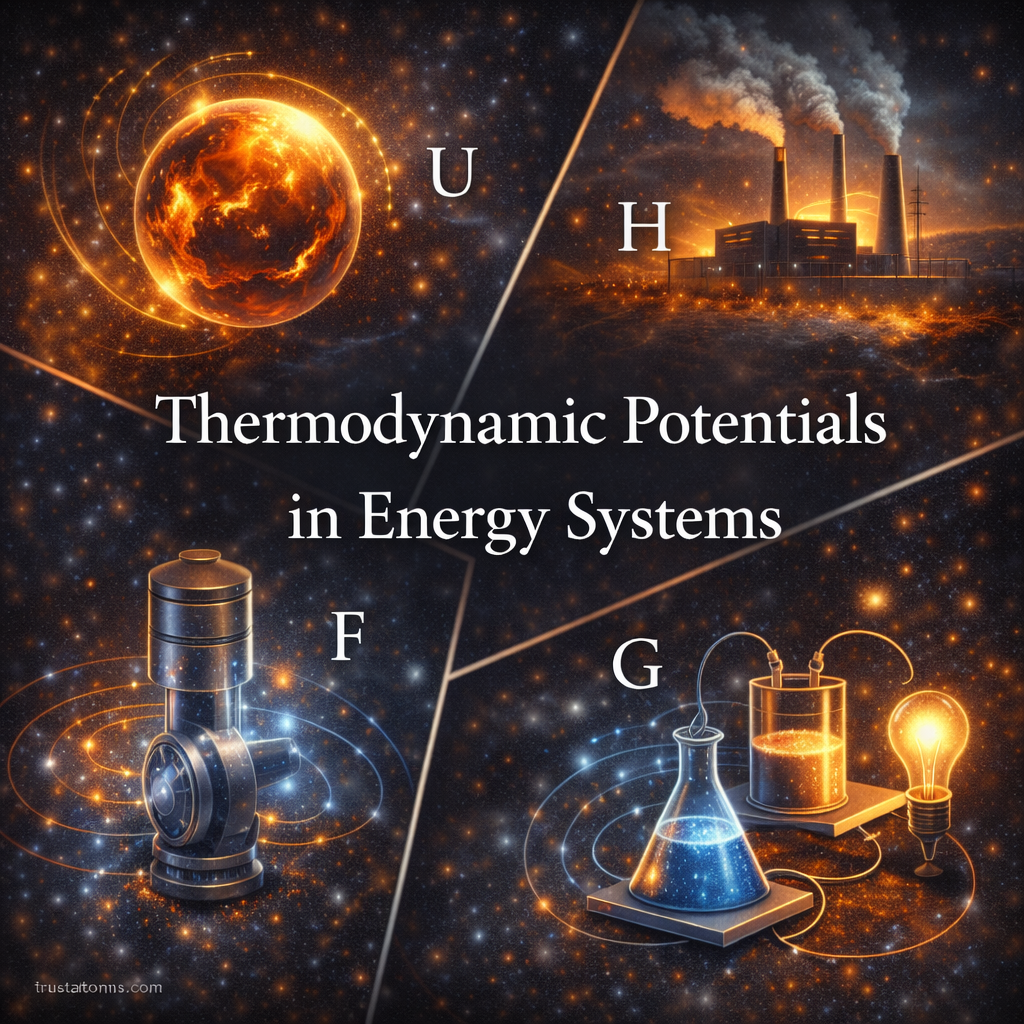
There are four primary thermodynamic potentials in classical thermodynamics:
- Internal Energy (U)
- Enthalpy (H)
- Helmholtz Free Energy (F)
- Gibbs Free Energy (G)
Each one describes energy in a different way depending on system constraints.
Internal Energy (U)
Internal energy represents the total microscopic energy of a system.
It includes:
- Kinetic energy of particles
- Potential energy from intermolecular forces
Internal energy is most useful when:
- Volume is constant
- No work other than pressure-volume work occurs
The first law of thermodynamics relates changes in internal energy to heat and work.
Internal energy is foundational, but not always the most convenient quantity for practical systems.
Enthalpy (H)
Enthalpy accounts for internal energy plus the energy associated with pressure and volume.
It is especially useful in:
- Constant-pressure processes
- Open systems
- Chemical reactions
Most real-world energy systems operate at approximately constant atmospheric pressure.
Examples include:
- Combustion engines
- Boilers
- Heat exchangers
Enthalpy simplifies heat transfer calculations under constant pressure conditions.
Helmholtz Free Energy (F)
Helmholtz free energy is useful for systems at:
- Constant temperature
- Constant volume
It determines:
- Maximum useful work obtainable (excluding pressure-volume work)
- Stability of systems at fixed volume
Applications include:
- Statistical mechanics
- Closed systems in thermal equilibrium
- Solid-state physics
When Helmholtz free energy decreases, a process can occur spontaneously under these constraints.
Gibbs Free Energy (G)
Gibbs free energy is one of the most widely used thermodynamic potentials.
It applies when:
- Temperature is constant
- Pressure is constant
This makes it ideal for:
- Chemical reactions
- Biological systems
- Industrial processes
A key principle:
If Gibbs free energy decreases, the process is spontaneous.
At equilibrium:
- Gibbs free energy is minimized.
Why Different Potentials Exist
Each thermodynamic potential corresponds to different environmental constraints.
For example:
- A sealed rigid container → Helmholtz free energy is most useful.
- A chemical reaction in open air → Gibbs free energy applies.
- An insulated piston system → Internal energy may be preferred.
By choosing the correct potential, complex calculations become manageable.
Thermodynamic Potentials and Energy Minimization
A central idea in thermodynamics is:
Systems move toward states that minimize the appropriate potential.
Examples:
- At constant temperature and pressure → Gibbs free energy is minimized.
- At constant temperature and volume → Helmholtz free energy is minimized.
This principle explains:
- Phase changes
- Chemical equilibrium
- Stability of matter
Minimization determines equilibrium configurations in energy systems.
Thermodynamic Potentials in Power Systems

Power plants and energy systems rely heavily on thermodynamic analysis.
Heat Engines
In heat engines:
- Enthalpy changes track heat flow.
- Efficiency depends on temperature differences.
Refrigeration Systems
Refrigerators operate by:
- Moving heat from cold to hot reservoirs.
- Using work to manipulate energy flow.
Free energy concepts help determine:
- Maximum possible efficiency.
- Limits imposed by thermodynamic laws.
Applications in Chemical Energy Systems
Batteries and fuel cells are governed by Gibbs free energy.
The change in Gibbs free energy determines:
- Electrical work obtainable from chemical reactions.
- Voltage output of electrochemical cells.
In biological systems:
- ATP hydrolysis releases energy due to negative Gibbs free energy change.
- Cellular processes depend on free energy gradients.
Phase Transitions and Potentials
Thermodynamic potentials help predict phase changes.
For example:
- When Gibbs free energy of liquid equals that of vapor → boiling occurs.
- When Gibbs free energy of solid equals liquid → melting occurs.
Equilibrium between phases happens when the relevant potential is equal in both states.
Mathematical Insight (Conceptual)
Each thermodynamic potential is derived from internal energy by incorporating constraints.
Conceptually:
- Add pressure-volume terms → Enthalpy.
- Subtract temperature-entropy terms → Free energies.
These transformations allow analysis under real-world operating conditions.
No single potential is universally “best” — the correct one depends on constraints.
Why Thermodynamic Potentials Matter in Modern Physics
Thermodynamic potentials connect:
- Energy conservation
- Entropy
- Equilibrium
- Stability
They are used in:
- Engineering design
- Materials science
- Chemical thermodynamics
- Astrophysical modeling
Even advanced theories such as statistical mechanics and quantum thermodynamics rely on these classical potentials.
Common Misconceptions
“Free Energy Means Energy Is Free”
Free energy does not mean costless energy.
It refers to:
- Energy available to do useful work under specific conditions.
“All Energy Can Be Converted to Work”
The second law of thermodynamics limits usable energy.
Entropy increases reduce the amount of extractable work.
Thermodynamic potentials account for these limits.
Final Thoughts
Thermodynamic potentials in energy systems provide a structured way to analyze how energy flows, transforms, and stabilizes.
By selecting the correct potential:
- Engineers predict efficiency.
- Chemists determine reaction spontaneity.
- Physicists analyze equilibrium.
From combustion engines to living cells, thermodynamic potentials guide our understanding of energy behavior.
They transform abstract thermodynamic laws into practical tools for designing and optimizing real-world systems.