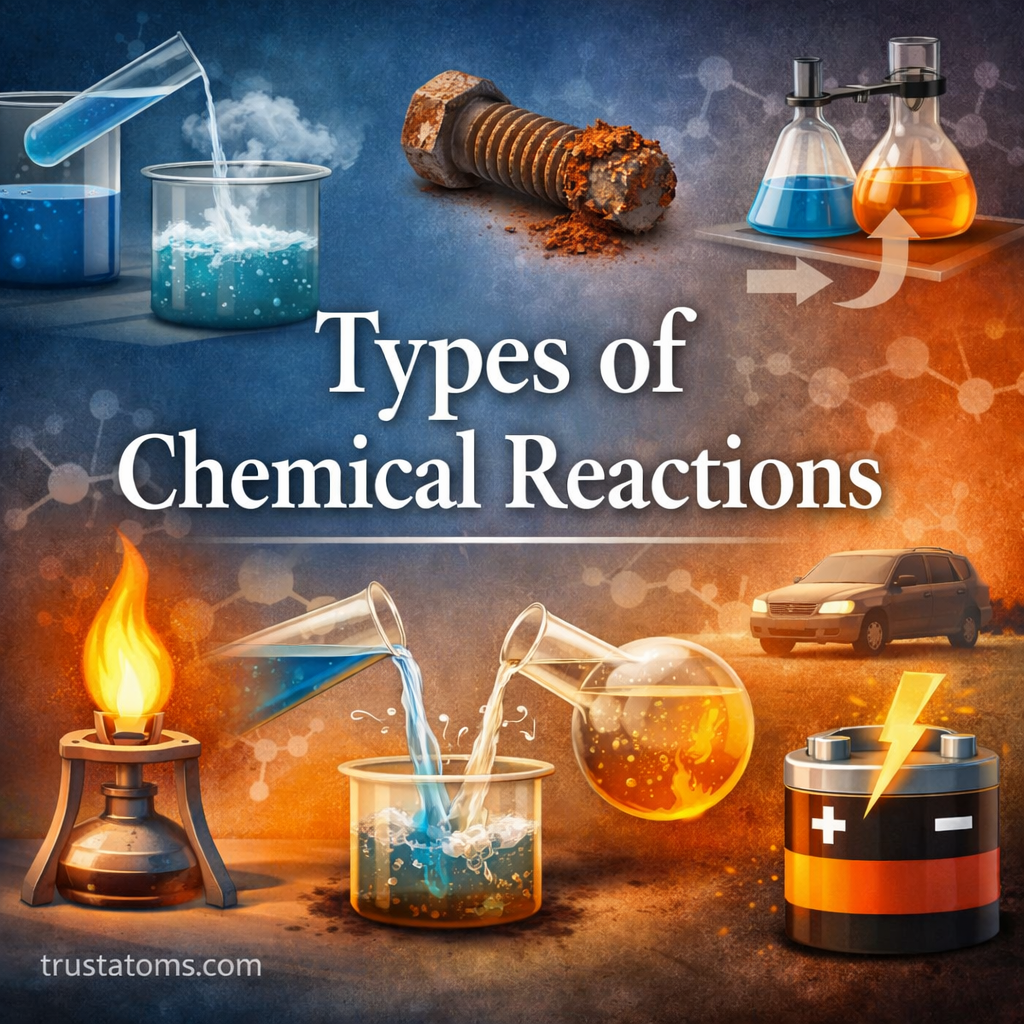
Chemical reactions are the foundation of chemistry. They explain how substances transform, combine, break apart, and rearrange to form new materials. From rust forming on iron to digestion in your body, chemical reactions are happening all around you.
In this guide, we’ll explore the main types of chemical reactions, how they work, and real-world examples that make them easier to understand.
What Is a Chemical Reaction?
A chemical reaction occurs when substances (called reactants) change into new substances (called products). During this process:
- Atoms are rearranged
- Chemical bonds are broken and formed
- Energy may be absorbed or released
Chemists classify reactions into categories based on patterns in how reactants transform into products.
1. Synthesis (Combination) Reactions
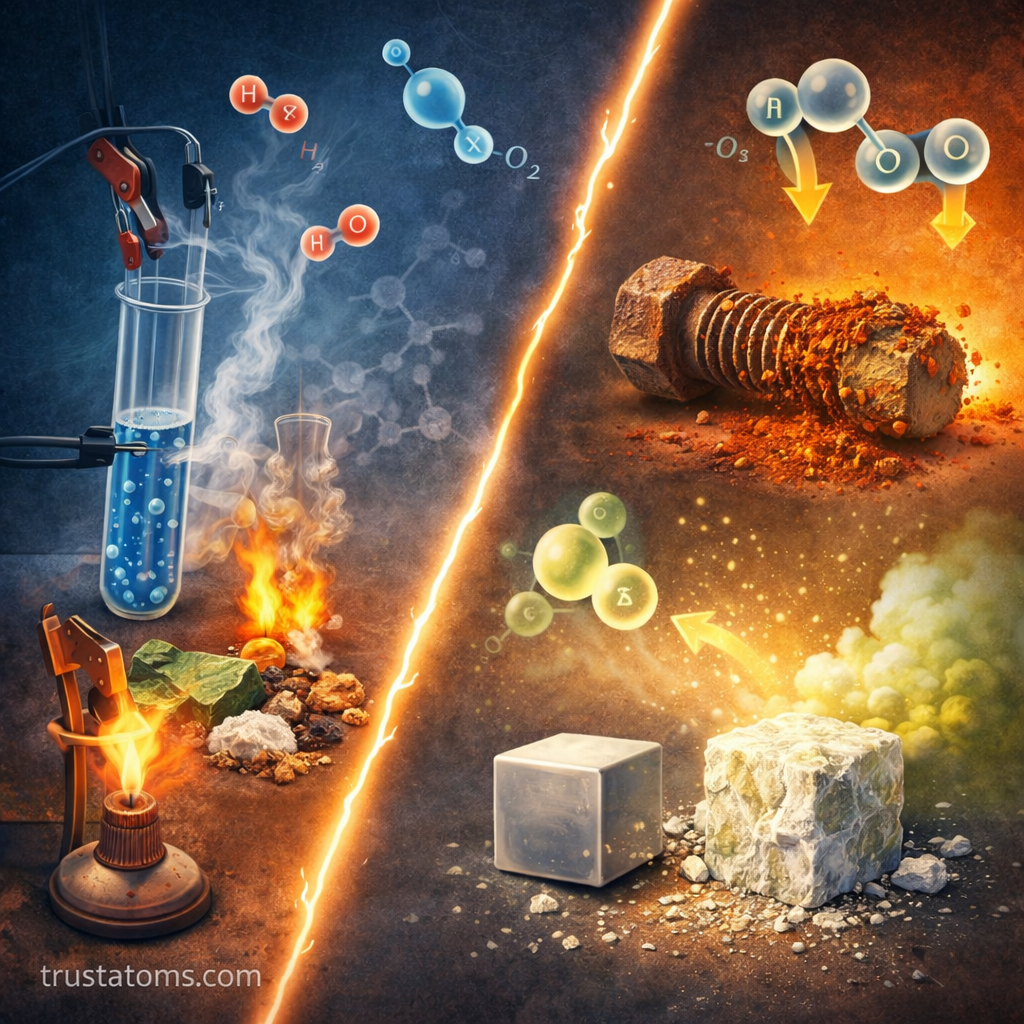
A synthesis reaction happens when two or more substances combine to form a single, more complex product.
General pattern:
A + B → AB
Key Characteristics
- Multiple reactants
- One single product
- Often releases energy
Real-World Examples
- Hydrogen combining with oxygen to form water
- Iron reacting with oxygen to form rust
- Sodium reacting with chlorine to form table salt
Synthesis reactions are common in nature and industry, especially when building more complex molecules from simpler ones.
2. Decomposition Reactions
A decomposition reaction is the opposite of synthesis. A single compound breaks down into two or more simpler substances.
General pattern:
AB → A + B
Key Characteristics
- One reactant
- Multiple products
- Often requires energy input (heat, light, or electricity)
Real-World Examples
- Water breaking down into hydrogen and oxygen during electrolysis
- Calcium carbonate decomposing when heated
- Hydrogen peroxide breaking down into water and oxygen
Decomposition reactions are important in processes like digestion, industrial manufacturing, and energy production.
3. Single Replacement (Single Displacement) Reactions
In a single replacement reaction, one element replaces another element in a compound.
General pattern:
A + BC → AC + B
Key Characteristics
- One free element reacts with a compound
- One element switches places
- Often occurs between metals
Real-World Examples
- Zinc replacing copper in copper sulfate solution
- Iron displacing copper from copper chloride
These reactions depend on the relative reactivity of the elements involved.
4. Double Replacement (Double Displacement) Reactions
A double replacement reaction occurs when two compounds exchange parts to form two new compounds.
General pattern:
AB + CD → AD + CB
Key Characteristics
- Two compounds react
- Ions swap partners
- Often occurs in aqueous (water-based) solutions
Real-World Examples
- Silver nitrate reacting with sodium chloride to form silver chloride
- Acid-base neutralization reactions
Many precipitation reactions (where a solid forms from solution) fall into this category.
5. Combustion Reactions
A combustion reaction occurs when a substance reacts rapidly with oxygen, releasing energy in the form of heat and light.
General pattern (for hydrocarbons):
Fuel + Oxygen → Carbon dioxide + Water + Energy
Key Characteristics
- Requires oxygen
- Releases heat and light
- Often produces flames
Real-World Examples
- Burning gasoline in a car engine
- A candle flame
- Natural gas burning on a stove
Combustion reactions are essential for energy production but also contribute to air pollution and climate change.
6. Acid-Base Reactions
Acid-base reactions involve the transfer of protons (hydrogen ions) between substances.
Key Characteristics
- An acid reacts with a base
- Often produces water and a salt
- Usually occurs in solution
Real-World Examples
- Stomach acid reacting with antacids
- Vinegar reacting with baking soda
These reactions are critical in biological systems and industrial chemistry.
7. Redox (Oxidation-Reduction) Reactions
Redox reactions involve the transfer of electrons between substances.
- Oxidation = loss of electrons
- Reduction = gain of electrons
These two processes always occur together.
Real-World Examples
- Rusting of iron
- Cellular respiration
- Photosynthesis
- Batteries generating electricity
Redox reactions power many natural and technological processes.
Endothermic vs. Exothermic Reactions
Chemical reactions are also classified based on energy flow:
Exothermic Reactions
- Release energy
- Surroundings become warmer
- Example: Combustion
Endothermic Reactions
- Absorb energy
- Surroundings become cooler
- Example: Photosynthesis
Understanding energy changes helps scientists predict how reactions behave.
Why Understanding Reaction Types Matters
Knowing the types of chemical reactions helps you:
- Predict products of reactions
- Understand biological processes
- Improve industrial manufacturing
- Analyze environmental changes
- Solve chemistry problems more efficiently
Classification simplifies the complexity of chemistry into understandable patterns.
Final Thoughts
Chemical reactions may look complicated, but most follow predictable patterns. Synthesis builds compounds. Decomposition breaks them apart. Replacement reactions swap elements. Combustion releases energy. Redox reactions transfer electrons.
By recognizing these categories, you gain a clearer understanding of how matter transforms — from laboratory experiments to everyday life.
Chemistry isn’t just about formulas. It’s about patterns of change.