Velocity and acceleration are closely related concepts in physics, but they are not the same thing. Many people confuse the two because both describe motion.
Understanding the difference between velocity and acceleration is essential for grasping Newton’s laws, force, and motion.
In this guide, we’ll break down their definitions, formulas, units, and real-world differences in simple terms.
What Is Velocity?
Velocity is the rate of change of position over time.
Unlike speed, velocity includes:
- Magnitude (how fast something moves)
- Direction (which way it moves)
Because velocity includes direction, it is a vector quantity.
Formula for Velocity
v = d / t
Where:
- v = velocity
- d = displacement
- t = time
Displacement measures the change in position, not total distance traveled.
Units of Velocity
Velocity is measured in:
meters per second (m/s)
Other units may include:
- kilometers per hour (km/h)
- miles per hour (mph)
What Is Acceleration?
Acceleration is the rate of change of velocity over time.
Since velocity includes direction, acceleration can result from:
- Changing speed
- Changing direction
- Changing both
Acceleration is also a vector quantity.
Formula for Acceleration
a = (vf − vi) / t
Where:
- a = acceleration
- vf = final velocity
- vi = initial velocity
- t = time
Units of Acceleration
Acceleration is measured in:
meters per second squared (m/s²)
This means velocity changes by a certain number of meters per second every second.
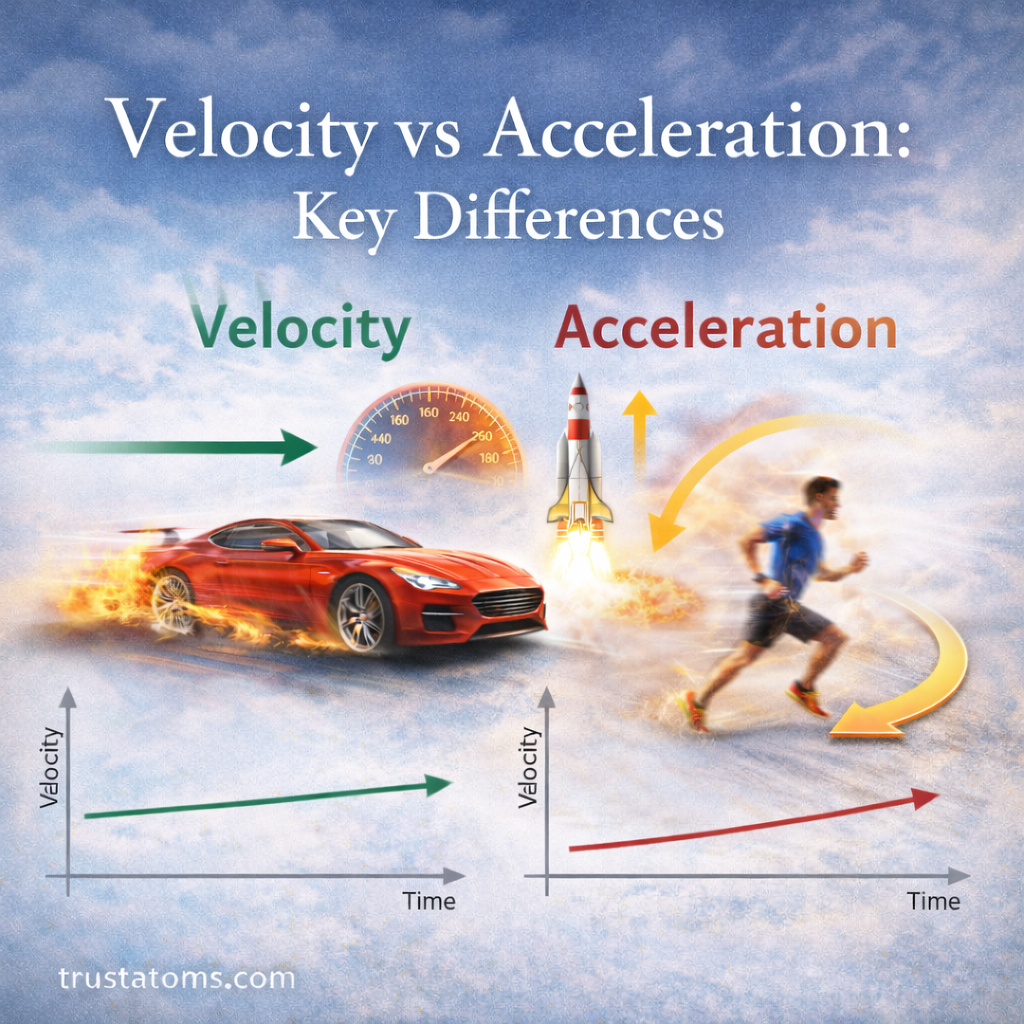
Key Differences Between Velocity and Acceleration
Here’s a clear comparison:
Velocity describes:
- How fast something is moving
- The direction of motion
- Change in position over time
Acceleration describes:
- How velocity changes
- How quickly speed increases or decreases
- How direction changes
In short:
Velocity = motion
Acceleration = change in motion
Can You Have Velocity Without Acceleration?
Yes.
If an object moves at a constant speed in a straight line, it has:
- Constant velocity
- Zero acceleration
Example:
- A car cruising at steady speed on a straight highway
Because velocity is not changing, acceleration equals zero.
Can You Have Acceleration Without Changing Speed?
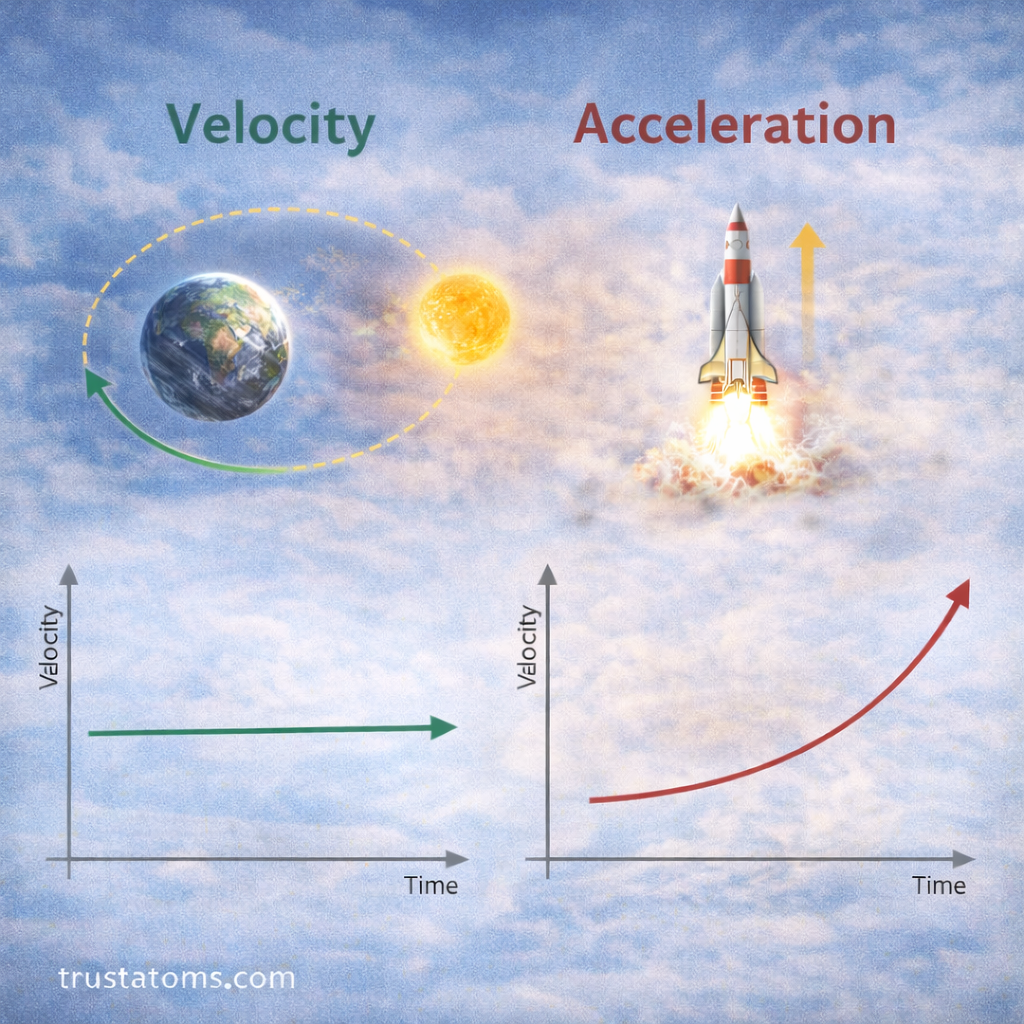
Yes.
If an object changes direction while maintaining speed, it still accelerates.
Example:
- A car turning a corner
- A satellite orbiting Earth
- A ball moving in a circle
Even though speed stays constant, direction changes — which means velocity changes.
Real-World Examples
1. Driving a Car
- Pressing the gas → acceleration increases velocity
- Maintaining speed → constant velocity, zero acceleration
- Braking → negative acceleration (deceleration)
- Turning → acceleration due to direction change
2. Falling Objects
An object in free fall:
- Has increasing velocity
- Has constant acceleration (approximately 9.8 m/s² near Earth’s surface)
Gravity continuously accelerates the object downward.
3. Sports Motion
A sprinter:
- Accelerates at the start
- Maintains velocity during peak speed
- Decelerates near the finish
Acceleration changes velocity at each stage.
Mathematical Relationship Between Velocity and Acceleration
Acceleration is the derivative of velocity with respect to time.
In simpler terms:
Acceleration tells us how fast velocity changes.
If acceleration is constant:
Velocity increases steadily over time.
If acceleration is zero:
Velocity remains constant.
Graphical Differences
On motion graphs:
Velocity–time graph:
- Slope represents acceleration
Position–time graph:
- Slope represents velocity
Acceleration–time graph:
- Shows how acceleration changes
Understanding graphs helps clarify the difference between the two concepts.
Common Misconceptions
“Acceleration Means Speeding Up”
Not always.
Slowing down and turning are also forms of acceleration.
“If Speed Is Constant, There’s No Acceleration”
Incorrect if direction changes.
Turning involves acceleration.
“Velocity and Speed Are the Same”
Speed is scalar (no direction).
Velocity includes direction.
Why This Difference Matters
Understanding velocity vs acceleration is crucial for:
- Newton’s Laws of Motion
- Engineering design
- Vehicle safety
- Rocket science
- Sports physics
- Orbital mechanics
Acceleration determines how forces change velocity.
Velocity describes how objects move through space.
Both concepts are foundational to classical mechanics.
Quick Summary
Velocity:
- Measures motion
- Includes speed and direction
- Units: m/s
Acceleration:
- Measures change in velocity
- Includes changes in speed or direction
- Units: m/s²
Velocity tells you how fast.
Acceleration tells you how fast that speed changes.
Final Thoughts
Velocity and acceleration are closely connected but fundamentally different.
Velocity describes motion.
Acceleration describes how motion changes.
Once you understand this distinction, many physics concepts — from force to momentum — become much clearer.
Recognizing the difference is a key step toward mastering motion in physics.