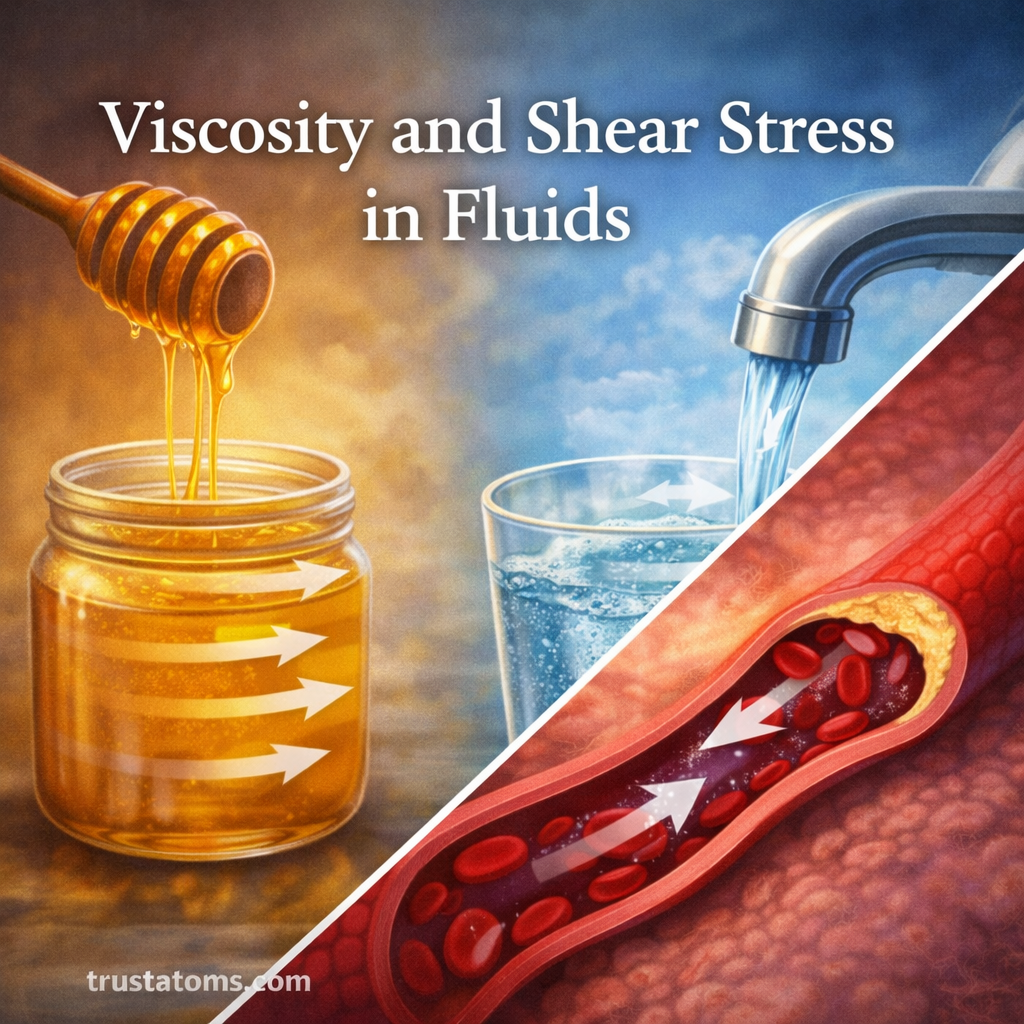
Why does honey flow more slowly than water?
Why does oil behave differently at cold temperatures?
Why do some fluids resist motion while others move freely?
The answer lies in viscosity and shear stress — two core concepts in fluid mechanics that explain how fluids resist deformation and motion.
In this guide, we’ll break down what viscosity is, how shear stress works, the relationship between them, and why these ideas matter in physics, engineering, and everyday life.
What Is Viscosity?
Viscosity is a measure of a fluid’s resistance to flow.
It describes how much a fluid resists internal motion when layers slide past each other.
In simple terms:
- Low viscosity → flows easily (like water)
- High viscosity → flows slowly (like syrup)
Viscosity comes from internal friction between fluid layers.
What Is Shear Stress?
Shear stress occurs when a force acts parallel to a surface.
In fluids, shear stress develops when one layer of fluid moves relative to another.
Imagine fluid between two plates:
- Bottom plate is stationary.
- Top plate moves sideways.
- Fluid layers between them move at different speeds.
The force required to keep the top plate moving creates shear stress within the fluid.
Shear stress is typically represented as force per unit area.
The Relationship Between Viscosity and Shear Stress
In many fluids, shear stress is directly proportional to the rate at which velocity changes across layers.
This relationship is described conceptually as:
Shear Stress ∝ Viscosity × Velocity Gradient
The velocity gradient describes how quickly speed changes from one layer to another.
Higher viscosity means:
- Greater resistance
- Larger shear stress for the same motion
Lower viscosity means:
- Less resistance
- Smaller shear stress
Newtonian vs. Non-Newtonian Fluids
Fluids behave differently depending on their internal structure.
Newtonian Fluids
Newtonian fluids have constant viscosity.
Shear stress increases linearly with shear rate.
Examples:
- Water
- Air
- Most thin oils
For these fluids, viscosity does not change with applied force.
Non-Newtonian Fluids
Non-Newtonian fluids change viscosity depending on stress or shear rate.
Examples:
- Ketchup (thins when shaken)
- Toothpaste
- Blood
- Oobleck (cornstarch mixture)
Some become thinner when stressed (shear-thinning).
Others become thicker (shear-thickening).
What Causes Viscosity?
Viscosity arises from molecular interactions.
In liquids:
- Molecules are close together.
- Intermolecular forces resist motion.
- Stronger forces → higher viscosity.
In gases:
- Molecules are farther apart.
- Viscosity comes from collisions transferring momentum.
Temperature affects viscosity differently:
- Liquids: Higher temperature → lower viscosity.
- Gases: Higher temperature → higher viscosity.
Shear Stress in Real Fluid Systems
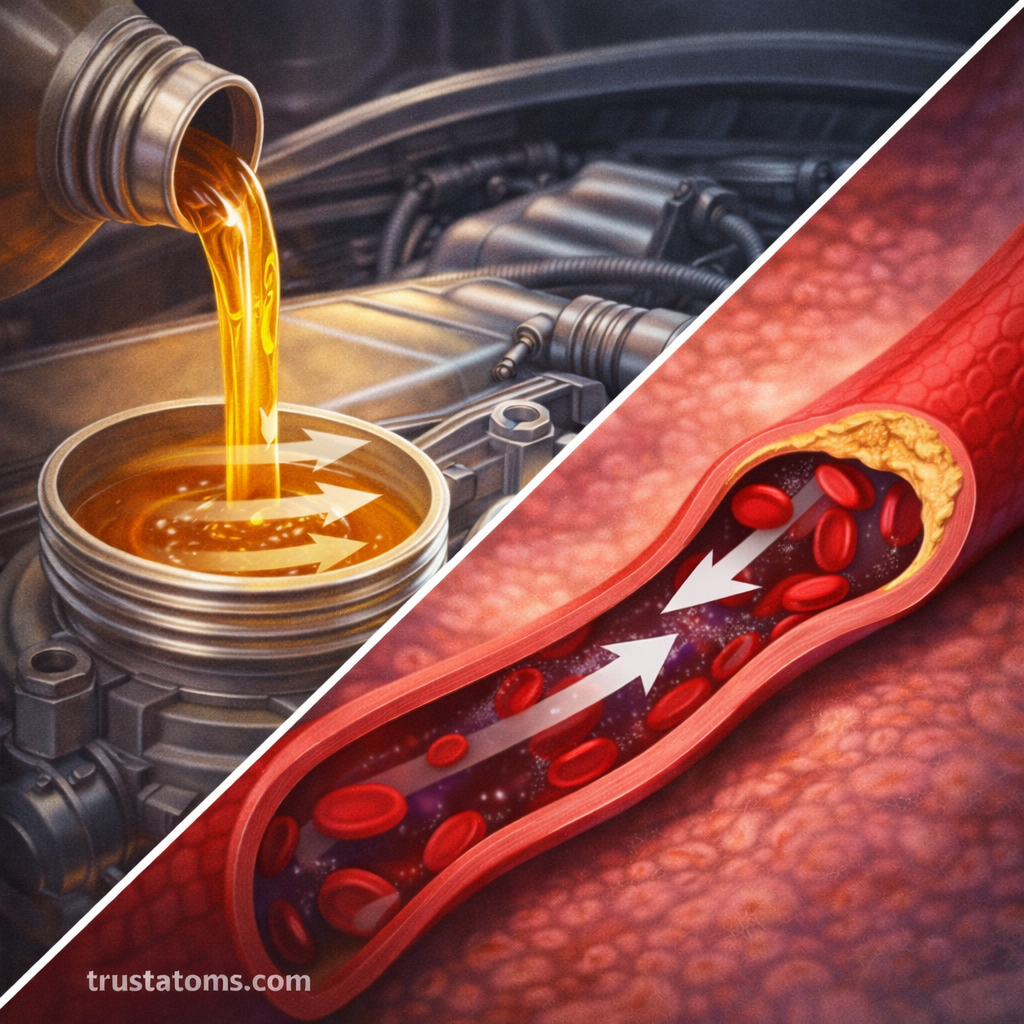
Shear stress plays a major role in many systems.
1. Blood Flow
Blood experiences shear stress as it moves through arteries.
High shear stress can:
- Influence vessel health
- Affect clot formation
- Change cellular behavior
2. Lubrication Systems
Engine oil reduces shear stress between moving engine parts.
Without sufficient viscosity:
- Parts would experience excessive friction
- Heat would increase
- Mechanical failure could occur
3. Industrial Mixing
Manufacturing processes depend on controlling viscosity and shear.
Examples:
- Paint consistency
- Food processing
- Polymer production
Understanding shear behavior ensures smooth processing.
Laminar Flow and Viscosity
Viscosity plays a key role in determining flow type.
There are two main flow regimes:
Laminar Flow
- Smooth, layered motion
- Fluid particles follow predictable paths
- Occurs at low speeds and high viscosity
Turbulent Flow
- Chaotic, irregular motion
- Energy dissipates quickly
- Occurs at high speeds and low viscosity
The balance between inertial forces and viscous forces determines which regime occurs.
Units of Viscosity
There are two common types:
Dynamic Viscosity
Measured in:
- Pascal-seconds (Pa·s)
This describes internal resistance to shear.
Kinematic Viscosity
Measured in:
- Square meters per second (m²/s)
This accounts for fluid density in addition to dynamic viscosity.
Both are essential in engineering calculations.
Why Viscosity and Shear Stress Matter in Physics
These concepts help explain:
- Why fluids flow differently
- How energy dissipates
- How friction develops in moving fluids
- How forces distribute inside liquids and gases
They are essential for:
- Fluid dynamics
- Mechanical engineering
- Aerospace systems
- Biomedical research
- Environmental science
Without understanding viscosity and shear stress, predicting fluid behavior would be impossible.
Common Misconceptions
Viscosity is not the same as density.
A fluid can be dense but still flow easily.
Shear stress only exists in solids.
Fluids experience shear stress whenever layers move relative to each other.
All fluids behave the same under force.
Non-Newtonian fluids behave very differently from simple liquids like water.
Final Thoughts
Viscosity and shear stress reveal the hidden internal forces within fluids.
Whenever fluid flows:
- Layers interact
- Internal friction develops
- Shear forces resist motion
These microscopic interactions determine how rivers flow, how engines run, how blood circulates, and how industrial systems operate.
Understanding viscosity and shear stress means understanding how fluids resist motion — and how that resistance shapes the physical world.