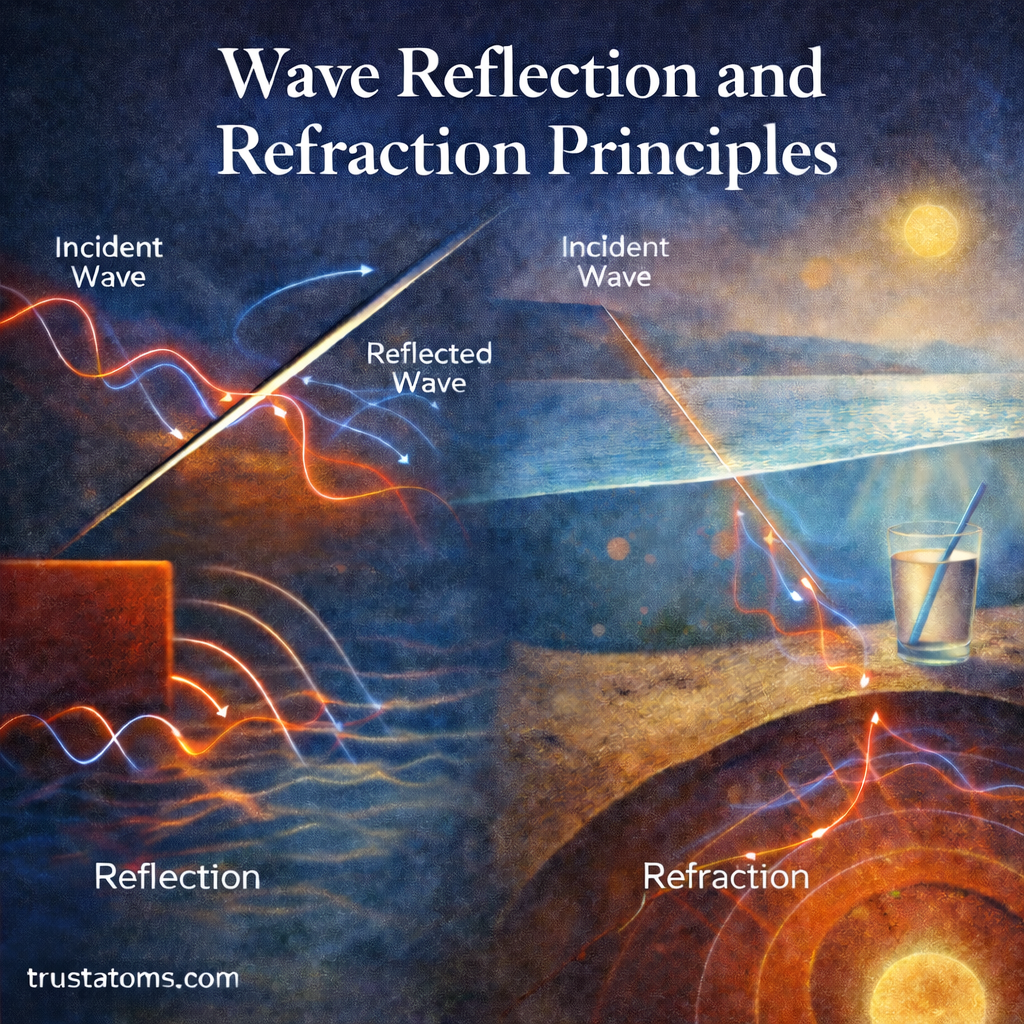
Waves rarely travel forever in a straight line. When they encounter boundaries or enter new materials, their behavior changes. Two of the most important wave behaviors in physics are reflection and refraction.
These principles apply to:
- Light waves
- Sound waves
- Water waves
- Seismic waves
- Electromagnetic waves
Understanding reflection and refraction explains mirrors, lenses, echoes, rainbows, fiber optics, and even earthquake analysis.
This guide breaks the concepts down clearly and systematically.
What Is Wave Reflection?
Reflection occurs when a wave strikes a boundary and bounces back into the original medium.
The wave does not pass through the boundary completely. Instead, part or all of its energy returns.
Common examples include:
- Light reflecting off a mirror
- Echoes from canyon walls
- Water waves bouncing off a dock
- Radar signals returning to a receiver
Law of Reflection
The law of reflection is simple and precise:
The angle of incidence equals the angle of reflection.
This means:
- The incoming wave strikes a surface at a certain angle.
- The reflected wave leaves at the same angle.
- Both angles are measured relative to a line perpendicular to the surface (called the normal).
This law applies to all types of waves.
Types of Reflection
Reflection depends on surface properties.
Specular Reflection
Occurs on smooth surfaces.
- Clear, sharp reflection
- Image formation possible
- Example: mirror or calm water
Diffuse Reflection
Occurs on rough surfaces.
- Light or sound scatters in many directions
- No clear image
- Example: paper, walls, rough terrain
Even when scattered, the law of reflection still holds at each microscopic surface point.
What Is Wave Refraction?
Refraction occurs when a wave changes direction as it passes from one medium into another.
This bending happens because the wave’s speed changes.
Important principle:
- Frequency stays the same
- Speed changes
- Wavelength adjusts accordingly
Refraction explains why objects underwater appear shifted or bent.
Why Waves Bend During Refraction
When a wave crosses a boundary at an angle:
- One side of the wave enters the new medium first.
- Its speed changes.
- The rest of the wave follows.
- The wavefront pivots, causing bending.
If the wave slows down in the new medium, it bends toward the normal.
If it speeds up, it bends away from the normal.
Refraction in Light Waves
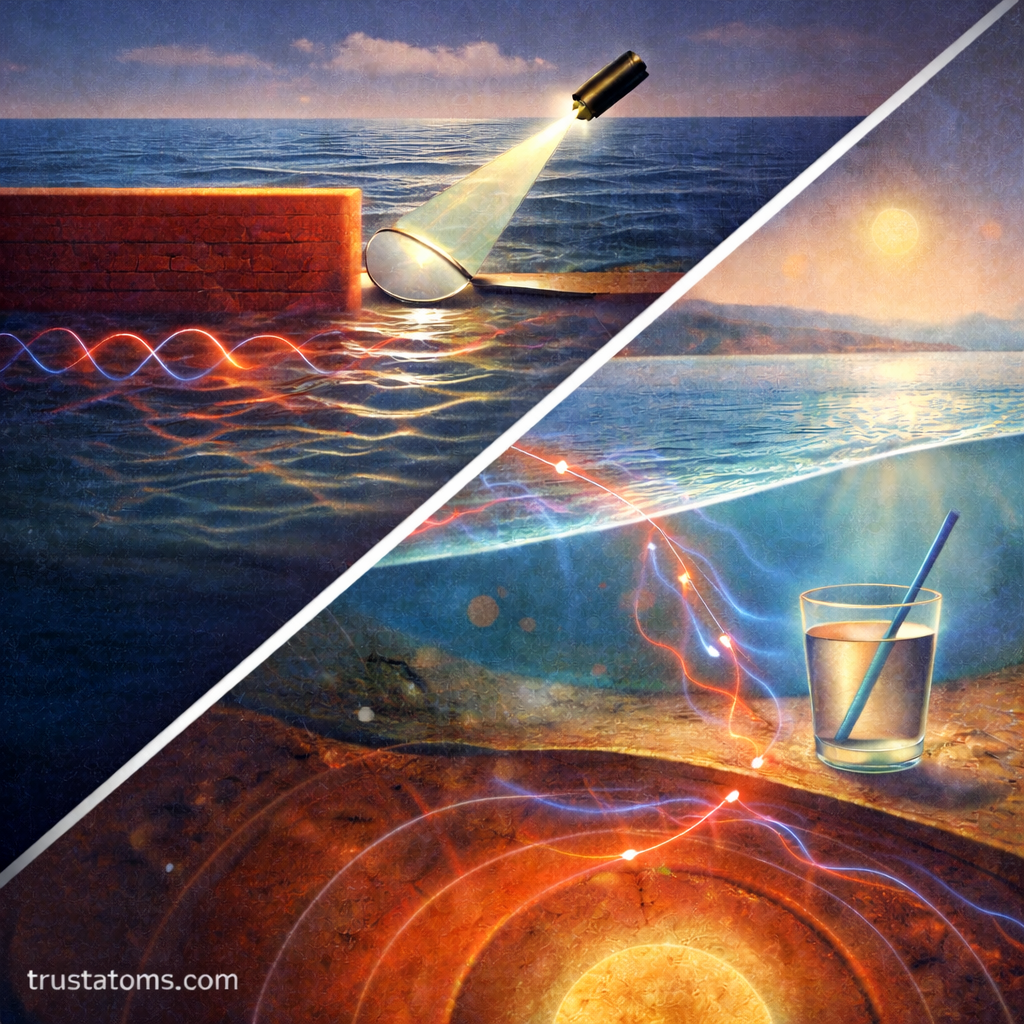
Light refraction is governed by how fast light travels in a material.
Different materials have different refractive indices.
Examples of refraction in action:
- A straw appearing bent in water
- Rainbows forming in raindrops
- Lenses focusing light
- Optical fiber transmission
The degree of bending depends on the change in speed between materials.
Refraction in Sound Waves
Sound also refracts.
Refraction in air commonly happens due to:
- Temperature differences
- Wind gradients
- Density variations
For example:
- Sound may travel farther at night because cooler air near the ground bends sound waves downward.
- Underwater sound bends toward cooler, denser layers.
Partial Reflection and Transmission
At most boundaries, waves do not fully reflect or fully transmit.
Instead:
- Some energy reflects
- Some energy transmits into the new medium
- The proportions depend on material properties
This behavior is crucial in:
- Medical ultrasound imaging
- Anti-reflective coatings
- Acoustic insulation
- Radio signal transmission
Total Internal Reflection
Total internal reflection occurs when a wave cannot pass into the second medium at all.
This happens when:
- A wave travels from a slower medium to a faster medium
- The incident angle exceeds a certain critical angle
Instead of refracting outward, the wave reflects completely inside the original medium.
Applications include:
- Fiber optic cables
- Endoscopes
- Prism-based instruments
This principle allows light to travel long distances with minimal loss.
Reflection and Refraction of Water Waves
Water waves clearly demonstrate both principles.
Reflection:
- Waves bounce off seawalls or cliffs
- Harbor design uses reflection principles to reduce damage
Refraction:
- Waves bend when moving from deep to shallow water
- Causes waves to align parallel to shorelines
This explains coastal wave patterns and beach erosion.
Reflection and Refraction of Seismic Waves
Seismic waves change direction and reflect inside Earth.
Scientists analyze:
- Reflected waves
- Refracted waves
- Travel times
This allows geophysicists to:
- Map Earth’s interior
- Detect oil and mineral deposits
- Study tectonic structures
Much of what we know about Earth’s core comes from wave behavior.
Key Differences Between Reflection and Refraction
Reflection:
- Occurs at a boundary
- Wave stays in original medium
- Angle in equals angle out
Refraction:
- Occurs when entering a new medium
- Wave speed changes
- Direction bends unless entering straight on
Both processes can happen simultaneously.
Real-World Applications
Understanding reflection and refraction enables:
- Designing mirrors and lenses
- Building telescopes and microscopes
- Engineering optical fiber networks
- Improving architectural acoustics
- Creating radar and sonar systems
- Studying earthquakes
These principles are foundational to physics and engineering.
Why These Principles Matter
Reflection and refraction reveal a deeper idea:
Waves respond to boundaries and material properties in predictable ways.
By understanding how waves interact with surfaces and media, we can:
- Control light
- Manage sound
- Transmit information
- Explore unseen environments
From rainbows in the sky to high-speed internet cables underground, reflection and refraction shape the modern world.
Key Takeaways
- Reflection occurs when waves bounce off a boundary.
- The angle of incidence equals the angle of reflection.
- Refraction occurs when waves change direction due to speed changes in a new medium.
- Frequency remains constant during refraction.
- Total internal reflection traps waves inside a medium.
- Both principles apply to light, sound, water, and seismic waves.
Wave reflection and refraction are universal behaviors that connect optics, acoustics, oceanography, and geophysics under one elegant framework.