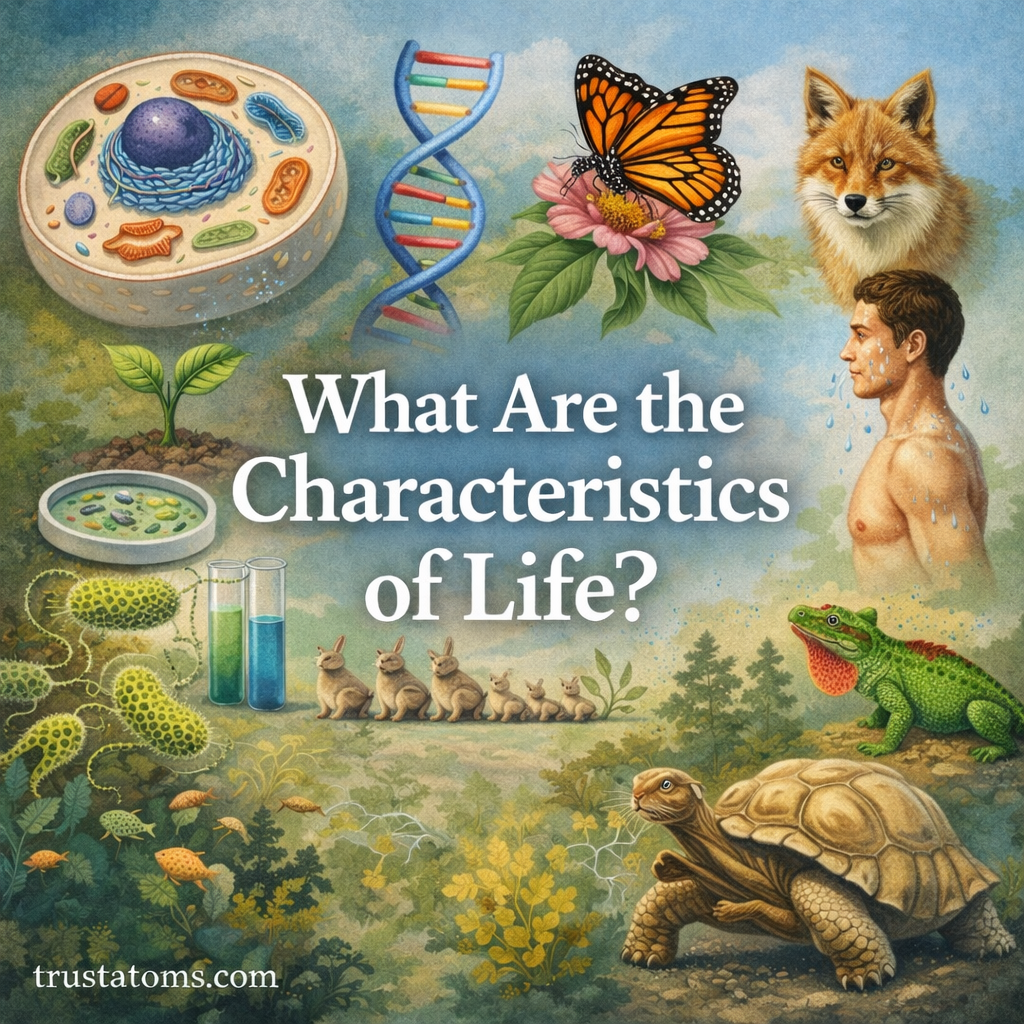
Life on Earth exists in an incredible range of forms, from microscopic bacteria to giant trees and complex animals. Despite their differences, all living organisms share certain fundamental traits that distinguish them from nonliving matter.
Biology identifies these shared traits as the characteristics of life. These characteristics describe the processes and features that allow organisms to survive, grow, and reproduce.
Understanding these characteristics helps scientists determine whether something is alive and how living systems function in nature.
What Defines Life?
Living things are organized systems that maintain internal stability, use energy, grow, reproduce, and adapt over time. No single characteristic alone defines life. Instead, life is identified by a combination of key biological traits.
Scientists generally recognize several core characteristics shared by all living organisms.
These include:
- Cellular organization
- Metabolism and energy use
- Homeostasis
- Growth and development
- Reproduction
- Response to stimuli
- Evolution and adaptation
Together, these traits form the foundation of life as studied in biology.
Cellular Organization
All living organisms are made of one or more cells. Cells are the smallest units capable of carrying out life processes.
There are two main types of organisms based on cellular structure:
Single-Celled Organisms
These organisms consist of only one cell that performs all life functions.
Examples include:
- Bacteria
- Amoebas
- Certain algae
Multicellular Organisms
These organisms contain many specialized cells that work together.
Examples include:
- Plants
- Animals
- Fungi
In multicellular organisms, cells organize into tissues and organs that perform specific functions.
Metabolism and Energy Use
Living organisms must obtain and use energy to maintain life. The chemical reactions that sustain life are known as metabolism.
Metabolism includes two major types of reactions:
Anabolism
These reactions build complex molecules from simpler ones.
Examples include:
- Protein synthesis
- Tissue growth
Catabolism
These reactions break down molecules to release energy.
Examples include:
- Digestion of food
- Cellular respiration
Energy allows organisms to grow, repair themselves, and perform daily functions.
Homeostasis
Homeostasis refers to the ability of organisms to maintain stable internal conditions, even when external environments change.
Examples of homeostasis include:
- Humans maintaining a constant body temperature
- Plants regulating water balance
- Cells controlling chemical concentrations
Without homeostasis, biological systems would quickly become unstable and unable to support life.
Growth and Development
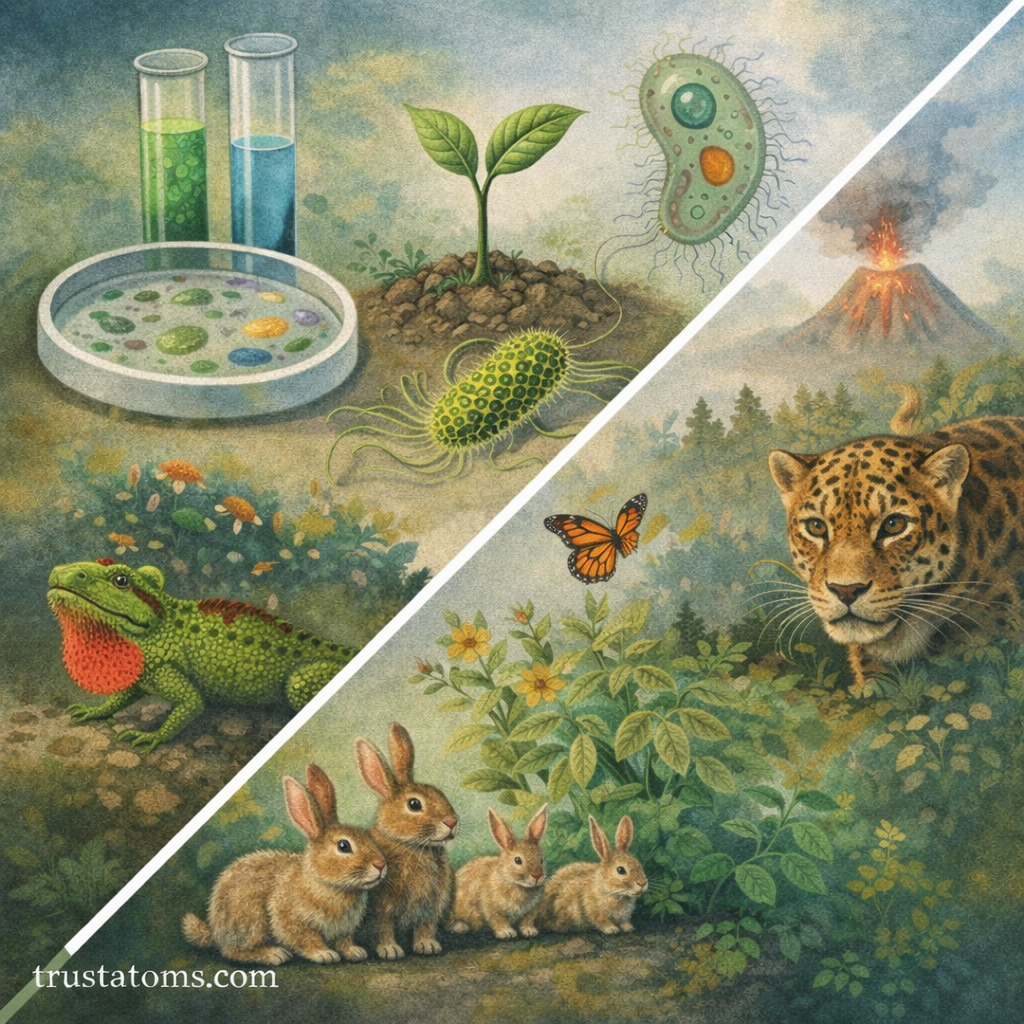
All living organisms grow and develop according to specific instructions encoded in their DNA.
Growth involves an increase in size or number of cells, while development refers to the changes an organism undergoes throughout its life cycle.
Examples include:
- A seed growing into a mature plant
- A caterpillar transforming into a butterfly
- Human growth from infancy to adulthood
These processes follow precise biological instructions stored in genetic material.
Reproduction
Reproduction allows organisms to produce new individuals and pass their genetic information to the next generation.
There are two primary types of reproduction:
Asexual Reproduction
A single organism produces offspring genetically identical to itself.
Examples include:
- Bacteria dividing by binary fission
- Certain plants growing new individuals from cuttings
Sexual Reproduction
Two parent organisms combine genetic material to produce offspring with genetic variation.
Examples include:
- Humans and most animals
- Many flowering plants
Reproduction ensures the continuation of species over time.
Response to Stimuli
Living organisms can detect and respond to changes in their environment. These changes are called stimuli.
Examples include:
- Plants bending toward light (phototropism)
- Animals reacting to temperature changes
- Humans withdrawing a hand from a hot surface
Responses to stimuli help organisms survive by adjusting their behavior or physiology to changing conditions.
Evolution and Adaptation
Over long periods of time, populations of organisms evolve through genetic changes and natural selection.
Evolution allows species to adapt to their environments.
Examples of adaptations include:
- Camouflage in animals
- Drought resistance in plants
- Specialized beaks in birds
These adaptations improve an organism’s chances of survival and reproduction.
Why the Characteristics of Life Matter
Understanding the characteristics of life helps scientists:
- Identify and classify living organisms
- Study ecosystems and biodiversity
- Understand disease and biological processes
- Search for life beyond Earth
- Develop new technologies in medicine and biotechnology
These traits provide the framework scientists use to explore the living world.
Final Thoughts
The characteristics of life describe the essential features shared by all living organisms. From cellular structure and metabolism to reproduction and evolution, these traits explain how living systems function and persist over time.
By studying these characteristics, biologists gain insight into the complexity of life and the processes that sustain living organisms on Earth.