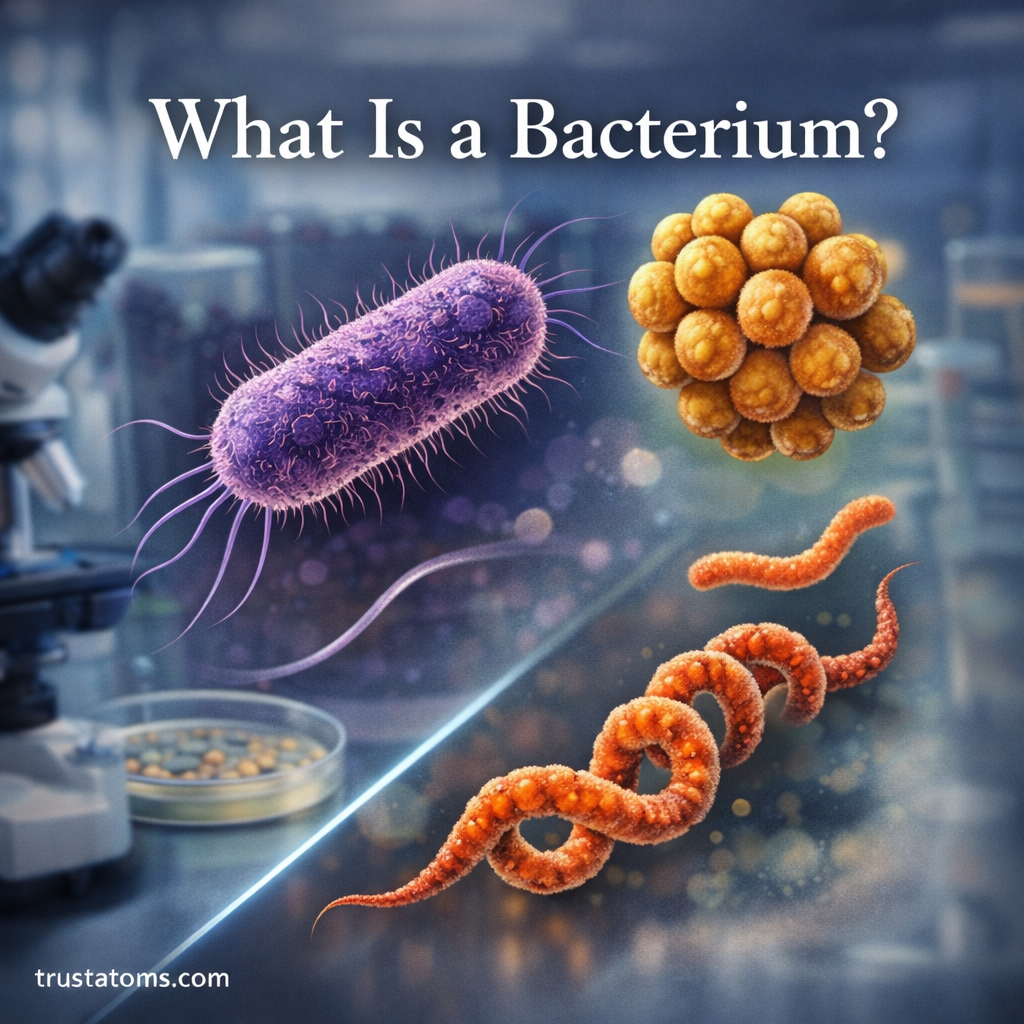
A bacterium is a single-celled microscopic organism that belongs to a group of life forms known as bacteria. These organisms are among the simplest and most abundant living things on Earth. Despite their tiny size, bacteria play essential roles in ecosystems, human health, food production, and biotechnology.
Bacteria exist almost everywhere — in soil, water, air, extreme environments, and even inside the human body. Some bacteria cause disease, but many are beneficial and necessary for life.
Definition of a Bacterium
A bacterium (plural: bacteria) is a single-celled prokaryotic microorganism. This means it does not have a nucleus or other membrane-bound organelles like more complex cells do.
Instead, its genetic material floats freely inside the cell.
Key characteristics of bacteria include:
- Single-celled organisms
- Lack of a nucleus
- Small size (usually 0.5–5 micrometers)
- Ability to reproduce quickly
- Wide environmental adaptability
Because of their simplicity and rapid reproduction, bacteria can evolve and adapt quickly to changing conditions.
Basic Structure of a Bacterial Cell

Although bacteria are simple compared to plant or animal cells, they still have several important structures.
Cell Wall
The cell wall surrounds the bacterium and gives it shape and protection. It also helps the cell maintain its structure in different environments.
Cell Membrane
Inside the cell wall is the cell membrane, which controls what enters and leaves the cell. It acts as a protective barrier and plays a role in energy production.
Cytoplasm
The cytoplasm is a gel-like fluid inside the cell where chemical reactions take place. It contains enzymes, nutrients, and ribosomes used to produce proteins.
DNA (Nucleoid Region)
Bacteria do not have a nucleus. Instead, their genetic material exists in a region called the nucleoid, where a circular DNA molecule stores the cell’s genetic instructions.
Flagella and Pili
Some bacteria have additional structures that help them interact with their environment:
- Flagella – tail-like structures used for movement
- Pili – hair-like structures that help bacteria attach to surfaces or exchange genetic material
Shapes of Bacteria
Bacteria come in several common shapes. These shapes help scientists classify and identify them.
Cocci
Cocci are spherical bacteria that appear round under a microscope.
Examples include:
- Streptococcus
- Staphylococcus
Bacilli
Bacilli are rod-shaped bacteria and are among the most common forms.
Examples include:
- Escherichia coli (E. coli)
- Bacillus species
Spirilla
Spirilla are spiral-shaped bacteria with a twisted or corkscrew-like appearance.
Examples include:
- Helicobacter pylori
- Spirillum species
Vibrio
Vibrio bacteria have a comma-like curved shape.
An example is:
- Vibrio cholerae, the bacterium responsible for cholera
How Bacteria Reproduce
Bacteria reproduce through a process called binary fission, a form of asexual reproduction.
The process involves:
- The bacterial DNA replicates
- The cell grows larger
- The cell splits into two identical daughter cells
Under favorable conditions, some bacteria can divide every 20 minutes, allowing populations to grow extremely quickly.
Where Bacteria Live
Bacteria are incredibly adaptable and can live in almost any environment on Earth.
Common habitats include:
- Soil
- Freshwater and oceans
- Air
- Human and animal bodies
- Plant surfaces
- Extreme environments like hot springs and deep-sea vents
Some bacteria, known as extremophiles, thrive in conditions that would kill most other organisms.
Beneficial Roles of Bacteria
Although bacteria often get attention for causing disease, most bacteria are beneficial.
Human Digestion
The human gut contains trillions of bacteria that help digest food and produce vitamins.
These bacteria are part of the human microbiome, which supports overall health.
Nutrient Recycling
Bacteria play a critical role in ecosystems by breaking down dead organisms and recycling nutrients back into the environment.
This process supports soil health and plant growth.
Food Production
Many foods depend on bacteria for fermentation.
Examples include:
- Yogurt
- Cheese
- Pickles
- Sauerkraut
Fermentation not only preserves food but also creates unique flavors and textures.
Biotechnology and Medicine
Bacteria are used in many scientific and industrial applications, including:
- Producing antibiotics
- Manufacturing insulin
- Waste treatment
- Genetic engineering research
Modern biotechnology often relies on bacterial cells to produce important medicines.
Harmful Bacteria and Disease
Some bacteria can cause infectious diseases. These bacteria are known as pathogens.
Examples of bacterial diseases include:
- Tuberculosis
- Strep throat
- Cholera
- Food poisoning
Pathogenic bacteria can invade the body, release toxins, or damage tissues.
However, modern medicine uses antibiotics to treat many bacterial infections.
Bacteria and Antibiotic Resistance
A growing challenge in medicine is antibiotic resistance. This occurs when bacteria evolve the ability to survive drugs designed to kill them.
Factors contributing to antibiotic resistance include:
- Overuse of antibiotics
- Incomplete treatment courses
- Use of antibiotics in agriculture
Scientists are studying bacterial genetics and behavior to develop new treatments and strategies.
Why Bacteria Matter
Bacteria are essential to life on Earth. They influence ecosystems, health, agriculture, and industry.
Understanding bacteria helps scientists:
- Develop new medicines
- Improve food production
- Study ecosystems
- Address environmental challenges
- Understand microbial evolution
Although they are microscopic, bacteria shape the biological systems that sustain life on our planet.
Final Thoughts
A bacterium is one of the simplest forms of life, yet it plays a profound role in the natural world. From supporting digestion to driving ecological cycles and advancing biotechnology, bacteria are indispensable to life on Earth.
Studying bacteria helps scientists understand both the beneficial and harmful ways microorganisms interact with living systems. As research continues, bacteria will remain a central focus in medicine, environmental science, and biology.