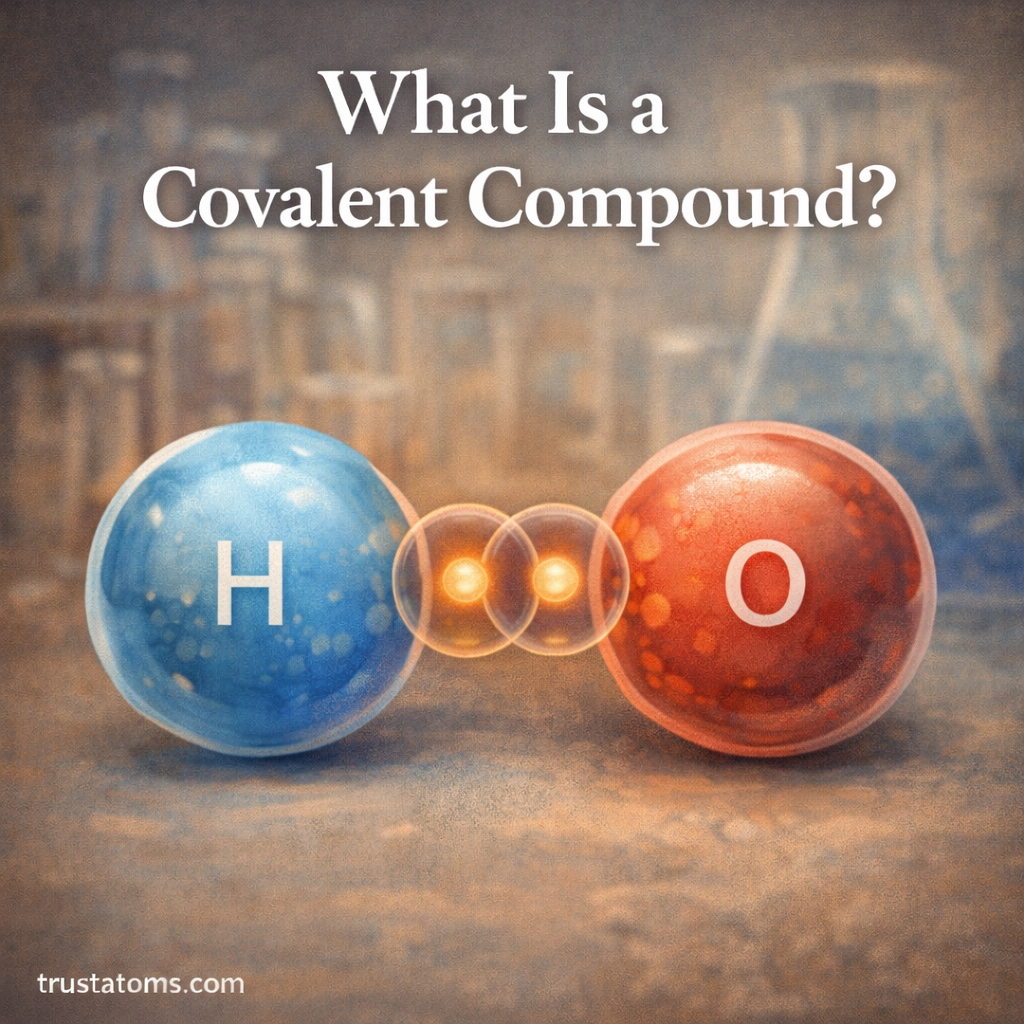
A covalent compound is a chemical compound formed when two or more nonmetal atoms share electrons. Instead of transferring electrons like ionic compounds do, covalent compounds are created through shared electron pairs that hold atoms together in stable molecules.
Covalent compounds make up many of the substances we encounter every day, including water, carbon dioxide, and methane. They are essential to biological systems, environmental chemistry, and many industrial processes.
Understanding covalent compounds helps explain how atoms bond together and how molecules form the building blocks of matter.
The Basic Idea of Covalent Bonding
Covalent compounds form when atoms share electrons in order to achieve stable electron configurations. Most atoms naturally seek a stable outer shell of electrons, often referred to as the octet rule.
Instead of giving up or gaining electrons, atoms involved in covalent bonding share one or more pairs of electrons.
This shared pair of electrons creates a covalent bond, which holds the atoms together in a molecule.
For example:
- Hydrogen atoms share electrons to form hydrogen gas.
- Oxygen atoms share electrons to form oxygen molecules.
- Hydrogen and oxygen share electrons to form water.
Which Elements Form Covalent Compounds?
Covalent compounds typically form between nonmetal elements on the periodic table.
These elements have similar electronegativity values, meaning neither atom strongly pulls electrons away from the other. Instead, they share electrons.
Common nonmetals that form covalent compounds include:
- Hydrogen
- Carbon
- Nitrogen
- Oxygen
- Sulfur
- Phosphorus
- Chlorine
Because these elements commonly bond with each other, covalent compounds are extremely widespread in nature.
How Covalent Compounds Form
Covalent compounds form through the sharing of electrons between atoms. This sharing allows each atom to reach a more stable electron arrangement.
The general process includes:
- Two nonmetal atoms approach each other.
- Each atom contributes one or more electrons.
- The electrons are shared between the atoms.
- A stable molecule forms.
Depending on how many electrons are shared, different types of covalent bonds can form.
Single Bonds
A single covalent bond occurs when two atoms share one pair of electrons.
Example: hydrogen molecules.
Double Bonds
A double covalent bond occurs when two pairs of electrons are shared.
Example: oxygen molecules.
Triple Bonds
A triple covalent bond occurs when three pairs of electrons are shared.
Example: nitrogen molecules.
The more electrons shared between atoms, the stronger the bond tends to be.
Properties of Covalent Compounds
Covalent compounds have several characteristic physical and chemical properties.
Common properties include:
- Lower melting and boiling points compared to ionic compounds
- Often exist as gases or liquids at room temperature
- Poor electrical conductivity
- Molecules held together by shared electrons
Because they do not contain freely moving ions, covalent compounds generally do not conduct electricity well.
Molecular Structure of Covalent Compounds
Covalent compounds exist as molecules, which are groups of atoms held together by covalent bonds.
These molecules can have different shapes depending on how the atoms share electrons.
Some common molecular structures include:
- Linear molecules
- Bent molecules
- Trigonal planar shapes
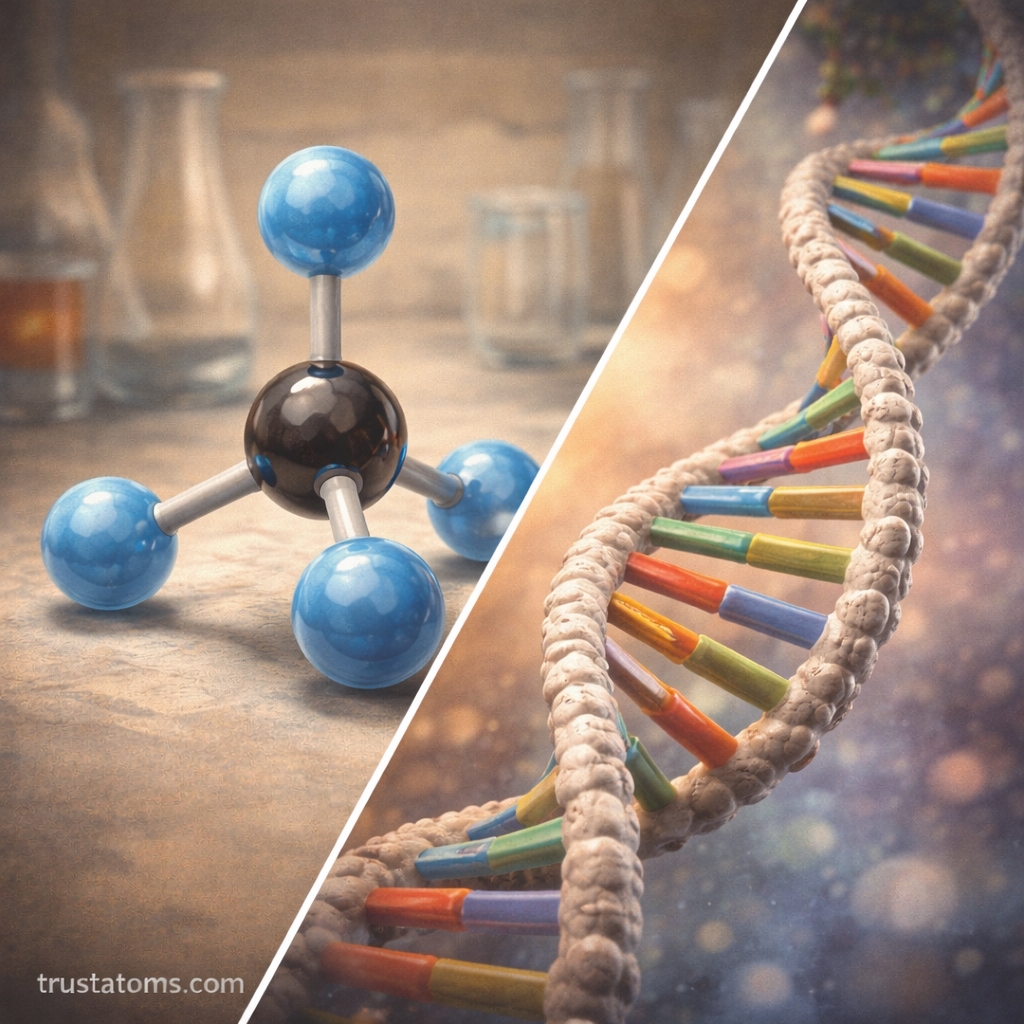
- Tetrahedral structures
The shape of a molecule influences its physical and chemical behavior, including how it interacts with other molecules.
Examples of Covalent Compounds
Many familiar substances are covalent compounds.
Examples include:
- Water
- Carbon dioxide
- Methane
- Ammonia
- Oxygen gas
These compounds play important roles in both natural and industrial systems.
For instance:
- Water is essential for life.
- Carbon dioxide is involved in the carbon cycle.
- Methane is used as a fuel.
Covalent Compounds in Biology and Chemistry
Covalent compounds are especially important in biological systems. Many molecules that support life rely on covalent bonding.
Examples include:
- Proteins
- DNA
- Carbohydrates
- Lipids
Carbon is particularly important because it can form multiple covalent bonds, allowing it to create complex molecular structures.
This ability makes carbon the foundation of organic chemistry, which studies carbon-based compounds.
Covalent vs. Ionic Compounds
Covalent compounds are often compared with ionic compounds because they represent two different types of chemical bonding.
Key differences include:
Covalent compounds:
- Form between nonmetals
- Involve sharing of electrons
- Usually form molecules
Ionic compounds:
- Form between metals and nonmetals
- Involve transfer of electrons
- Form crystal lattices of charged ions
Both types of compounds are important for understanding how chemical substances form and interact.
Why Covalent Compounds Matter
Covalent compounds are essential to chemistry because they form the basis of many natural and synthetic substances.
They are important in areas such as:
- Biological systems
- Environmental chemistry
- Materials science
- Medicine and pharmaceuticals
- Industrial manufacturing
By studying covalent compounds, scientists can understand how molecules behave and how complex chemical systems develop.
Final Thoughts
Covalent compounds are formed when atoms share electrons to create stable molecules. This type of bonding typically occurs between nonmetal elements and leads to the formation of many important substances found in nature.
From water and oxygen to complex biological molecules like DNA, covalent compounds play a central role in chemistry and life itself. Understanding how these compounds form and behave provides a foundation for exploring the structure and function of matter.