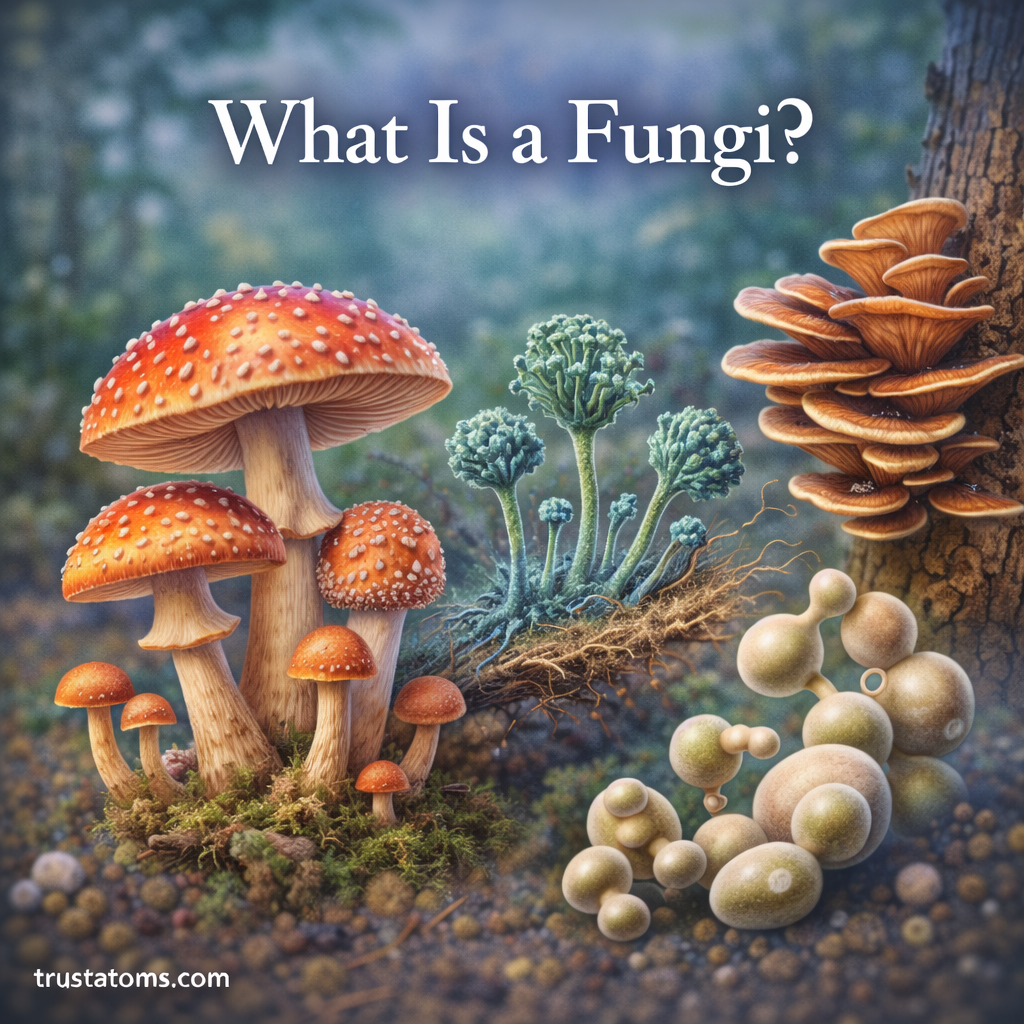
Fungi are a group of living organisms that include mushrooms, molds, yeasts, and other microscopic species. They belong to their own biological kingdom, separate from plants, animals, and bacteria. Fungi play essential roles in ecosystems by decomposing organic matter, recycling nutrients, and forming symbiotic relationships with plants and animals.
Although fungi often resemble plants, they differ in many important ways. For example, fungi do not perform photosynthesis and instead obtain nutrients by absorbing organic material from their surroundings.
Understanding fungi is an important part of biology, microbiology, medicine, and environmental science.
Definition of Fungi
Fungi are eukaryotic organisms that obtain nutrients by breaking down organic matter and absorbing the resulting molecules.
The term fungi refers to the plural form, while fungus refers to a single organism.
Key characteristics of fungi include:
- Cells with a nucleus (eukaryotic)
- Cell walls made of chitin
- Absorption of nutrients from external sources
- Reproduction through spores
- Growth as single cells or networks of filaments
Fungi range from microscopic organisms to large visible mushrooms.
The Kingdom Fungi
Fungi belong to the Kingdom Fungi, one of the major classifications of life.
This kingdom includes a wide range of organisms that share certain biological features.
Common groups of fungi include:
- Mushrooms
- Molds
- Yeasts
- Rusts and smuts
Scientists estimate that there may be millions of fungal species, though only a fraction have been formally identified.
Basic Structure of Fungi
Fungal organisms can have different structures depending on their species and environment.
Hyphae
Most fungi grow as long, thread-like structures called hyphae.
Hyphae are microscopic filaments that extend and branch as the fungus grows. These structures allow fungi to explore their environment and absorb nutrients.
Mycelium
A network of hyphae forms a structure called the mycelium.
The mycelium acts as the main body of the fungus and is responsible for:
- Nutrient absorption
- Growth
- Interaction with surrounding organisms
In soil ecosystems, mycelial networks can spread across large areas.
Fruiting Bodies
Some fungi produce visible reproductive structures known as fruiting bodies.
Examples include:
- Mushrooms
- Puffballs
- Bracket fungi
Fruiting bodies release spores that allow fungi to reproduce and spread.
How Fungi Obtain Nutrients
Unlike plants, fungi do not produce their own food through photosynthesis.
Instead, fungi use a process called external digestion.
The process works as follows:
- Fungi release digestive enzymes into their surroundings
- Organic material is broken down outside the cell
- Nutrients are absorbed through fungal cell walls
This method allows fungi to break down complex substances such as:
- Dead plants
- Animal remains
- Wood
- Organic waste
Types of Fungi
Fungi can be classified into several groups based on their structure and reproduction.
Mushrooms
Mushrooms are the visible fruiting bodies of certain fungi.
They often grow in soil, forests, or decaying organic material. Many mushrooms are edible, while others are toxic or poisonous.
Molds
Molds are fungi that grow as multicellular filaments.
They commonly grow on:
- Food
- Damp surfaces
- Organic debris
Molds play important roles in decomposition.
Yeasts
Yeasts are single-celled fungi.
They reproduce mainly through a process called budding.
Yeasts are widely used in:
- Baking
- Brewing
- Fermentation processes
Ecological Importance of Fungi
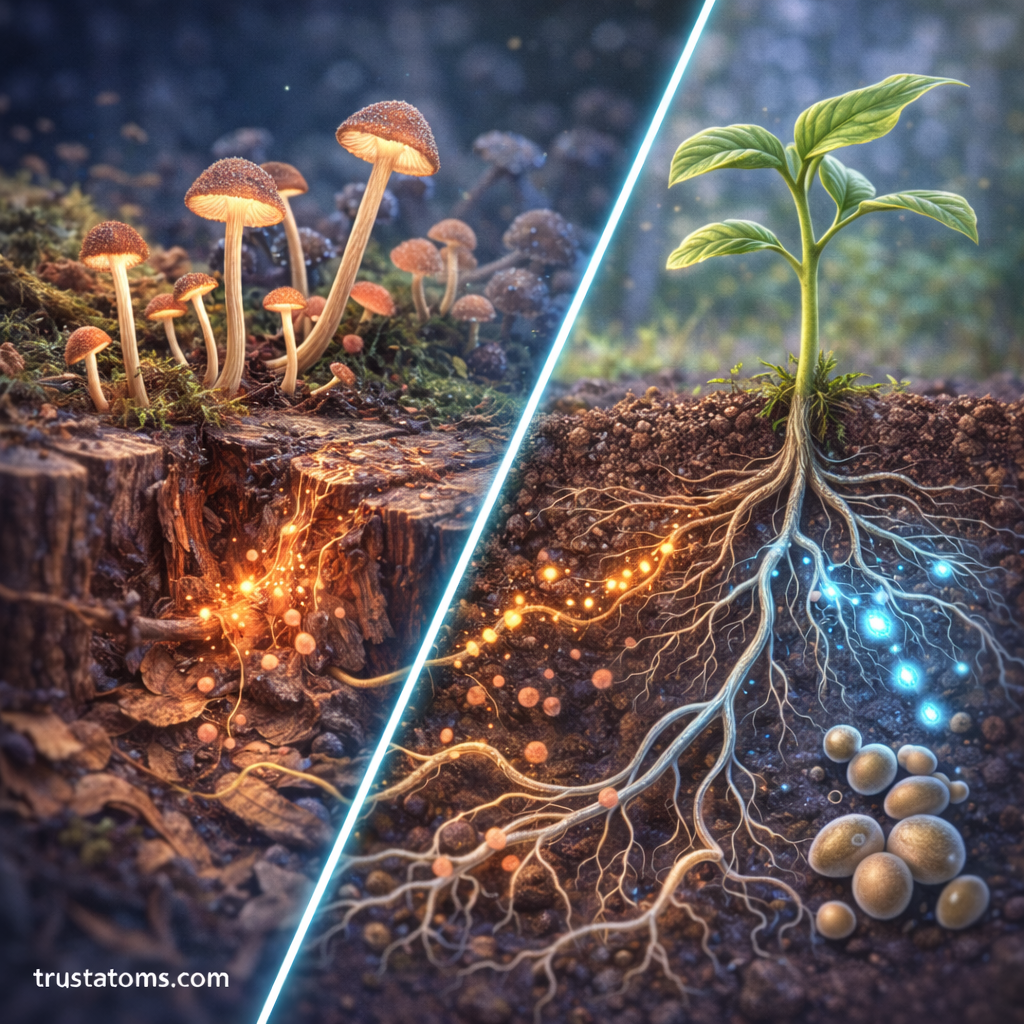
Fungi are essential for maintaining healthy ecosystems.
Decomposition
Fungi are among the most important decomposers in nature.
They break down dead plants and animals, releasing nutrients back into the environment.
Without fungi, organic waste would accumulate and nutrient cycles would slow dramatically.
Symbiotic Relationships
Many fungi form beneficial partnerships with other organisms.
One important example is mycorrhizae, a relationship between fungi and plant roots.
In this partnership:
- Fungi help plants absorb water and nutrients
- Plants provide sugars to the fungi
These relationships are critical for plant growth and soil health.
Food Webs
Fungi are also important parts of many food chains.
Some animals feed directly on fungi, while others depend on plants that rely on fungal partnerships.
Fungi and Human Life
Fungi affect human life in many ways, both positively and negatively.
Beneficial Uses
Fungi are used in several industries and scientific fields.
Examples include:
- Production of antibiotics (such as penicillin)
- Fermentation of foods and beverages
- Biotechnology research
- Agriculture and soil health
Fungi have also become important in modern medicine and pharmaceutical research.
Harmful Effects
Some fungi can cause problems for humans, plants, and animals.
Examples include:
- Crop diseases
- Food spoilage
- Fungal infections in humans
Common fungal infections include:
- Athlete’s foot
- Ringworm
- Yeast infections
However, most fungal species are harmless or beneficial.
Differences Between Fungi and Plants
Fungi were once classified as plants, but scientists now recognize key differences.
| Feature | Fungi | Plants |
|---|---|---|
| Nutrition | Absorb nutrients | Photosynthesis |
| Cell wall | Chitin | Cellulose |
| Chlorophyll | None | Present |
| Energy source | Organic matter | Sunlight |
These differences place fungi in their own unique kingdom of life.
Why Studying Fungi Matters
The study of fungi, known as mycology, is important for many areas of science.
Researchers study fungi to:
- Understand ecosystems
- Develop medicines
- Improve agriculture
- Study disease
- Explore biotechnology applications
Because fungi interact with so many biological systems, they remain a major focus of biological research.
Final Thoughts
Fungi are incredibly diverse organisms that play vital roles in nature and human society. From recycling nutrients in ecosystems to producing medicines and foods, fungi contribute to life in ways that are both visible and microscopic.
By understanding what fungi are and how they function, scientists continue to uncover new insights into biology, medicine, and environmental science.