
In chemistry, the mole is a fundamental unit used to measure the amount of a substance. Rather than counting individual atoms or molecules one by one—which would be impossible due to their enormous numbers—scientists use the mole as a convenient way to measure large quantities of particles.
The mole allows chemists to connect the microscopic world of atoms and molecules with measurable quantities like mass and volume. Understanding this concept is essential for studying chemical reactions, formulas, and laboratory measurements.
The Basic Definition of a Mole
A mole represents a specific number of particles.
One mole contains:
6.022 × 10²³ particles
This number is called Avogadro’s number. It tells us how many atoms, molecules, ions, or other particles are present in one mole of a substance.
These particles can include:
- Atoms (such as helium atoms)
- Molecules (such as water molecules)
- Ions (such as sodium ions)
- Electrons or other particles in specialized contexts
Because atoms and molecules are extremely small, chemists use the mole to handle quantities that are practical to measure in experiments.
Why Chemists Use the Mole
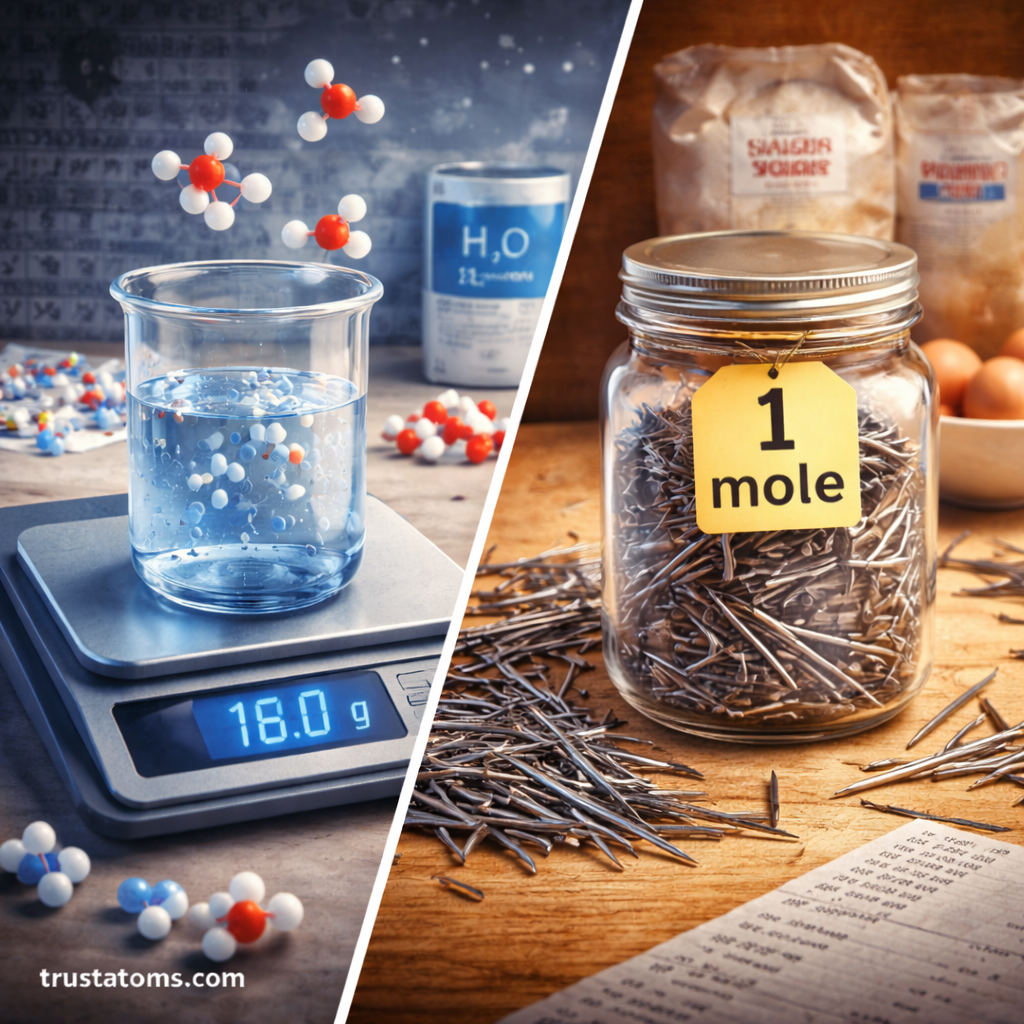
Chemical reactions occur when atoms and molecules interact in specific ratios. The mole allows chemists to count particles indirectly using mass.
For example:
- Instead of counting billions of water molecules
- A chemist can simply measure a specific mass of water that contains a known number of molecules
The mole provides a bridge between:
- Particle counts (atoms or molecules)
- Mass measurements (grams)
- Chemical equations
This connection makes it possible to calculate how substances react with one another.
Avogadro’s Number Explained
Avogadro’s number is one of the most important constants in chemistry.
Avogadro’s number:
6.022 × 10²³ particles per mole
This number is extremely large. To understand its scale:
- One mole of grains of sand would cover the entire Earth many times over.
- One mole of water molecules equals about 18 grams of water.
This constant allows scientists to convert between the number of particles and measurable laboratory quantities.
The Mole and Molar Mass
One of the most practical uses of the mole involves molar mass.
Molar mass is the mass of one mole of a substance, usually measured in grams per mole (g/mol).
The molar mass of a substance is determined from its chemical formula using atomic masses from the periodic table.
Examples include:
- Hydrogen (H): about 1 g/mol
- Oxygen (O): about 16 g/mol
- Water (H₂O): about 18 g/mol
This means:
- One mole of water molecules weighs about 18 grams
- One mole of oxygen atoms weighs about 16 grams
Using molar mass, chemists can easily convert between mass and the number of particles.
Example of a Mole in Chemistry
Consider water (H₂O).
Each water molecule contains:
- 2 hydrogen atoms
- 1 oxygen atom
One mole of water contains:
- 6.022 × 10²³ water molecules
This also means one mole of water contains:
- 1.204 × 10²⁴ hydrogen atoms
- 6.022 × 10²³ oxygen atoms
Even though these numbers are enormous, the mole allows scientists to work with them easily using measurable amounts.
How the Mole Is Used in Chemical Reactions
Chemical equations describe how substances react with one another.
The coefficients in chemical equations represent mole ratios.
For example, a reaction may indicate:
- 2 moles of hydrogen react with
- 1 mole of oxygen
- to produce 2 moles of water
This ratio helps chemists determine:
- How much reactant is needed
- How much product will form
- Whether a reaction has excess material
These calculations are part of a field called stoichiometry, which relies heavily on the mole concept.
Everyday Examples Related to the Mole
Although the mole is mainly used in chemistry labs, the concept can be compared to everyday counting units.
Just as we use:
- A dozen to represent 12 items
- A pair to represent 2 items
Chemists use the mole to represent 6.022 × 10²³ particles.
The difference is simply scale. The mole is designed to handle incredibly large numbers of microscopic particles.
Key Takeaways
- A mole is a unit used to measure the amount of a substance.
- One mole contains 6.022 × 10²³ particles, known as Avogadro’s number.
- The mole allows chemists to relate particle counts to measurable masses.
- Molar mass tells us the mass of one mole of a substance.
- The mole plays a critical role in chemical reactions and stoichiometry.
Understanding the mole provides a foundation for nearly every calculation in chemistry, helping scientists translate microscopic particle behavior into measurable quantities.