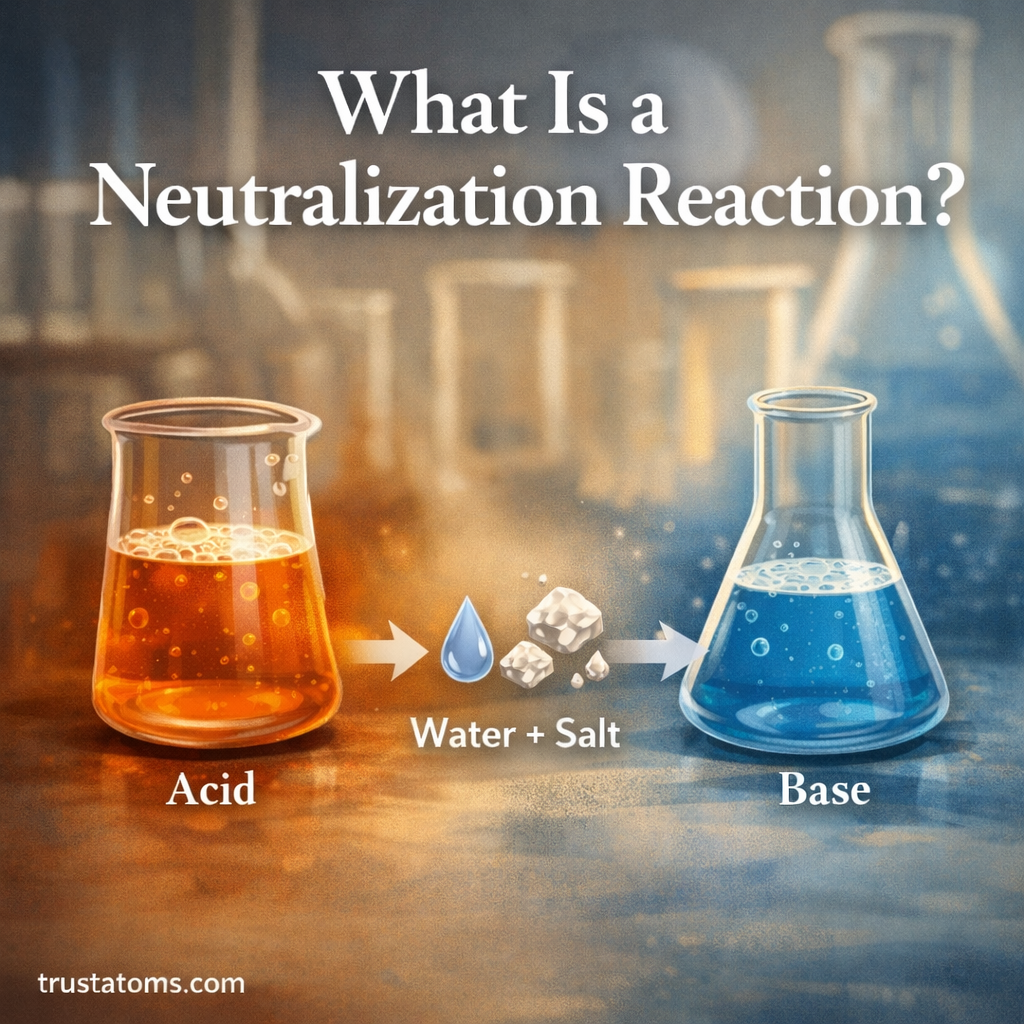
A neutralization reaction is a type of chemical reaction in which an acid and a base combine to produce water and a salt. This process reduces the acidic or basic properties of the substances involved, often bringing the solution closer to a neutral pH.
Neutralization reactions are an important part of chemistry because they occur in many natural processes, industrial applications, and everyday situations—from digestion in the human body to soil treatment in agriculture.
Understanding neutralization reactions helps explain how acids and bases interact and how chemical balance can be restored when solutions become too acidic or too basic.
The Basic Concept of Neutralization
A neutralization reaction occurs when hydrogen ions (H⁺) from an acid react with hydroxide ions (OH⁻) from a base.
When these ions combine, they form water.
At the same time, the remaining components of the acid and base combine to create a compound known as a salt.
In simple terms:
- Acid + Base → Water + Salt
This is the defining feature of a neutralization reaction.
How Neutralization Reactions Work
During the reaction, ions from the acid and base rearrange to form new substances.
The process generally follows these steps:
- The acid releases hydrogen ions (H⁺).
- The base releases hydroxide ions (OH⁻).
- The hydrogen and hydroxide ions combine to form water.
- The remaining ions form a salt.
Because the hydrogen ions and hydroxide ions cancel each other out, the solution becomes less acidic or less basic.
The Role of the pH Scale
Neutralization reactions directly influence the pH scale, which measures how acidic or basic a solution is.
The pH scale typically ranges from:
- 0–6: Acidic
- 7: Neutral
- 8–14: Basic (alkaline)
When neutralization occurs:
- The pH of an acidic solution increases.
- The pH of a basic solution decreases.
As the reaction progresses, the solution often moves closer to a neutral pH around 7.
Products of a Neutralization Reaction
Two main products result from neutralization reactions.
Water
Water forms when hydrogen ions from the acid combine with hydroxide ions from the base.
This is one of the key indicators that neutralization has occurred.
Salt
A salt is an ionic compound formed from the remaining ions of the acid and base.
Examples of salts produced in neutralization reactions include:
- Sodium chloride
- Calcium sulfate
- Potassium nitrate
Despite the name, not all salts are the same as table salt. In chemistry, the term refers to a wide variety of ionic compounds.
Examples of Neutralization in Everyday Life
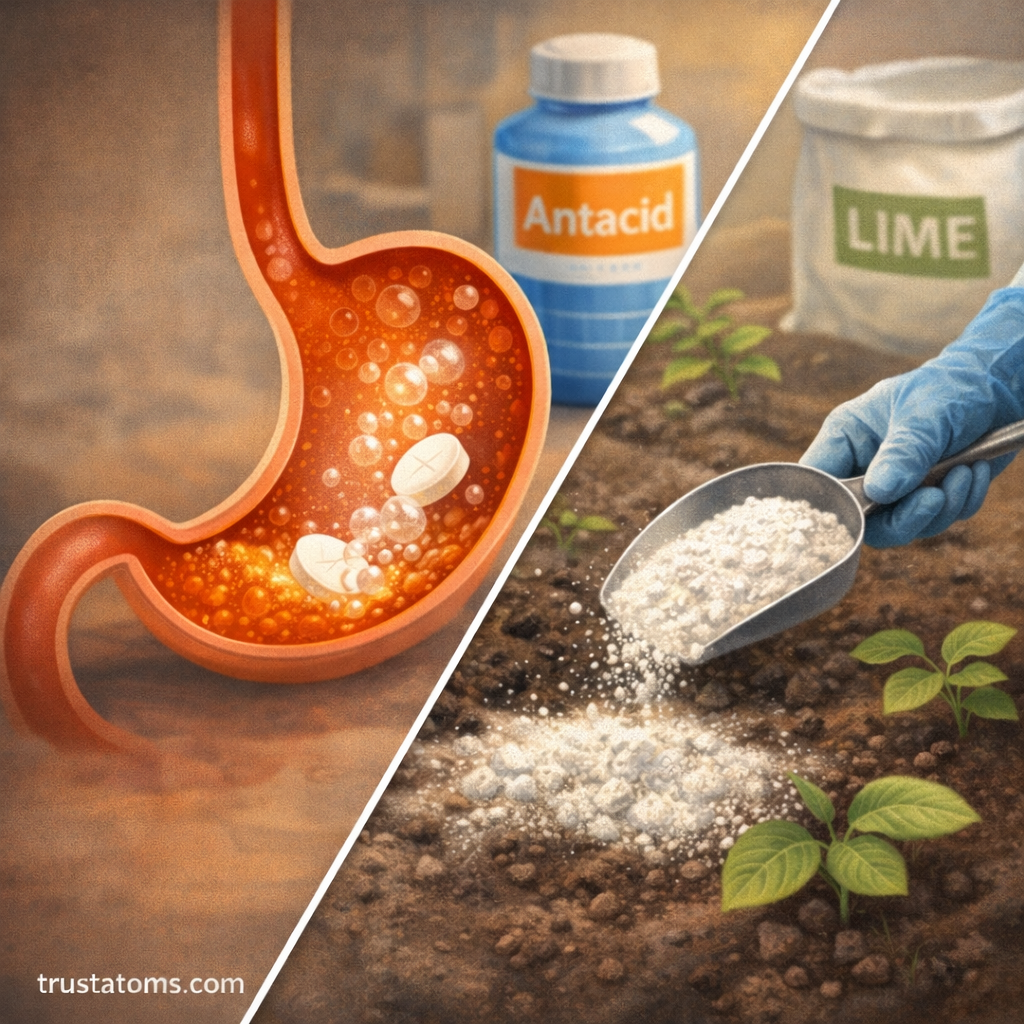
Neutralization reactions occur frequently in daily life and in natural systems.
Antacids and Stomach Acid
The stomach contains strong acid used to digest food.
Antacid tablets contain basic compounds that neutralize excess acid and help relieve heartburn.
Soil Treatment in Agriculture
Farmers often add lime to soil that has become too acidic.
The basic lime neutralizes the acidity and helps plants grow more effectively.
Wastewater Treatment
Industrial wastewater can contain acidic or basic chemicals.
Neutralization reactions are used to adjust the pH before the water is safely released into the environment.
Cleaning Products
Some household cleaning products use basic substances to neutralize acidic stains and residues.
Why Neutralization Reactions Are Important
Neutralization reactions play a key role in many scientific and practical applications.
They are important for:
- Maintaining balanced pH levels in natural ecosystems
- Producing salts and useful chemical compounds
- Treating industrial waste and pollution
- Supporting biological systems such as digestion
- Improving soil conditions for agriculture
Because acids and bases are common in many environments, neutralization reactions help regulate chemical balance across a wide range of systems.
Neutralization in Laboratory Experiments
In chemistry labs, neutralization reactions are often studied using titration experiments.
During a titration:
- A solution of known concentration is slowly added to another solution.
- Scientists monitor the pH change.
- The point at which the acid and base completely neutralize each other is called the equivalence point.
This technique helps chemists determine the concentration of unknown solutions.
Final Thoughts
Neutralization reactions are a fundamental type of chemical reaction that occur when acids and bases combine to produce water and a salt. These reactions reduce acidity or alkalinity and move solutions closer to neutral pH levels.
From digestion and agriculture to environmental protection and laboratory research, neutralization reactions play an essential role in maintaining chemical balance in both natural and human-made systems.
Understanding how these reactions work provides a strong foundation for learning more advanced concepts in chemistry.