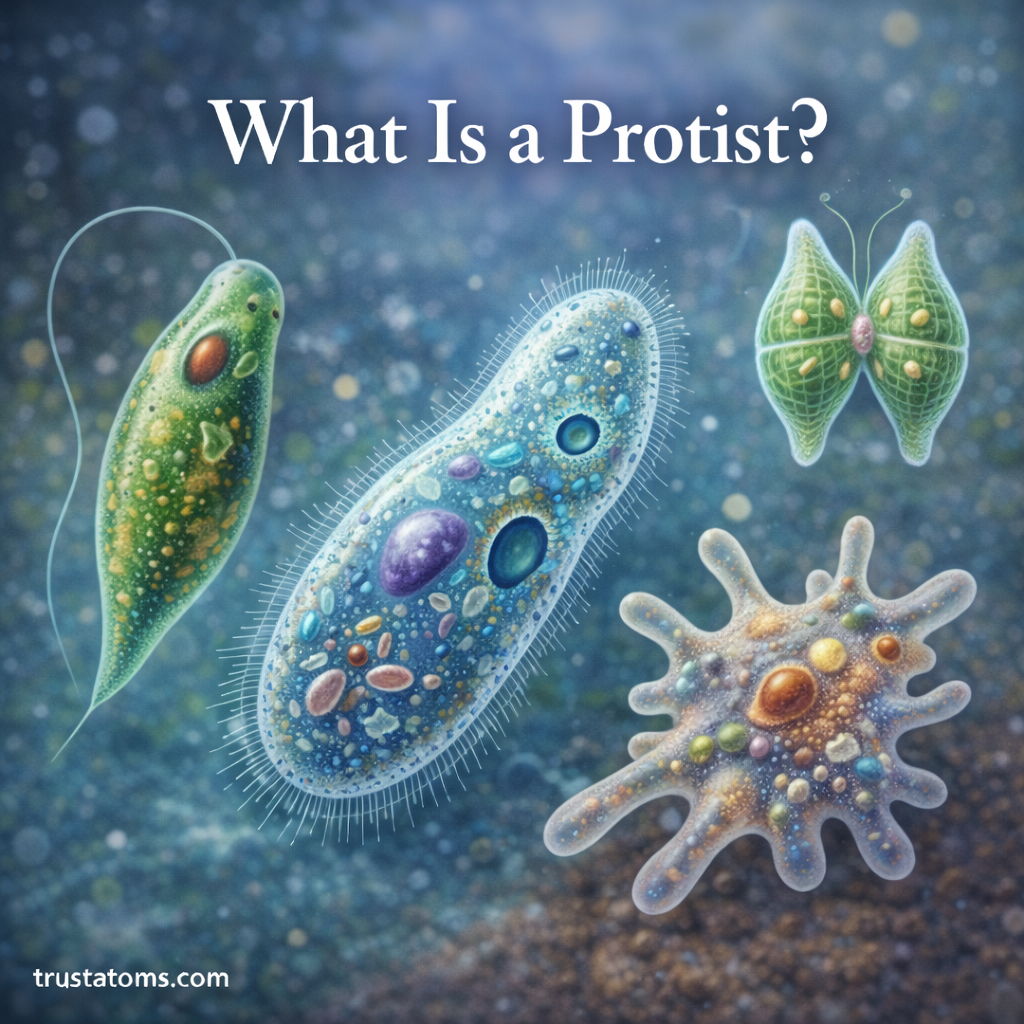
Protists are a diverse group of mostly microscopic organisms that belong to the kingdom Protista. They are eukaryotic organisms, meaning their cells contain a nucleus and other specialized structures called organelles. Protists are incredibly varied and include organisms that resemble plants, animals, and fungi.
Many protists live in aquatic environments such as oceans, lakes, and ponds, while others inhabit moist soil or live inside other organisms. Despite their diversity, most protists share one common trait: they are not classified as plants, animals, or fungi, but still belong to the broader domain of eukaryotic life.
Studying protists helps scientists better understand the evolution of complex life and the functioning of ecosystems.
Definition of a Protist
A protist is a eukaryotic organism that does not belong to the kingdoms Animalia, Plantae, or Fungi.
Most protists are single-celled, but some species are multicellular or form simple colonies.
Key characteristics of protists include:
- Cells with a nucleus (eukaryotic)
- Usually microscopic
- Found mostly in water or moist environments
- Highly diverse in structure and function
- Can be autotrophic or heterotrophic
Because of their diversity, protists are often described as a “catch-all” group for organisms that do not fit neatly into other biological kingdoms.
The Kingdom Protista
The kingdom Protista was created to classify organisms that share basic eukaryotic characteristics but differ significantly from plants, animals, and fungi.
Protists represent one of the earliest forms of eukaryotic life on Earth.
Scientists believe that more complex organisms evolved from ancient protist-like ancestors. Because of this, protists are extremely important in understanding biological evolution.
Examples of well-known protists include:
- Amoeba
- Paramecium
- Euglena
- Algae
- Plasmodium
Structure of Protist Cells
Protist cells contain many of the same structures found in other eukaryotic cells.
Nucleus
The nucleus stores the genetic material (DNA) that controls the cell’s activities.
This structure distinguishes protists from bacteria, which lack a nucleus.
Cell Membrane
The cell membrane surrounds the cell and regulates the movement of substances into and out of the organism.
It helps maintain the internal environment necessary for cellular functions.
Organelles
Protists may contain various organelles that carry out specific tasks.
Common organelles include:
- Mitochondria – produce energy
- Chloroplasts – perform photosynthesis in some protists
- Vacuoles – store nutrients and remove waste
- Contractile vacuoles – regulate water balance
These structures allow protists to perform many biological processes.
How Protists Move
Many protists can move through their environments using specialized structures.
Cilia
Cilia are tiny hair-like structures that beat rhythmically to move the organism through water.
Example: Paramecium
Flagella
Flagella are long whip-like appendages used for movement.
Example: Euglena
Pseudopodia
Some protists move using pseudopodia, which are temporary extensions of the cell.
Example: Amoeba
These extensions allow the organism to crawl along surfaces or capture food.
How Protists Obtain Nutrition
Protists obtain nutrients in several different ways depending on their species.
Photosynthesis
Some protists behave like plants and perform photosynthesis, using sunlight to produce food.
Examples include many types of algae.
Heterotrophic Feeding
Other protists obtain nutrients by consuming organic material or other microorganisms.
They may engulf food particles through processes such as phagocytosis.
Mixotrophic Nutrition
Some protists combine both strategies, performing photosynthesis when sunlight is available and consuming food when necessary.
This flexibility helps them survive in changing environments.
Types of Protists
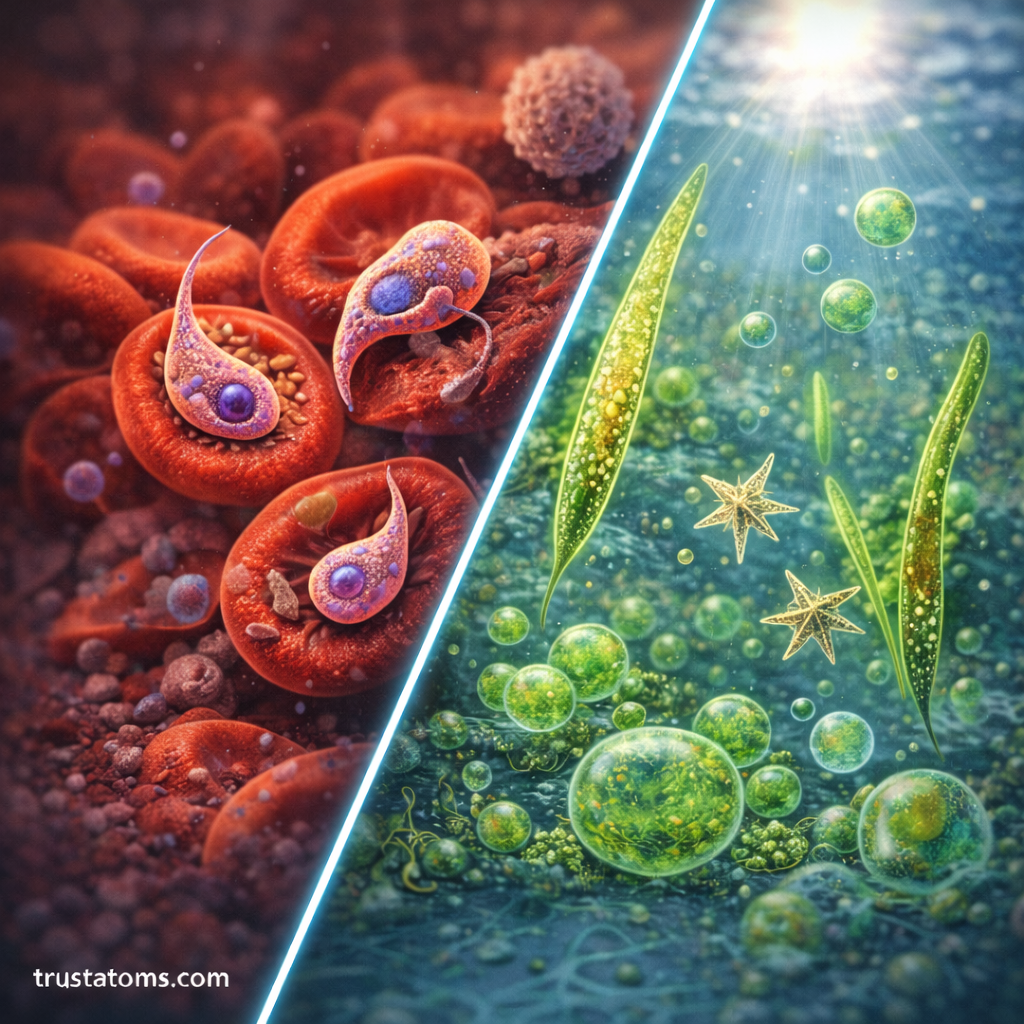
Protists are commonly grouped based on their nutritional methods and similarities to other organisms.
Animal-Like Protists (Protozoa)
These protists are heterotrophic and often move actively.
Examples include:
- Amoeba
- Paramecium
- Plasmodium
Some protozoa are parasites that cause diseases.
Plant-Like Protists (Algae)
Plant-like protists perform photosynthesis and produce oxygen.
Examples include:
- Diatoms
- Dinoflagellates
- Green algae
Algae are major producers in aquatic ecosystems.
Fungus-Like Protists
These protists obtain nutrients by absorbing organic matter.
Examples include:
- Slime molds
- Water molds
They often play roles in decomposition.
Ecological Importance of Protists
Protists are essential components of many ecosystems, especially aquatic environments.
Primary Producers
Photosynthetic protists such as algae form the base of aquatic food webs.
They produce large amounts of oxygen and provide food for many organisms.
Nutrient Cycling
Protists help recycle nutrients by breaking down organic matter and consuming bacteria.
This process supports healthy ecosystems.
Food Source for Other Organisms
Many small animals and microorganisms rely on protists as a food source.
Protists are a key link in the transfer of energy through ecosystems.
Protists and Human Health
Some protists can cause diseases in humans and animals.
Examples include:
- Plasmodium – causes malaria
- Giardia – causes intestinal infections
- Trypanosoma – causes sleeping sickness
However, most protists are harmless and play beneficial roles in ecosystems.
Why Studying Protists Matters
Studying protists helps scientists understand many important biological concepts.
Researchers study protists to:
- Learn about the evolution of complex cells
- Understand microbial ecosystems
- Study infectious diseases
- Explore biodiversity in aquatic environments
Protists also serve as important model organisms in scientific research.
Final Thoughts
Protists are a diverse and fascinating group of organisms that bridge the gap between simple microbes and complex multicellular life. Although many protists are microscopic, their impact on ecosystems, evolution, and human health is enormous.
From producing oxygen in oceans to forming the base of aquatic food chains, protists play critical roles in sustaining life on Earth.