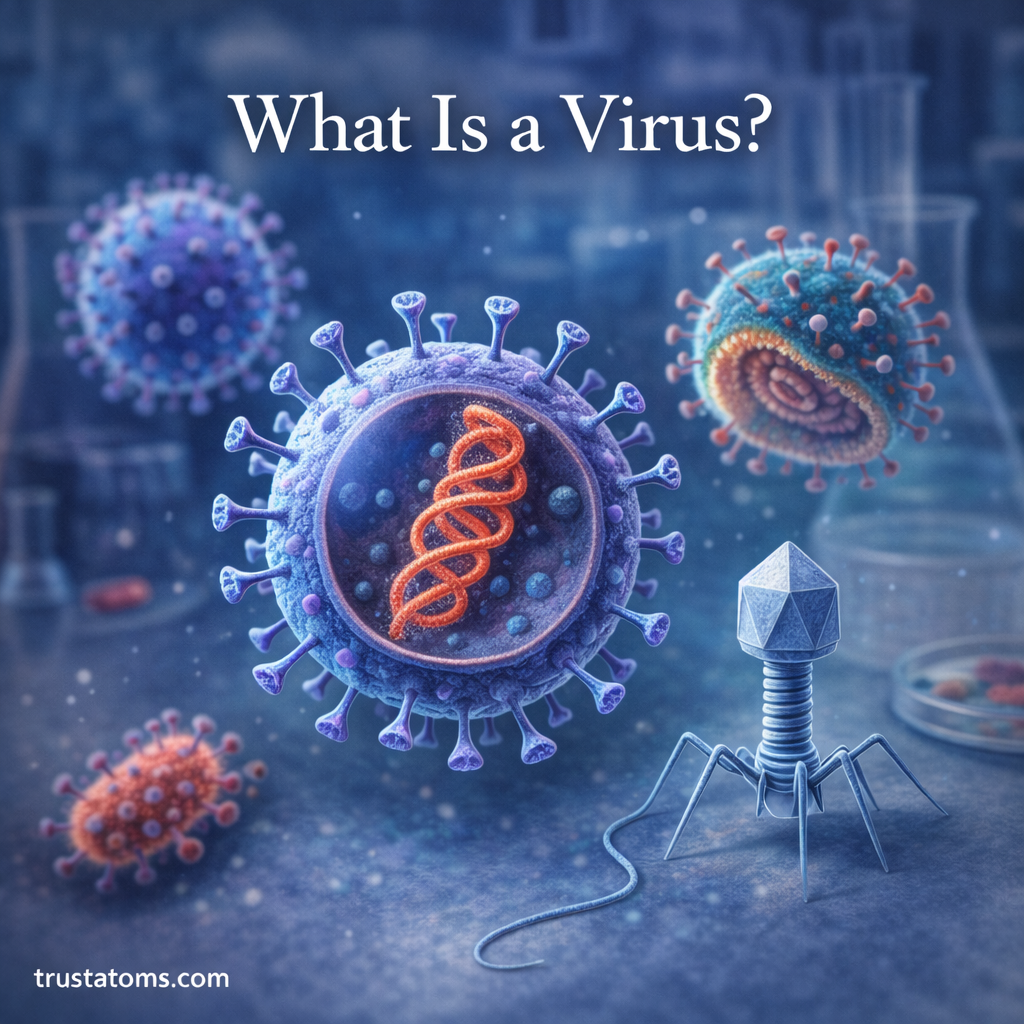
A virus is an extremely small infectious particle that can only reproduce inside the cells of living organisms. Viruses infect animals, plants, fungi, bacteria, and even other microorganisms. Because they cannot grow or reproduce independently, viruses are often described as being on the border between living and nonliving entities.
Viruses play important roles in biology, medicine, and ecology. Some viruses cause diseases in humans and animals, while others influence ecosystems or are used in scientific research and biotechnology.
Definition of a Virus
A virus is a microscopic infectious agent made primarily of genetic material and a protective protein coat. Unlike bacteria or other cells, viruses lack the cellular structures needed to carry out life processes on their own.
Key characteristics of viruses include:
- Extremely small size (much smaller than bacteria)
- Contain either DNA or RNA as genetic material
- Require a host cell to reproduce
- Lack cellular organelles
- Cannot perform metabolism independently
Because viruses depend entirely on host cells, they are often referred to as obligate intracellular parasites.
Basic Structure of a Virus
Although viruses vary widely in shape and complexity, most share a similar basic structure.
Genetic Material
At the core of every virus is genetic material, which contains the instructions needed to produce new virus particles.
This genetic material can be either:
- DNA (deoxyribonucleic acid)
- RNA (ribonucleic acid)
A virus contains only one type—never both.
Capsid (Protein Coat)
Surrounding the genetic material is a capsid, a protective protein shell.
The capsid:
- Protects the viral genetic material
- Helps viruses attach to host cells
- Plays a role in delivering viral genes into the host
Capsids are built from repeating protein units called capsomeres.
Viral Envelope (Some Viruses)
Some viruses have an additional outer layer known as a viral envelope.
This envelope is made from lipids taken from the host cell membrane during viral replication.
Enveloped viruses often have specialized proteins on their surface that help them recognize and enter host cells.
Examples of enveloped viruses include:
- Influenza virus
- HIV
- Coronavirus
Shapes of Viruses
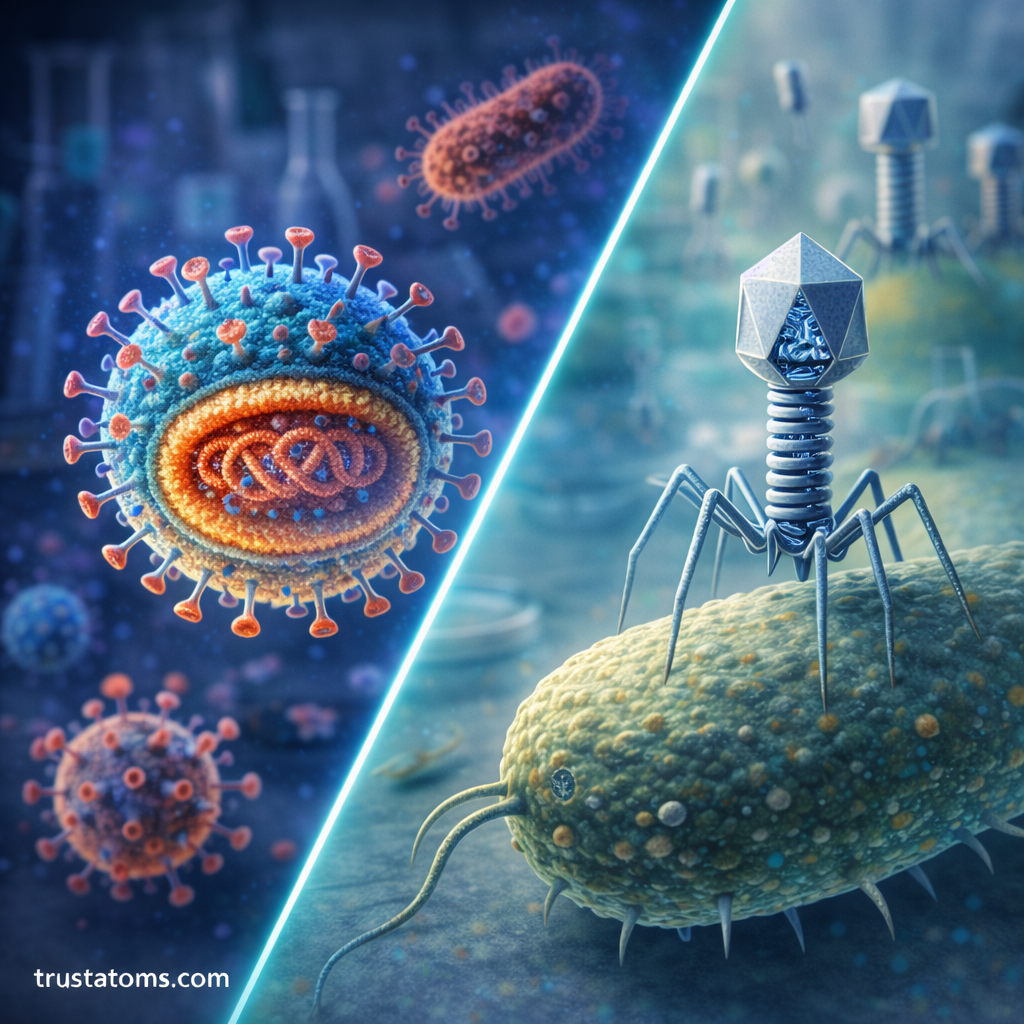
Viruses come in several structural shapes, which scientists use to classify them.
Helical Viruses
Helical viruses have a rod-like or spiral shape.
Examples include:
- Tobacco mosaic virus
Icosahedral Viruses
These viruses have a symmetrical, roughly spherical structure composed of triangular faces.
Examples include:
- Adenovirus
- Poliovirus
Complex Viruses
Some viruses have more complicated structures that do not fit into simple categories.
A well-known example is bacteriophages, viruses that infect bacteria. These viruses often have a head-and-tail structure used to inject genetic material into host cells.
How Viruses Infect Cells
Viruses reproduce through a process known as the viral replication cycle. This process requires a host cell.
The basic steps include:
- Attachment – The virus attaches to a specific receptor on the host cell.
- Entry – The virus or its genetic material enters the host cell.
- Replication – The viral genetic material takes control of the host cell’s machinery to produce viral components.
- Assembly – New virus particles are assembled inside the cell.
- Release – New viruses exit the cell to infect other cells.
This process can damage or destroy the infected cell.
How Viruses Spread
Viruses can spread in many ways depending on the type of virus.
Common transmission methods include:
- Respiratory droplets from coughing or sneezing
- Direct physical contact
- Contaminated food or water
- Insect bites (such as mosquitoes)
- Bodily fluids
- Contact with infected surfaces
The mode of transmission often determines how easily a virus spreads in populations.
Viruses and Human Disease
Many viruses cause diseases in humans and animals.
Examples of viral diseases include:
- Influenza
- COVID-19
- Measles
- Rabies
- HIV/AIDS
- Chickenpox
Because viruses live inside host cells, treating viral infections can be more challenging than treating bacterial infections.
Unlike bacteria, viruses cannot be treated with antibiotics. Instead, antiviral medications and vaccines are used to prevent or control infections.
Beneficial Roles of Viruses
Although viruses are often associated with disease, they also play beneficial roles in science and ecosystems.
Gene Transfer
Viruses can move genes between organisms, contributing to genetic diversity and evolution.
Biotechnology and Medicine
Scientists use viruses in several advanced technologies, including:
- Gene therapy
- Vaccine development
- Cancer research
- Molecular biology studies
Modified viruses can deliver healthy genes into cells to treat certain genetic disorders.
Ecosystem Balance
Viruses also help regulate populations of microorganisms in oceans, soil, and other ecosystems.
By infecting and destroying microbial cells, viruses help maintain ecological balance and nutrient cycles.
Differences Between Viruses and Cells
Viruses differ significantly from living cells.
| Feature | Viruses | Cells |
|---|---|---|
| Structure | Not made of cells | Cellular structure |
| Genetic material | DNA or RNA | DNA |
| Metabolism | None | Active metabolism |
| Reproduction | Requires host cell | Independent reproduction |
| Size | Much smaller | Larger |
Because viruses lack independent life processes, scientists still debate whether they should be considered truly living organisms.
Why Studying Viruses Is Important
Understanding viruses is crucial in modern science and medicine.
Virology, the study of viruses, helps scientists:
- Develop vaccines
- Prevent viral outbreaks
- Understand genetic evolution
- Improve medical treatments
- Study molecular biology
Research on viruses has led to major advances in medicine and biotechnology.
Final Thoughts
Viruses are unique biological entities that exist at the boundary between living and nonliving systems. Despite their tiny size, they have enormous impacts on health, ecosystems, and scientific research.
By studying viruses, scientists gain insights into disease prevention, genetic processes, and the complex interactions between organisms and microscopic infectious agents.