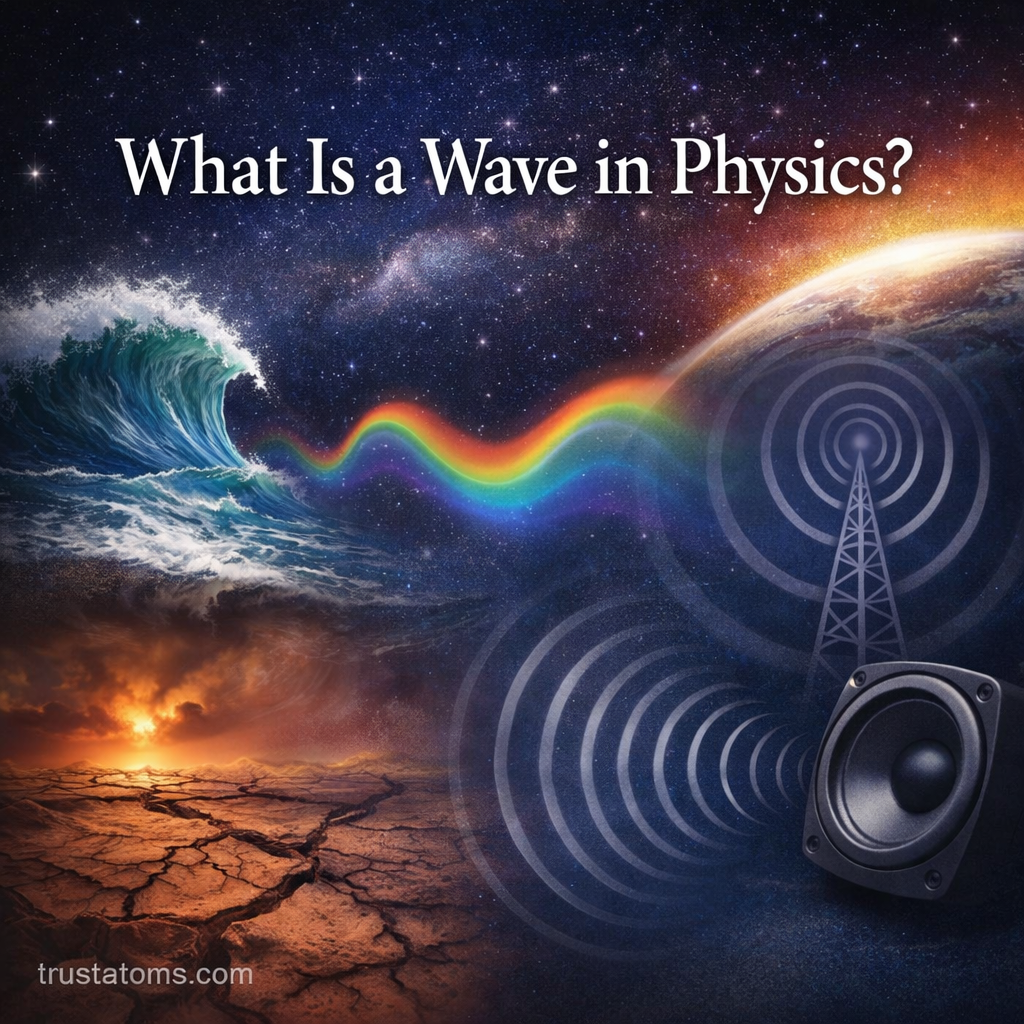
A wave is one of the most fundamental concepts in physics. From ocean swells and sound vibrations to light from the Sun, waves are everywhere.
In simple terms, a wave is a way that energy moves through space or through a medium without permanently moving the material itself.
In this guide, you’ll learn:
- The definition of a wave in physics
- The different types of waves
- How waves transfer energy
- Key wave properties
- Real-world examples
What Is a Wave?
In physics, a wave is a repeating motion that transfers energy from one place to another.
The important part is this:
A wave moves energy, not matter.
For example:
- Ocean waves move energy across the water’s surface.
- Sound waves move energy through the air.
- Light waves move energy through space.
The particles in the medium may vibrate, but they return to their original positions after the wave passes.
How Do Waves Transfer Energy?
Waves transfer energy through vibration.
Here’s how it works in simple steps:
- A source creates a disturbance (like dropping a rock into water).
- That disturbance causes nearby particles to move.
- Those particles affect neighboring particles.
- The energy continues moving outward.
Even though energy travels, the material itself does not travel long distances with the wave.
Think of a stadium wave at a sports game. The people don’t move around the stadium — they just stand up and sit down — but the wave moves around the arena.
The Two Main Types of Waves
In physics, waves are divided into two major categories:
1. Mechanical Waves
Mechanical waves require a medium (something to travel through).
Examples include:
- Sound waves (travel through air, water, or solids)
- Ocean waves (travel through water)
- Seismic waves (travel through Earth)
Without a medium, mechanical waves cannot exist.
For example, there is no sound in outer space because there is no air for sound waves to travel through.
2. Electromagnetic Waves
Electromagnetic waves do not require a medium.
They can travel through empty space.
Examples include:
- Radio waves
- Microwaves
- Infrared
- Visible light
- Ultraviolet
- X-rays
- Gamma rays
Light from the Sun reaches Earth through the vacuum of space because it is an electromagnetic wave.
Transverse vs. Longitudinal Waves

Waves can also be classified by how particles move.
Transverse Waves
In transverse waves, particles move perpendicular to the direction the wave travels.
Examples:
- Ocean surface waves
- Light waves
- Waves on a rope
These waves have visible crests (high points) and troughs (low points).
Longitudinal Waves
In longitudinal waves, particles move parallel to the direction of the wave.
The motion creates:
- Compressions (particles close together)
- Rarefactions (particles spread apart)
Sound waves are the most common example of longitudinal waves.
Key Properties of Waves
All waves share important characteristics:
Wavelength
The distance between repeating points in a wave, such as crest to crest.
Frequency
How many wave cycles pass a point per second.
Amplitude
The height of the wave from its rest position. Greater amplitude usually means more energy.
Wave Speed
How fast the wave travels through a medium or space.
These properties help scientists measure and describe wave behavior.
Real-Life Examples of Waves
Waves are part of everyday life:
- Music playing through speakers
- Wi-Fi signals connecting devices
- Earthquakes sending seismic waves
- Ocean tides and swells
- Light allowing us to see
Even the colors you see depend on different wavelengths of light.
Why Waves Matter in Physics
Understanding waves allows scientists and engineers to:
- Develop communication technologies
- Design medical imaging tools
- Predict earthquakes
- Study atoms and molecules
- Explore space
Wave theory is essential to modern physics, electronics, astronomy, and engineering.
Without waves, much of today’s technology would not exist.
Key Takeaways
- A wave is a repeating motion that transfers energy.
- Waves move energy, not matter.
- Mechanical waves require a medium.
- Electromagnetic waves can travel through space.
- Waves have properties like wavelength, frequency, amplitude, and speed.
Once you understand waves, you begin to see that energy movement is one of the most powerful patterns in the universe.