An electric field is one of the most important ideas in physics. It explains how electric forces act across space — even when objects are not touching.
If you’ve ever wondered how charged particles “feel” a force from a distance, the answer is: through an electric field.
Let’s break it down in a simple and clear way.
The Basic Definition of an Electric Field
An electric field is:
A region around a charged object where other charged objects experience a force.
In other words, a charged particle creates an invisible influence in the space around it. Any other charge placed in that region will feel a push or pull.
Electric fields explain how electricity works at a fundamental level.
Who Discovered the Concept?
The modern understanding of electric fields was developed by scientists like Michael Faraday and later mathematically refined by James Clerk Maxwell.
Faraday introduced the idea of “field lines” to visualize invisible forces, while Maxwell created equations that describe how electric and magnetic fields behave.
Their work forms the foundation of classical electromagnetism.
How Electric Fields Work
Every charged object creates an electric field around it.
There are two types of electric charge:
- Positive charge
- Negative charge
The electric field behaves differently depending on the type of charge.
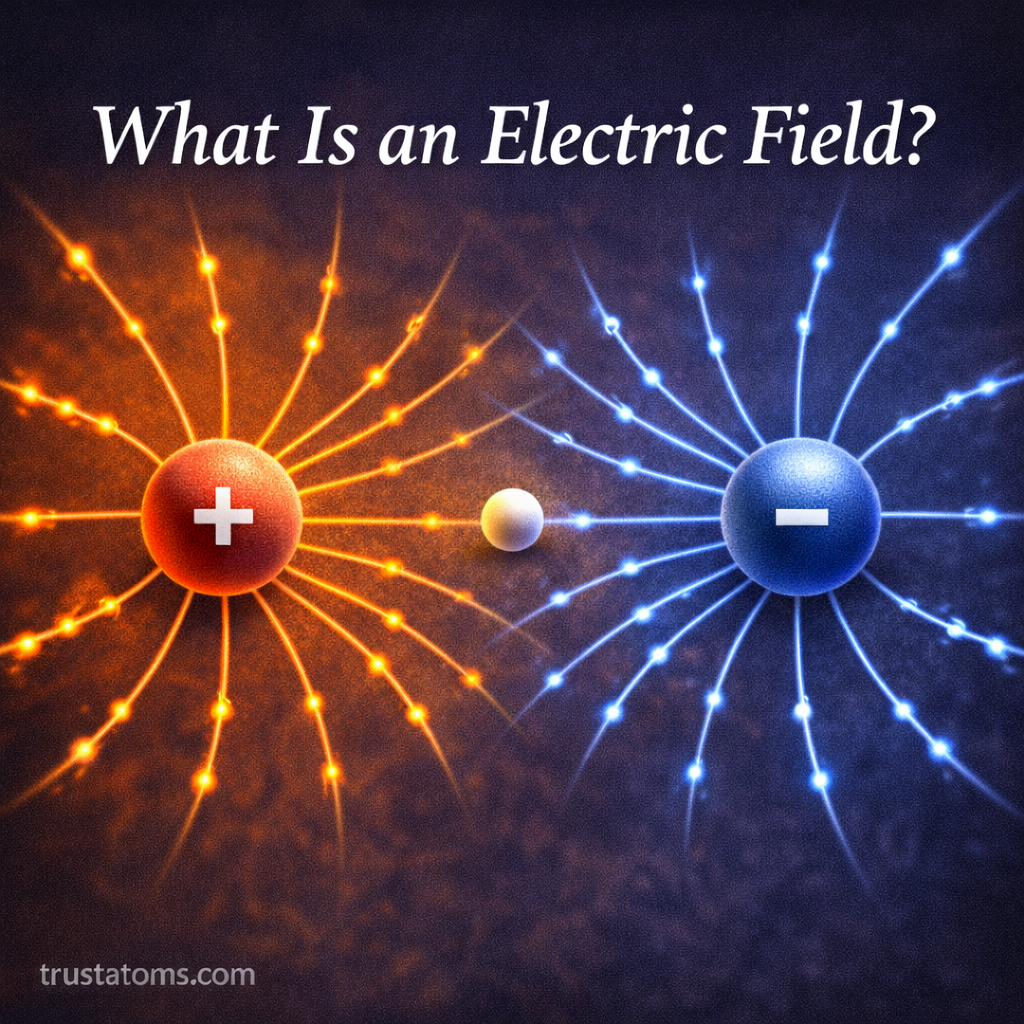
Around a Positive Charge
- Field lines point outward.
- A positive test charge would be pushed away.
Around a Negative Charge
- Field lines point inward.
- A positive test charge would be pulled toward it.
The direction of an electric field is defined as the direction a positive test charge would move.
Electric Field Strength
Electric fields have both:
- Magnitude (how strong they are)
- Direction
The strength of an electric field depends on:
- The amount of charge creating it
- The distance from the charge
Key idea:
- Closer to the charge → stronger field
- Farther from the charge → weaker field
This explains why electric forces decrease with distance.
Electric Field Lines
Electric field lines are a visual tool used to represent electric fields.
They follow three important rules:
- They start on positive charges and end on negative charges.
- They never cross each other.
- The closer the lines are together, the stronger the field.
These lines are not physical objects — they help us picture invisible forces.
Electric Fields and Force
The electric field determines the force experienced by a charge.
If you place a charge inside an electric field:
- It experiences a force.
- The direction depends on the sign of the charge.
- The strength depends on both the field and the charge amount.
This relationship explains how electric forces act without direct contact.
Everyday Examples of Electric Fields
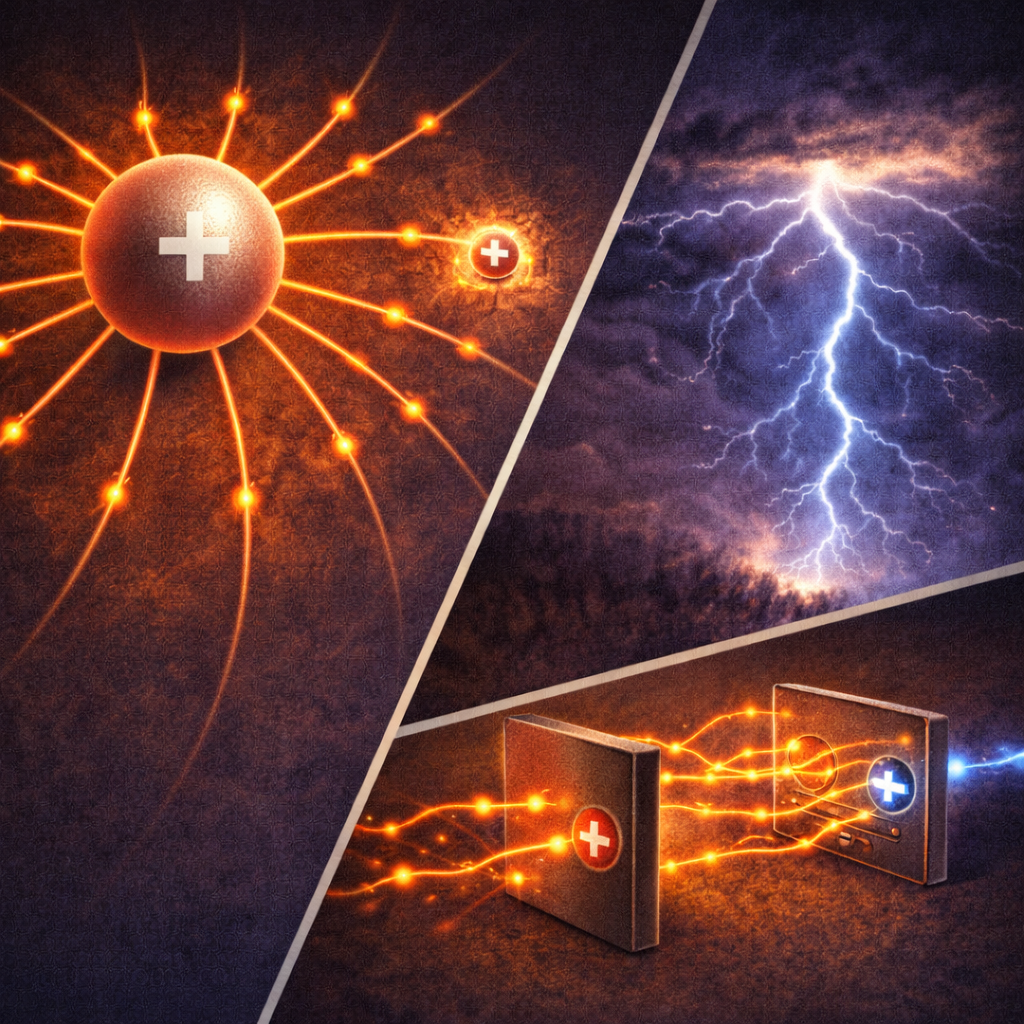
Electric fields are not just theoretical — they exist in real-world systems.
Static Electricity
When you rub a balloon on your hair:
- Charges build up.
- An electric field forms around the balloon.
- The balloon can attract small pieces of paper.
Capacitors
Capacitors store energy using electric fields between two plates.
They are found in:
- Phones
- Computers
- Power supplies
- Camera flashes
Lightning
Lightning is a dramatic example of electric fields.
- Large charge differences build up in clouds.
- The electric field becomes strong enough to cause a discharge.
- A massive spark forms between cloud and ground.
Electric Fields vs. Electric Force
It’s important to distinguish between the two:
- Electric field = the influence created by a charge
- Electric force = the push or pull felt by another charge
The field exists whether or not another charge is present.
The force only appears when another charge enters the field.
Electric Fields and Energy
Electric fields store energy.
This energy can be converted into:
- Motion
- Heat
- Light
- Electrical current
For example:
- Batteries create electric fields that push charges through circuits.
- Power plants generate electric fields that drive large-scale electrical systems.
Why Electric Fields Matter
Electric fields are essential for understanding:
- How circuits work
- How atoms interact
- How electromagnetic waves travel
- How electronics operate
- How energy is transmitted
They are one of the core concepts that connect electricity and magnetism into a unified theory.
Without electric fields, modern physics and electrical engineering would not exist.
Common Misconceptions About Electric Fields
Here are a few misunderstandings:
“Electric fields are visible.”
They are invisible. We use diagrams and field lines to represent them.
“Electric fields only exist when current flows.”
Electric fields exist around any charged object — even if no current is present.
“Fields require contact.”
Electric fields act at a distance. No physical touching is required.
Simple Summary
An electric field is:
- A region around a charged object
- Responsible for electric forces
- Stronger closer to the charge
- Represented by field lines
- Fundamental to electromagnetism
It explains how electric charges influence each other across space.
Final Thoughts
The concept of the electric field changed physics forever. Instead of thinking of forces as mysterious actions at a distance, scientists realized that space itself can carry influence through fields.
Electric fields connect microscopic particles, power everyday electronics, and even create lightning storms.
Understanding electric fields gives you a deeper insight into how the universe works — from atoms to power grids.