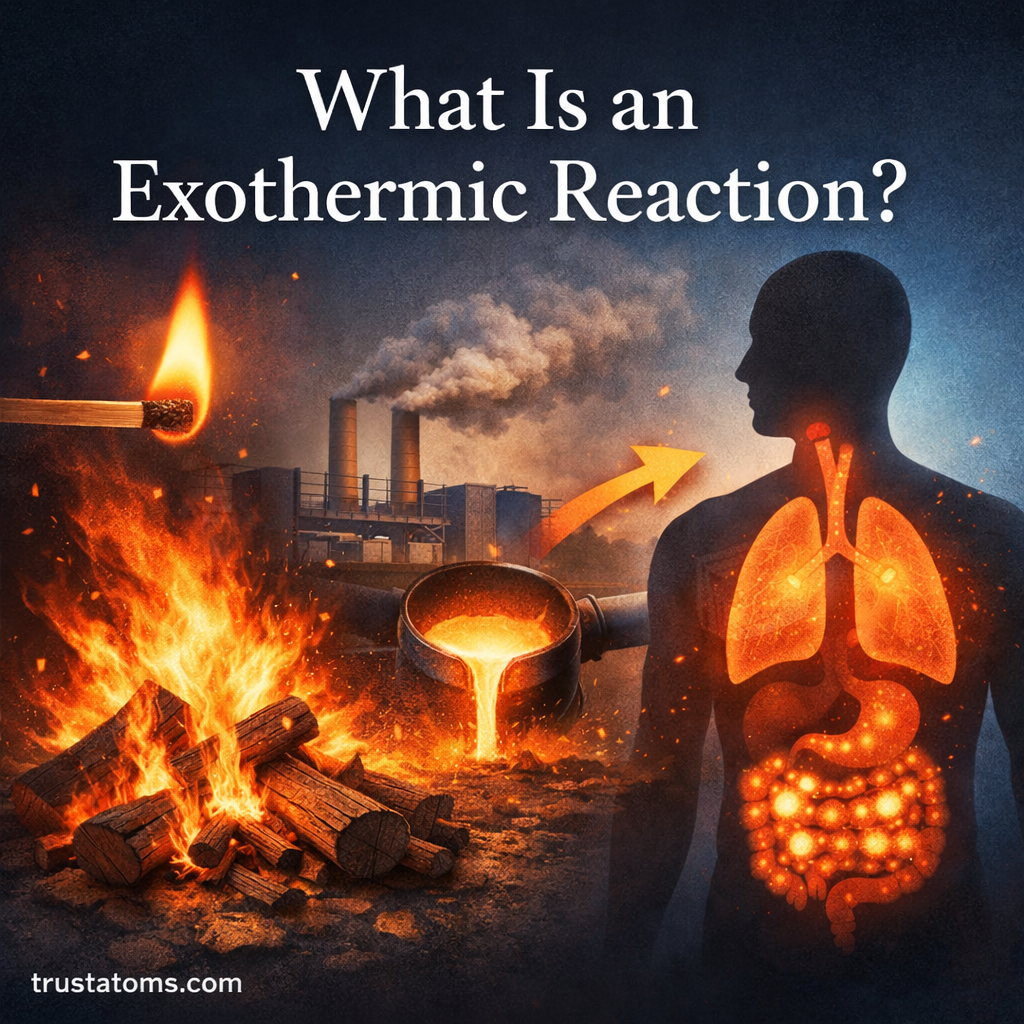
Exothermic reactions are chemical reactions that release energy into their surroundings, usually in the form of heat. These reactions are common in everyday life—from lighting a match to burning fuel in a car engine. In chemistry, understanding exothermic reactions helps explain how energy flows through chemical processes and why certain reactions occur spontaneously.
When an exothermic reaction takes place, the total energy released by forming new chemical bonds is greater than the energy required to break the original bonds in the reactants. The extra energy is released into the environment, often causing the surroundings to become warmer.
Understanding the Basics of Exothermic Reactions
A chemical reaction involves breaking bonds in reactant molecules and forming new bonds to create products.
In an exothermic reaction:
- Energy is absorbed to break the bonds in the reactants.
- New bonds form in the products.
- The energy released from forming new bonds is greater than the energy absorbed.
The difference between these energies is released as heat or sometimes light.
Key Characteristics of Exothermic Reactions
Exothermic reactions share several recognizable features:
- Heat is released into the surrounding environment
- The temperature of the surroundings often increases
- Energy appears as heat, light, or sound
- The products have lower energy than the reactants
Chemists describe this energy release using enthalpy change (ΔH). In exothermic reactions, the enthalpy change is negative because energy leaves the system.
Everyday Examples of Exothermic Reactions
Many common processes involve exothermic reactions. These reactions release energy that we can observe directly.
Combustion Reactions
Burning fuels is one of the most familiar examples.
Examples include:
- Burning wood in a fireplace
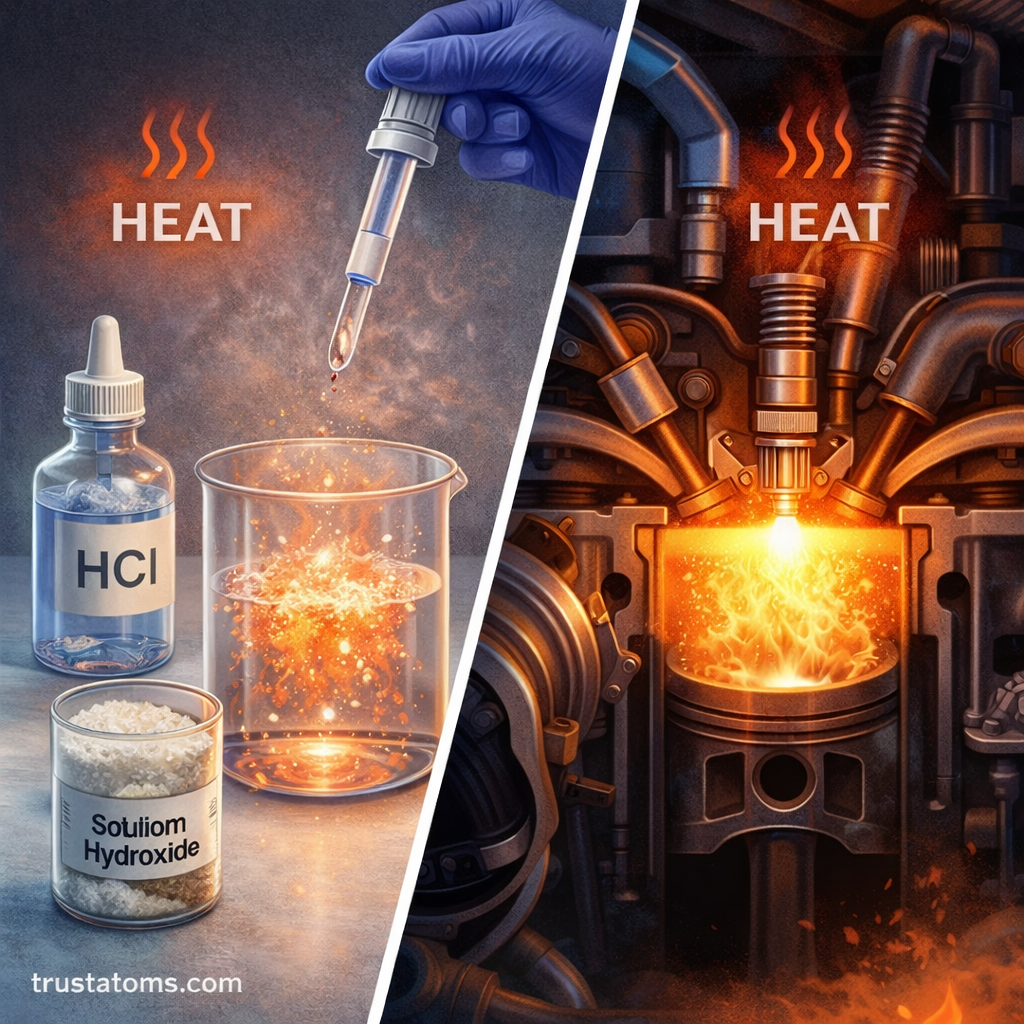
- Gasoline combusting in a car engine
- Natural gas burning in a stove
Combustion reactions release large amounts of heat and sometimes light.
Neutralization Reactions
When an acid reacts with a base, the reaction typically releases heat.
Example:
- Hydrochloric acid reacting with sodium hydroxide produces water and salt while releasing heat.
Cellular Respiration
Living organisms rely on exothermic reactions to produce energy.
During cellular respiration:
- Glucose reacts with oxygen
- Energy is released
- Carbon dioxide and water are produced
This reaction powers many biological processes in the body.
Energy Changes in Exothermic Reactions
Chemists often visualize exothermic reactions using energy diagrams.
In these diagrams:
- Reactants start at a higher energy level
- Products end at a lower energy level
- The difference between them represents released energy
Although energy is released overall, most reactions still require a small initial input called activation energy. This energy jump starts the reaction by breaking the first chemical bonds.
Once the reaction begins, the energy released keeps the process going.
Why Exothermic Reactions Matter
Exothermic reactions play a crucial role in science, technology, and everyday life.
Energy Production
Many power sources rely on exothermic reactions, including:
- Fossil fuel combustion
- Propane and natural gas heating
- Rocket fuel reactions
These processes release energy that can be converted into electricity, motion, or heat.
Industrial Processes
Industries use exothermic reactions to manufacture materials and chemicals. Controlled energy release allows factories to maintain efficient production conditions.
Examples include:
- Metal extraction from ores
- Chemical manufacturing
- Fertilizer production
Biological Systems
Life itself depends on energy-releasing reactions. Organisms break down molecules like glucose to release energy needed for:
- Movement
- Growth
- Body temperature regulation
- Cellular repair
Exothermic vs Endothermic Reactions
To understand exothermic reactions more clearly, it helps to compare them with their opposite: endothermic reactions.
Exothermic Reactions
- Release heat into surroundings
- Surroundings become warmer
- Products have lower energy than reactants
- Enthalpy change (ΔH) is negative
Endothermic Reactions
- Absorb heat from surroundings
- Surroundings become cooler
- Products have higher energy than reactants
- Enthalpy change (ΔH) is positive
Both types of reactions are essential for chemical systems and natural processes.
Signs That a Reaction Is Exothermic
In experiments or real-world reactions, several clues may indicate that a reaction is exothermic.
Common signs include:
- A noticeable increase in temperature
- Light being emitted (such as flames or sparks)
- Sound produced during the reaction
- Heat felt near the reaction site
These signals indicate that energy is being released from the reacting substances.
Final Thoughts
Exothermic reactions are a fundamental concept in chemistry because they explain how chemical processes release energy into the environment. From burning fuels to powering living cells, these reactions drive many systems that support modern life and natural ecosystems.
By understanding how energy changes during chemical reactions, scientists can design safer industrial processes, develop better energy sources, and deepen our understanding of the physical world.