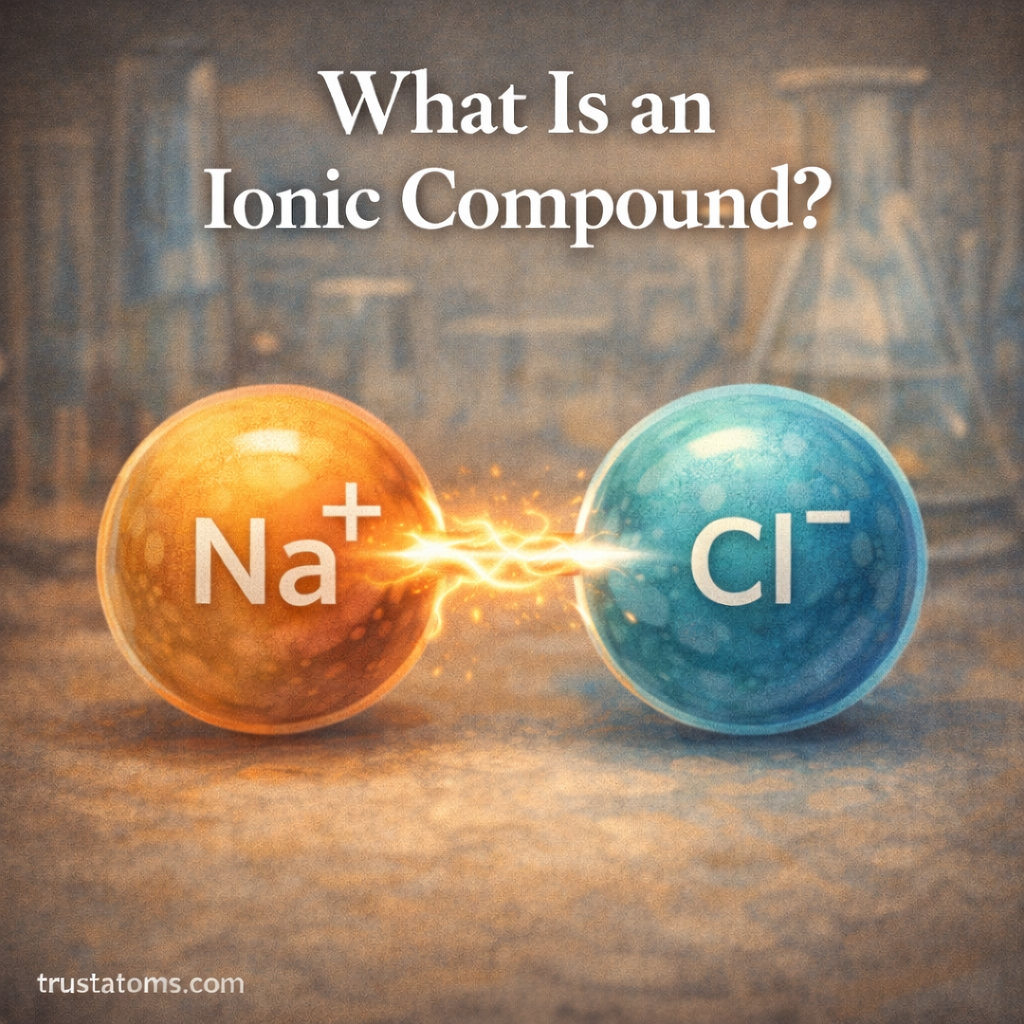
An ionic compound is a chemical compound formed when atoms transfer electrons from one atom to another. This transfer creates charged particles called ions, which attract each other through strong electrostatic forces.
Ionic compounds are common in chemistry and everyday life. Substances such as table salt, baking soda, and many minerals are examples of ionic compounds. These compounds play important roles in biological systems, industrial processes, and environmental chemistry.
Understanding ionic compounds helps explain how atoms interact and how many common materials form.
The Basic Idea of Ionic Bonding
Ionic compounds form through ionic bonding, which occurs when one atom loses electrons and another atom gains them.
This process produces two types of ions:
- Cations – positively charged ions that have lost electrons
- Anions – negatively charged ions that have gained electrons
Because opposite charges attract, the positively and negatively charged ions are pulled together, forming a stable ionic compound.
This electrostatic attraction is called an ionic bond.
How Ionic Compounds Form
Ionic compounds typically form between metals and nonmetals.
Metals tend to lose electrons easily, while nonmetals tend to gain electrons. This difference in electron behavior allows electron transfer to occur.
The general formation process looks like this:
- A metal atom releases one or more electrons.
- A nonmetal atom accepts those electrons.
- The metal becomes a positively charged ion.
- The nonmetal becomes a negatively charged ion.
- The oppositely charged ions attract and form an ionic compound.
Instead of forming individual molecules, ionic compounds usually arrange themselves into repeating structures called crystal lattices.
Structure of Ionic Compounds
Ionic compounds form highly organized, repeating patterns of ions known as crystal lattices.
In this structure:
- Positive and negative ions alternate positions.
- The arrangement maximizes attraction between opposite charges.
- The structure increases stability.
These crystal lattices are responsible for many of the physical properties of ionic compounds, such as their hardness and high melting points.
Properties of Ionic Compounds
Ionic compounds have several distinct characteristics that help distinguish them from other types of compounds.
Common properties include:
- High melting and boiling points
- Solid crystalline structure at room temperature
- Brittle texture
- Ability to conduct electricity when dissolved in water or melted
When ionic compounds dissolve in water, the ions separate and move freely, allowing the solution to conduct electricity.
Examples of Ionic Compounds
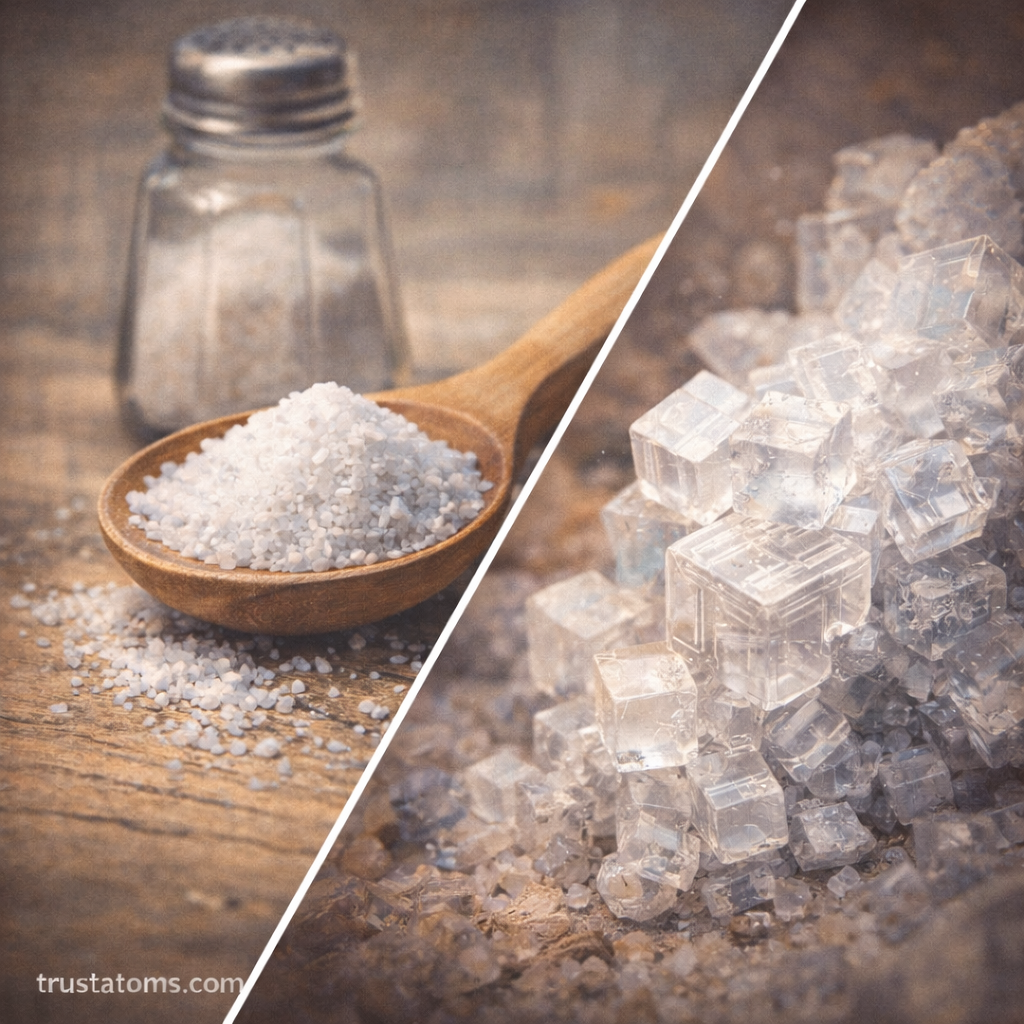
Many familiar substances are ionic compounds.
Examples include:
- Sodium chloride (table salt)
- Calcium chloride
- Potassium bromide
- Magnesium oxide
- Sodium bicarbonate (baking soda)
These compounds are commonly found in:
- Food and cooking
- Medical treatments
- Industrial manufacturing
- Natural mineral deposits
Ionic Compounds in Everyday Life
Ionic compounds play important roles in daily life and natural systems.
Table Salt
Sodium chloride is one of the most common ionic compounds. It is widely used in food preparation and preservation.
Electrolytes in the Body
Ions such as sodium, potassium, and calcium help regulate important biological functions, including nerve signals and muscle contractions.
Construction Materials
Many building materials contain ionic compounds, such as calcium carbonate in limestone.
Water Treatment
Ionic compounds are often used to remove impurities from water during purification processes.
Ionic Compounds vs. Covalent Compounds
Ionic compounds are often compared with covalent compounds because they represent two different bonding methods in chemistry.
Ionic compounds:
- Form between metals and nonmetals
- Involve transfer of electrons
- Form crystal lattice structures
Covalent compounds:
- Form between nonmetals
- Involve sharing of electrons
- Form individual molecules
Both types of compounds are essential for understanding how atoms combine to create matter.
Why Ionic Compounds Matter
Ionic compounds are fundamental to many areas of chemistry and science.
They are important in:
- Biological systems
- Environmental processes
- Industrial chemistry
- Energy storage technologies
- Materials science
Because ions interact strongly with each other and with water, ionic compounds help drive many chemical reactions that occur in nature and technology.
Final Thoughts
An ionic compound forms when electrons transfer from one atom to another, creating positively and negatively charged ions that attract each other. These ions arrange themselves into stable crystal structures held together by strong electrostatic forces.
From table salt to minerals and electrolytes in the human body, ionic compounds are a vital part of chemistry and everyday life. Learning how these compounds form provides a key foundation for understanding chemical bonding and the structure of matter.