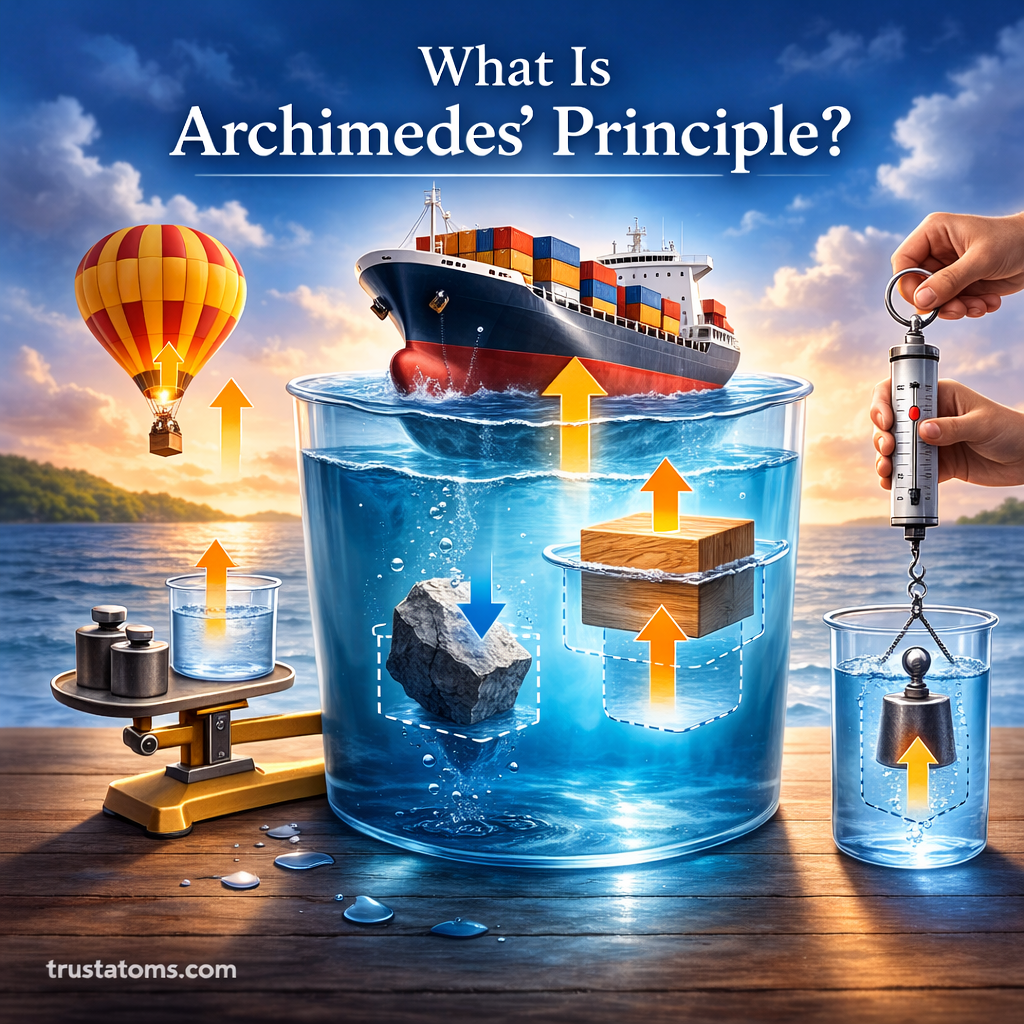
Archimedes’ Principle is a fundamental law of physics that explains why objects float or sink in fluids.
It states:
An object submerged in a fluid experiences an upward force equal to the weight of the fluid it displaces.
This simple idea explains everything from ships floating on water to hot air balloons rising in the sky.
Archimedes’ Principle is one of the most important concepts in fluid mechanics.
The Origin of Archimedes’ Principle
The principle is named after Archimedes, an ancient Greek mathematician and scientist.
According to legend, Archimedes discovered the concept while taking a bath. As he stepped into the water, he noticed the water level rise. He realized that the volume of water displaced was equal to the volume of his body submerged.
This observation led to a deeper understanding of buoyancy.
Understanding the Core Idea
When an object is placed in a fluid:
- It pushes some of the fluid out of the way.
- The fluid exerts an upward force on the object.
- That upward force equals the weight of the displaced fluid.
This upward force is called the buoyant force.
The more fluid an object displaces, the greater the buoyant force.
Why Objects Float or Sink
Archimedes’ Principle helps determine whether an object will float or sink.
An object floats if:
- The buoyant force equals its weight before it fully submerges.
An object sinks if:
- Its weight is greater than the maximum buoyant force the fluid can provide.
This is why:
- A steel ship floats (it displaces enough water to balance its weight).
- A small solid steel ball sinks (it displaces very little water relative to its weight).
Floating depends on displaced fluid, not just the material itself.
Archimedes’ Principle and Density

The principle is closely connected to density.
If an object’s average density is:
- Less than the fluid’s density → it floats.
- Greater than the fluid’s density → it sinks.
For example:
- Ice floats in water because it is less dense than liquid water.
- Wood floats because it is less dense than water.
- Rocks usually sink because they are denser than water.
Density comparison determines the outcome.
Archimedes’ Principle in Action
Archimedes’ Principle applies in both liquids and gases.
Ships and Boats
Ships are designed to displace large volumes of water.
Even though steel is dense, the ship’s overall structure includes air-filled space, lowering its average density.
Submarines
Submarines control buoyancy by adjusting ballast tanks.
By filling tanks with water:
- The submarine increases its density and sinks.
By pumping water out:
- The submarine decreases its density and rises.
Hot Air Balloons
Air is also a fluid.
When air inside a balloon is heated:
- It becomes less dense.
- The balloon displaces heavier surrounding air.
- The buoyant force lifts it upward.
Factors That Affect Buoyant Force
Several factors influence buoyancy:
1. Fluid Density
Denser fluids create greater buoyant force.
For example:
- Floating is easier in saltwater than freshwater.
- Objects float more easily in very dense liquids like mercury.
2. Volume of Displaced Fluid
The larger the submerged volume, the greater the buoyant force.
This is why larger ships displace massive amounts of water.
3. Gravity
Buoyant force depends on gravity.
On a planet with weaker gravity, buoyant forces would be smaller.
Real-World Applications
Archimedes’ Principle is used in:
- Shipbuilding
- Naval engineering
- Oceanography
- Aviation (balloons and airships)
- Hydrometers for measuring fluid density
It provides a predictable way to calculate floating behavior.
The Big Picture
Archimedes’ Principle states that the buoyant force on a submerged object equals the weight of the displaced fluid.
It explains:
- Why ships float
- How submarines dive and rise
- Why hot air balloons ascend
- How density affects floating
By connecting fluid displacement with weight, Archimedes’ Principle remains one of the most elegant and practical ideas in physics.
Understanding it gives insight into buoyancy, fluid motion, and real-world engineering systems.