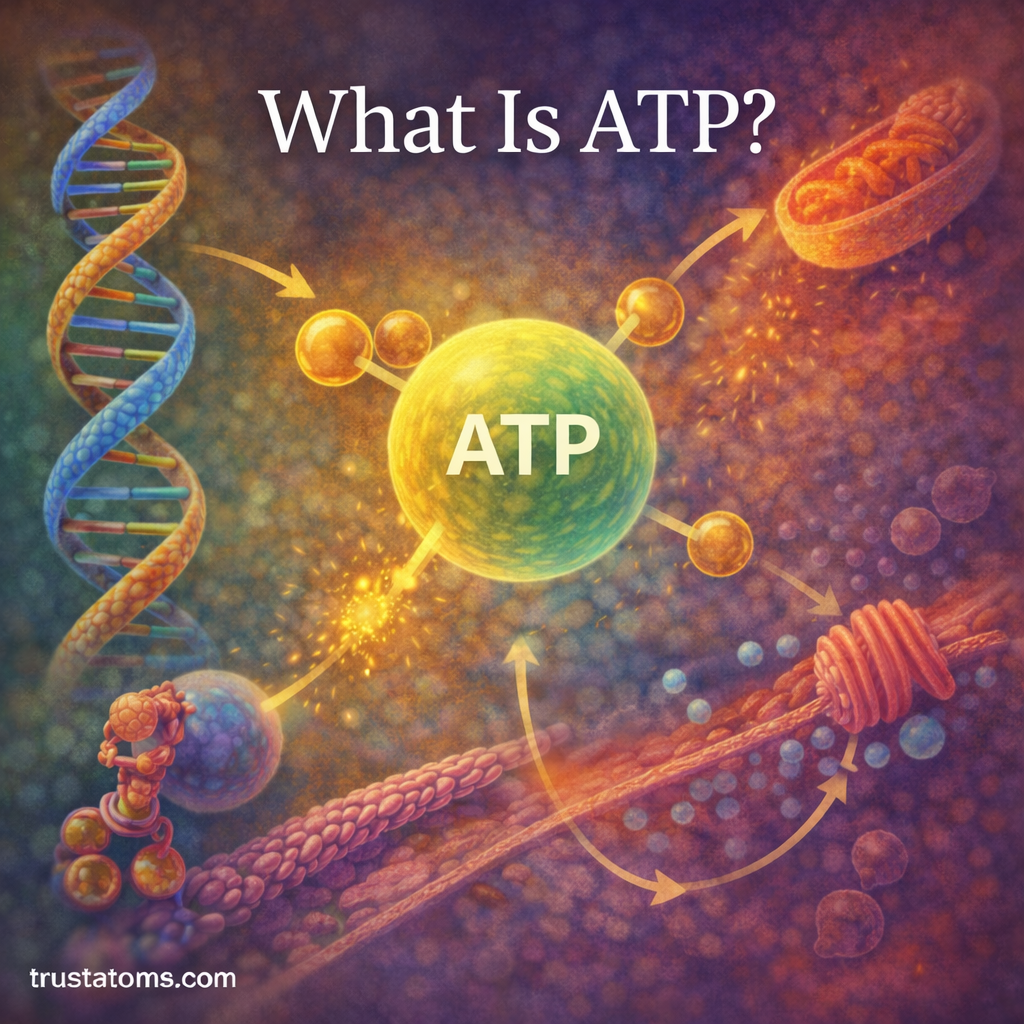
Every living cell requires energy to perform essential tasks. From muscle movement and nerve signaling to building new molecules and transporting nutrients, biological processes depend on a reliable energy source. In cells, that energy comes primarily from a molecule known as ATP.
ATP is often described as the energy currency of life because it stores and transfers energy within cells. Nearly every metabolic activity depends on ATP to power cellular work. Without it, cells would not be able to sustain life.
Understanding ATP is essential to understanding how organisms grow, move, and maintain their internal balance.
What ATP Stands For
ATP stands for adenosine triphosphate. It is a small molecule found in all living cells and plays a central role in cellular metabolism.
ATP consists of three main components:
- Adenine – a nitrogen-containing base
- Ribose – a five-carbon sugar
- Three phosphate groups
The three phosphate groups are especially important because they store energy in their chemical bonds.
When ATP releases energy, it typically does so by breaking one of these phosphate bonds.
Why ATP Is Called the Energy Currency of Cells
Cells need a way to store and deliver energy efficiently. ATP serves this purpose perfectly because it can quickly release energy when needed.
When a cell requires energy, ATP is converted into ADP (adenosine diphosphate) by removing one phosphate group.
This reaction releases usable energy that powers cellular activities.
The process looks like this in simple terms:
- ATP contains three phosphate groups.
- The bond holding the final phosphate breaks.
- Energy is released.
- ATP becomes ADP.
Because this process happens rapidly and repeatedly, ATP acts like a rechargeable battery inside cells.
How ATP Stores Energy
Energy in ATP is stored in the bonds between its phosphate groups.
These bonds are often referred to as high-energy bonds because breaking them releases a significant amount of energy that cells can use.
However, the energy is not stored simply because the bonds are strong. Instead, energy is released due to changes in molecular stability when the bond is broken.
Key factors include:
- Repulsion between negatively charged phosphate groups
- Greater stability of the resulting molecules
- Energy released during chemical rearrangement
These factors make ATP an efficient molecule for energy transfer.
How Cells Produce ATP
Cells constantly use ATP, so they must continuously produce more of it. ATP is generated through several metabolic pathways.
Cellular Respiration
The primary method of ATP production in many organisms is cellular respiration, which occurs in mitochondria.
Cellular respiration breaks down nutrients such as glucose and converts the stored chemical energy into ATP.
This process occurs in several stages:
- Glycolysis
- The citric acid cycle
- The electron transport chain
Together, these stages convert energy from food molecules into ATP.
Photosynthesis
In plants and algae, ATP is also produced during photosynthesis.
Light energy from the sun powers chemical reactions inside chloroplasts, generating ATP that is used to build glucose and other carbohydrates.
Although photosynthesis creates ATP, much of it is used immediately within the chloroplast.
Fermentation
When oxygen is unavailable, cells may produce ATP through fermentation.
Fermentation is less efficient than cellular respiration but allows cells to continue generating small amounts of ATP under low-oxygen conditions.
Examples include:
- Lactic acid fermentation in muscle cells
- Alcohol fermentation in yeast
How ATP Powers Cellular Work
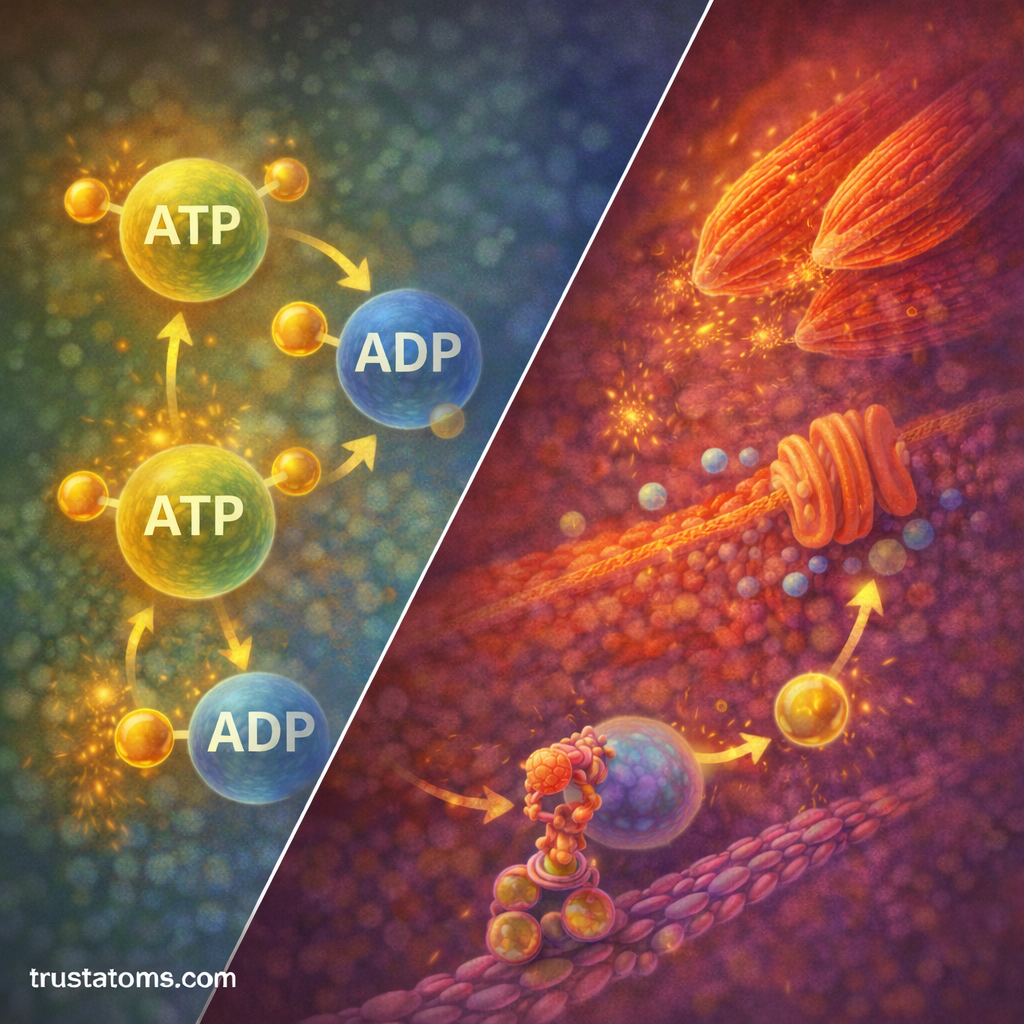
ATP provides energy for three major types of cellular work.
Chemical Work
Chemical work involves building complex molecules from simpler ones.
ATP powers processes such as:
- Protein synthesis
- DNA replication
- Lipid formation
- Cellular growth and repair
Without ATP, cells could not produce essential biological molecules.
Transport Work
Transport work involves moving substances across cell membranes.
ATP powers active transport, which allows cells to move molecules against concentration gradients.
Examples include:
- Ion pumps that regulate sodium and potassium levels
- Transport of nutrients into cells
- Removal of cellular waste products
These transport processes are critical for maintaining proper cell function.
Mechanical Work
Mechanical work involves movement within cells and organisms.
ATP fuels:
- Muscle contraction
- Movement of cilia and flagella
- Transport of vesicles within cells
- Cytoskeletal changes during cell division
These movements are essential for many biological functions, from circulation to reproduction.
The ATP Cycle
ATP is constantly recycled in cells through a process known as the ATP cycle.
The cycle works as follows:
- ATP releases energy and becomes ADP.
- ADP combines with a phosphate group.
- Energy from metabolism restores the bond.
- ATP is regenerated.
This cycle happens extremely rapidly. In fact, the human body recycles its entire supply of ATP many times each day.
Despite the constant turnover, the total amount of ATP in the body at any moment remains relatively small.
Where ATP Is Found in Cells
ATP is present throughout the cell but is produced most abundantly in specific locations.
Key cellular locations include:
- Mitochondria – primary ATP production during cellular respiration
- Cytoplasm – ATP production during glycolysis
- Chloroplasts – ATP production during photosynthesis in plants
These specialized regions allow cells to generate energy efficiently for different metabolic processes.
Why ATP Is Essential for Life
ATP plays a central role in almost every biological process.
Cells rely on ATP to:
- Power metabolism
- Maintain ion balance
- Build biological molecules
- Enable cellular movement
- Support growth and reproduction
Without ATP, cells would lose the ability to perform essential tasks and biological systems would quickly shut down.
Because of its universal importance, ATP is found in all known forms of life, from bacteria to humans.
Final Thoughts
ATP is one of the most important molecules in biology. Acting as the cell’s primary energy carrier, it connects energy-producing processes with the countless reactions required for life.
Through continuous production and recycling, ATP powers chemical reactions, cellular transport, and mechanical movement across all living organisms.
By understanding ATP, scientists gain insight into how cells function, how energy flows through biological systems, and how life itself is sustained at the molecular level.