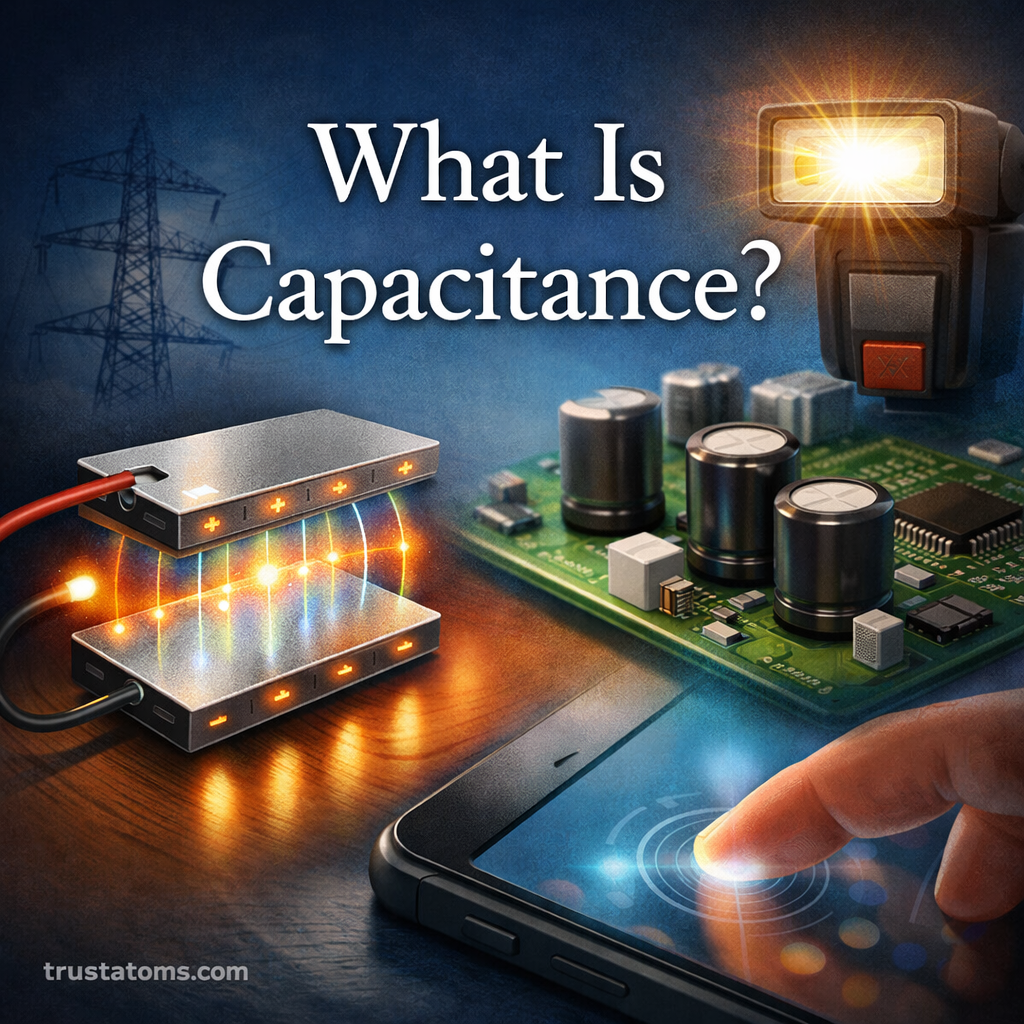
Capacitance is a fundamental concept in physics and electrical engineering that explains how electrical energy can be stored in an electric field. From smartphone circuits to power grids and camera flashes, capacitance plays a critical role in modern technology.
In simple terms, capacitance measures a system’s ability to store electric charge.
This guide explains what capacitance is, how it works, the formula behind it, and where it appears in real-world applications.
What Is Capacitance in Simple Terms?
Capacitance is the ability of a device or system to store electric charge when a voltage is applied.
When electrical energy builds up between two conductors separated by an insulating material, that system exhibits capacitance.
The greater the amount of charge stored for a given voltage, the higher the capacitance.
The Basic Definition
Capacitance is defined as:
C = Q / V
Where:
- C = Capacitance (measured in farads)
- Q = Electric charge (measured in coulombs)
- V = Voltage (measured in volts)
This formula tells us that capacitance equals the amount of stored charge divided by the applied voltage.
If a system can store more charge at the same voltage, it has higher capacitance.
What Is a Capacitor?
A capacitor is a device specifically designed to store electrical energy.
It typically consists of:
- Two conductive plates
- An insulating material between them (called a dielectric)
When voltage is applied:
- One plate accumulates positive charge
- The other plate accumulates negative charge
- An electric field forms between them
The energy is stored in this electric field.
The Unit of Capacitance: The Farad
Capacitance is measured in farads (F), named after physicist Michael Faraday.
One farad is defined as:
The capacitance of a system that stores one coulomb of charge when one volt is applied.
In practice, one farad is very large. Most electronic components use:
- Microfarads (µF) – one millionth of a farad
- Nanofarads (nF) – one billionth of a farad
- Picofarads (pF) – one trillionth of a farad
What Determines Capacitance?
Several factors affect how much charge a capacitor can store.
1. Plate Area
Larger plates can store more charge.
More surface area means greater capacitance.
2. Distance Between Plates
The closer the plates are together, the stronger the electric field interaction.
Smaller distance increases capacitance.
3. Type of Dielectric Material
The insulating material between the plates affects how well the electric field forms.
Materials with higher dielectric constants increase capacitance.
The mathematical relationship for a parallel-plate capacitor is:
C = εA / d
Where:
- ε = Permittivity of the dielectric
- A = Area of the plates
- d = Distance between plates
How Does Capacitance Work Physically?
Capacitance works because electric charges create electric fields.
When opposite charges accumulate on two plates:
- An electric field forms between them
- Energy becomes stored in that field
- The field resists further charge buildup
The system eventually reaches equilibrium, where the applied voltage matches the electric field strength.
When connected to a circuit, the stored energy can be released.
Energy Stored in a Capacitor
A capacitor doesn’t just store charge — it stores energy.
The energy stored is calculated using:
E = ½ C V²
Where:
- E = Energy (joules)
- C = Capacitance
- V = Voltage
Notice that energy increases with the square of the voltage. Doubling the voltage increases stored energy by four times.
Real-World Applications of Capacitance

Capacitance is everywhere in modern electronics.
Power Supply Filtering
Capacitors smooth out voltage fluctuations in power supplies.
They store excess energy and release it when voltage drops.
Camera Flashes
Capacitors quickly store energy and release it in a short burst.
Signal Processing
Capacitors help filter frequencies in audio equipment and communication systems.
Touchscreens
Capacitive touchscreens detect changes in capacitance when your finger approaches the surface.
Energy Storage Systems
Supercapacitors can store and release energy faster than batteries.
Capacitance vs. Resistance vs. Inductance
Capacitance is often compared with other electrical properties:
- Resistance opposes current flow.
- Inductance stores energy in magnetic fields.
- Capacitance stores energy in electric fields.
Each plays a different role in circuit behavior.
Why Capacitance Matters in Physics
Capacitance connects directly to key physics principles:
- Electric fields
- Electrostatics
- Potential difference
- Energy conservation
It helps scientists and engineers design everything from microchips to large-scale electrical systems.
Understanding capacitance also deepens your understanding of how electric forces behave in space.
Final Thoughts
Capacitance is the measure of how much electric charge a system can store per unit of voltage.
It depends on plate size, distance between conductors, and the insulating material between them. The stored energy exists in the electric field formed between charged surfaces.
Although the concept is rooted in electrostatics, its impact extends into nearly every electronic device we use today.
From simple circuits to advanced energy storage systems, capacitance is one of the core building blocks of electrical physics.