Circular motion is the movement of an object along a circular path.
From a spinning fan blade to a planet orbiting a star, circular motion appears everywhere in physics. Even though the object may move at a constant speed, its direction is always changing — and that means forces are involved.
In this guide, you’ll learn:
- What circular motion is
- The difference between speed and velocity
- What centripetal force means
- Key formulas
- Real-world examples
What Is Circular Motion?
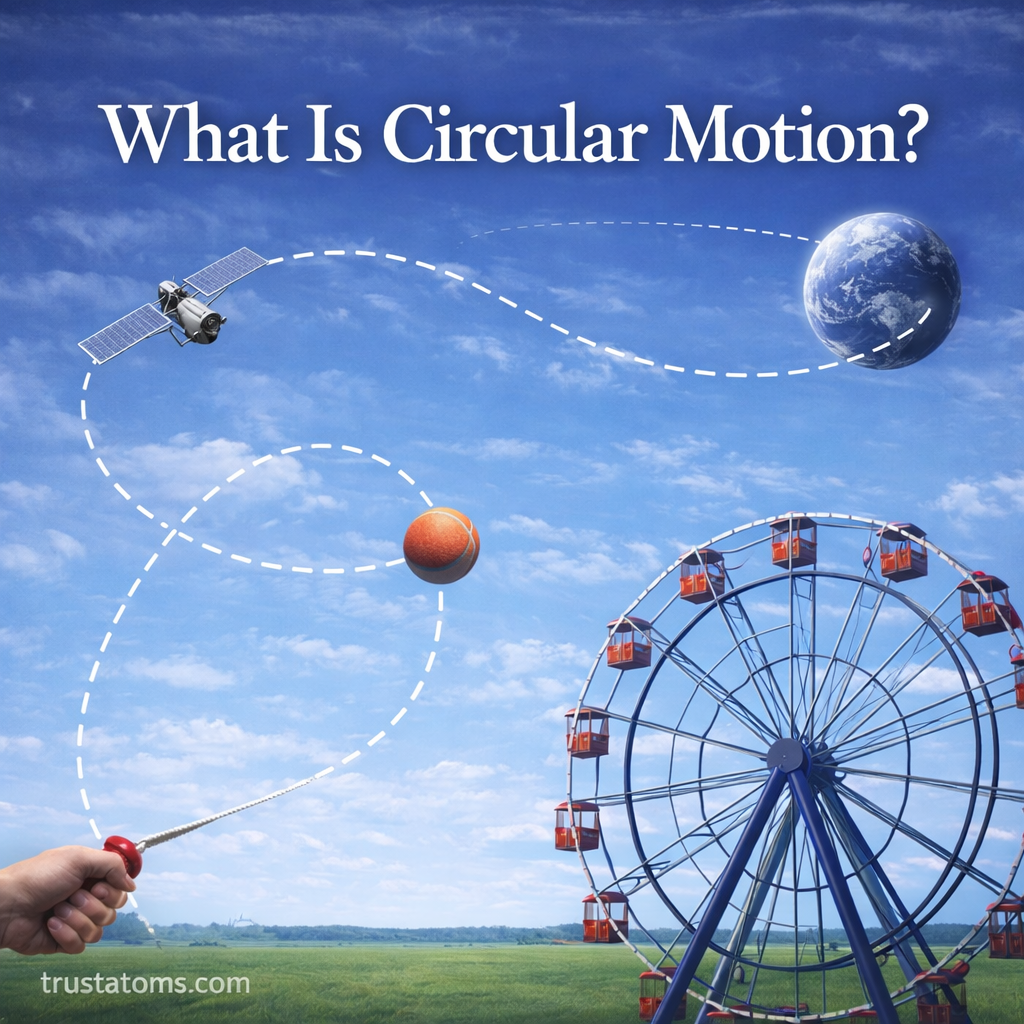
Circular motion occurs when an object moves in a circle around a fixed point or axis.
Examples include:
- A car turning around a roundabout
- A ball tied to a string and swung overhead
- A satellite orbiting Earth
- A rotating ceiling fan
In all cases, the object continuously changes direction as it moves along the circle.
Even if the speed remains constant, the velocity changes because velocity includes direction.
Speed vs. Velocity in Circular Motion
This distinction is critical.
- Speed = how fast something moves
- Velocity = speed plus direction
In circular motion:
- Speed can stay constant
- Velocity is always changing
Since acceleration is defined as a change in velocity, circular motion always involves acceleration — even at constant speed.
What Is Centripetal Acceleration?
Centripetal acceleration is the inward acceleration that keeps an object moving in a circular path.
Without this inward pull, the object would move in a straight line due to inertia.
Centripetal acceleration:
- Always points toward the center of the circle
- Changes the direction of motion
- Does not necessarily change speed
The formula for centripetal acceleration is:
a = v² / r
Where:
- a = centripetal acceleration
- v = speed
- r = radius of the circle
This shows that:
- Faster speed → greater inward acceleration
- Smaller radius → greater inward acceleration
What Is Centripetal Force?

Centripetal force is the inward force that causes centripetal acceleration.
It is not a new type of force. Instead, it can be provided by different forces depending on the situation.
For example:
- Tension provides centripetal force for a ball on a string
- Gravity provides centripetal force for planets in orbit
- Friction provides centripetal force for a car turning
The formula for centripetal force is:
F = mv² / r
Where:
- F = centripetal force
- m = mass
- v = speed
- r = radius
Uniform vs. Non-Uniform Circular Motion
Uniform Circular Motion
Occurs when:
- Speed is constant
- Only direction changes
Acceleration exists because direction changes.
Non-Uniform Circular Motion
Occurs when:
- Speed changes
- Direction changes
In this case, there are two accelerations:
- Centripetal acceleration (inward)
- Tangential acceleration (along the path)
Why Objects Don’t Fly Off Immediately
If you spin a ball tied to a string:
- The string pulls inward
- The ball moves in a circle
If the string breaks:
- The ball flies off in a straight line
This demonstrates inertia — objects naturally move in straight lines unless acted upon by a force.
Circular motion requires constant inward force.
Real-World Examples of Circular Motion
Circular motion is found in:
- Ferris wheels
- Washing machines
- Roller coasters
- Orbiting satellites
- Rotating machinery
Even electrons in atoms are often described using circular motion models (in simplified physics).
Circular Motion and Gravity
Planets orbit the Sun due to circular motion.
Gravity acts as the centripetal force.
Without gravity:
- Planets would move in straight lines into space
Instead, they continuously “fall” toward the Sun while moving forward, creating an orbit.
Key Relationships to Remember
In circular motion:
- Larger speed → greater inward force required
- Smaller radius → greater inward force required
- Larger mass → greater force required
If the force is not strong enough:
- The object cannot maintain the circular path
Common Mistakes to Avoid
Students often:
- Think circular motion has no acceleration if speed is constant
- Confuse centripetal force with a separate physical force
- Forget that direction change means acceleration
- Mix up radius and diameter in formulas
Always remember:
Acceleration is about change in velocity — not just change in speed.
Why Circular Motion Matters
Understanding circular motion is essential for:
- Engineering design
- Aerospace travel
- Mechanical systems
- Physics problem solving
- Understanding planetary orbits
It forms the foundation for advanced topics like rotational dynamics and orbital mechanics.
Final Thoughts
Circular motion may seem simple — just moving in a circle — but it involves constant inward acceleration and force.
Even when speed remains constant, direction changes create acceleration.
From spinning wheels to orbiting planets, circular motion explains how objects stay on curved paths instead of flying off in straight lines.
Mastering this concept helps unlock deeper understanding in physics and motion.