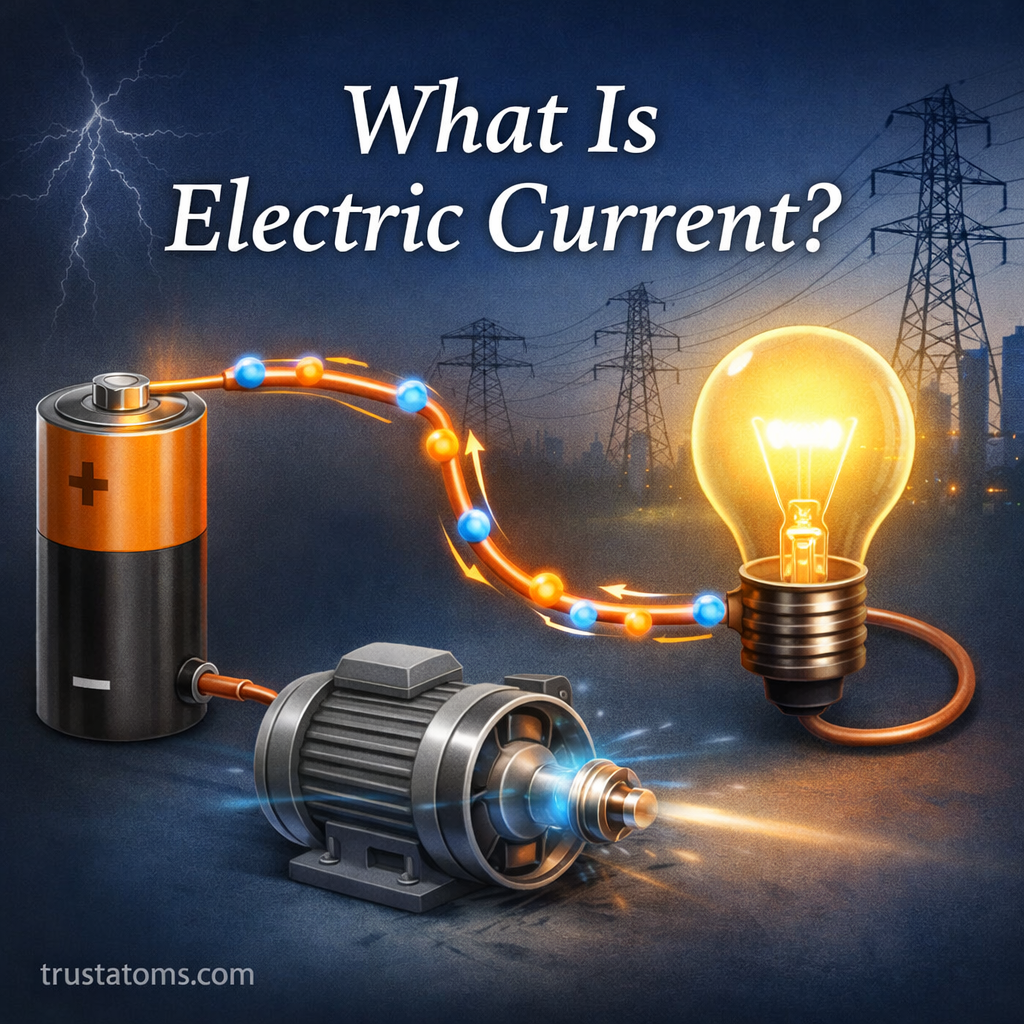
Electric current is one of the most fundamental concepts in physics. It powers your phone, lights your home, runs your computer, and drives nearly every modern technology.
But what exactly is electric current?
In simple terms, electric current is the flow of electric charge through a material. Most commonly, that charge is carried by electrons moving through a wire.
Let’s break it down in a clear, practical way.
The Basic Definition of Electric Current
Electric current is defined as:
The rate at which electric charge flows past a given point in a circuit.
In physics terms, current measures how much charge passes through a conductor in a certain amount of time.
The standard unit of electric current is the ampere (amp), abbreviated as A.
The Formula for Electric Current
The mathematical definition is:
I = Q / t
Where:
- I = electric current (in amperes)
- Q = electric charge (in coulombs)
- t = time (in seconds)
If 1 coulomb of charge passes through a wire in 1 second, the current is 1 ampere.
What Actually Moves in Electric Current?
In most everyday circuits (like copper wires), the moving particles are electrons.
Electrons are negatively charged subatomic particles found in atoms. In conductive materials like metals:
- Some electrons are loosely bound.
- They can move freely between atoms.
- When a voltage is applied, they begin to drift in one direction.
That movement creates electric current.
Important Note About Direction
Interestingly, the defined direction of current (called conventional current) is opposite to the actual flow of electrons.
- Electrons move from negative to positive.
- Conventional current is defined as flowing from positive to negative.
This historical convention is still used in circuit diagrams today.
How Electric Current Is Created
Electric current requires two key things:
- A conductive path (like a wire)
- A voltage source (like a battery)
Voltage is the “push” that drives electrons through a conductor.
Without voltage, electrons move randomly. With voltage applied, they move in an organized way, creating a measurable current.
Everyday Example
Think of electric current like water flowing through a pipe:
- Voltage = water pressure
- Current = amount of water flowing
- Resistance = pipe width or blockage
Higher pressure → more flow
Narrower pipe → less flow
This analogy helps visualize how electrical systems work.
Types of Electric Current
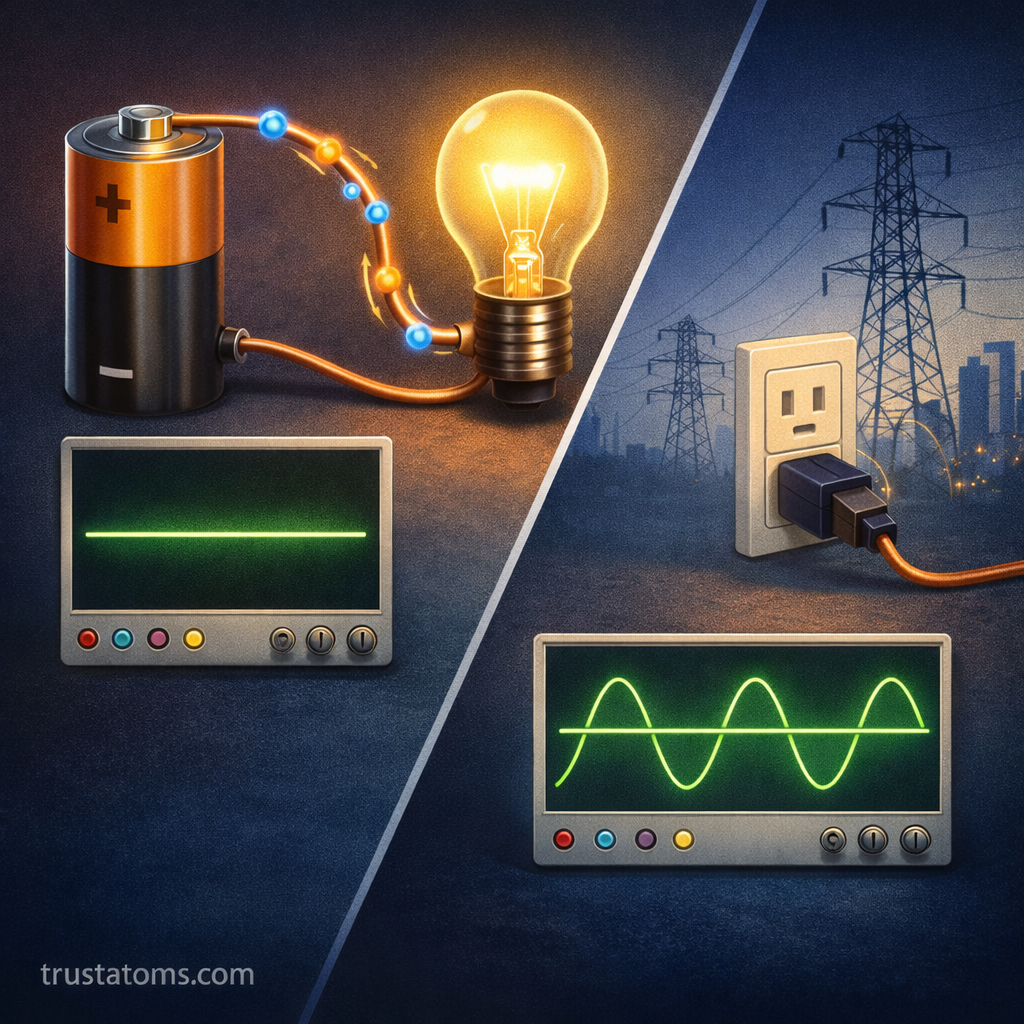
There are two main types of electric current used in real-world applications.
Direct Current (DC)
Direct current flows in one constant direction.
Examples:
- Batteries
- Solar panels
- Phone chargers
- Most electronic devices internally
In DC, the flow of charge remains steady over time.
Alternating Current (AC)
Alternating current changes direction periodically.
Examples:
- Household wall outlets
- Power grids
- Large appliances
In the United States, household AC changes direction 60 times per second (60 Hz).
AC is efficient for transmitting electricity over long distances, which is why power companies use it.
How Electric Current Is Measured
Electric current is measured using a device called an ammeter.
To measure current:
- The ammeter must be placed in series with the circuit.
- This allows all the current to pass through the measuring device.
Currents can range from:
- Microamps (very tiny currents in electronics)
- Milliamps (small devices)
- Amps (household appliances)
- Thousands of amps (industrial systems)
Electric Current and Ohm’s Law
Electric current is closely connected to voltage and resistance through Ohm’s Law:
V = I × R
Where:
- V = voltage (volts)
- I = current (amps)
- R = resistance (ohms)
From this equation:
- Higher voltage → higher current (if resistance stays the same)
- Higher resistance → lower current (if voltage stays the same)
This relationship is foundational in electrical engineering and circuit design.
Why Electric Current Matters
Electric current is responsible for:
- Producing light (light bulbs)
- Generating heat (heaters, stoves)
- Creating motion (electric motors)
- Powering digital electronics
- Enabling communication systems
Without controlled electric current, modern civilization would not function.
From medical devices to spacecraft systems, current flow is at the heart of nearly every technological advancement.
Common Misconceptions About Electric Current
Here are a few common misunderstandings:
“Electricity moves at the speed of light.”
The signal moves close to the speed of light, but the actual electrons drift much more slowly.
“Voltage and current are the same.”
They are different:
- Voltage is the electrical pressure.
- Current is the flow of charge.
“Current only exists in wires.”
Electric current can also flow through:
- Electrolytes (like saltwater)
- Plasma
- Semiconductor materials
A Simple Summary
Electric current is:
- The flow of electric charge
- Measured in amperes
- Driven by voltage
- Opposed by resistance
- Essential for powering modern technology
Understanding electric current is a foundational step in learning physics, electronics, and engineering.
Once you grasp current, you can better understand circuits, energy systems, and the electrical world around you.
Final Thoughts
Electric current may seem invisible, but its effects are everywhere — in light, motion, heat, and information transfer.
By understanding how electric charge flows and how voltage and resistance influence that flow, you unlock one of the most important principles in physics.
Whether you’re studying science, working in engineering, or simply curious about how your devices work, electric current is a concept worth mastering.