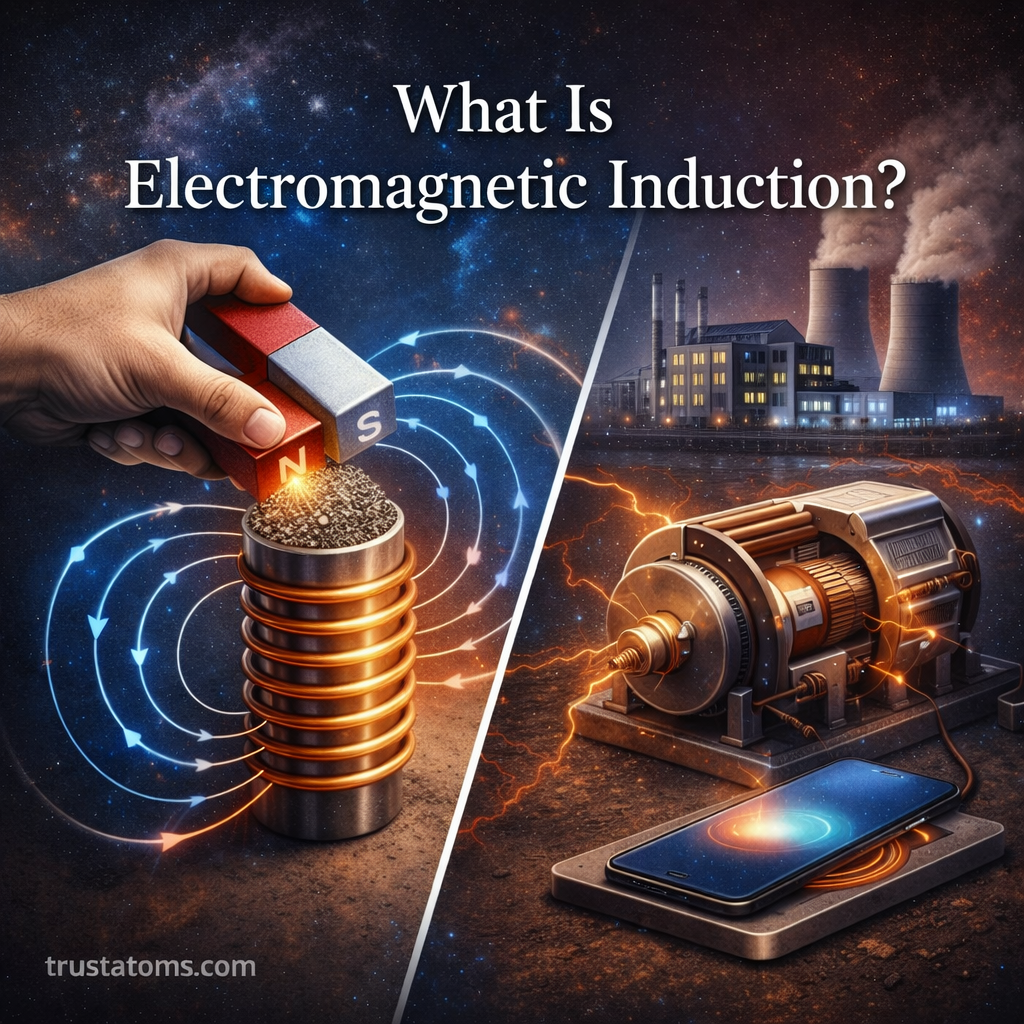
Electromagnetic induction is the process by which a changing magnetic field creates an electric current in a conductor.
This principle is one of the most important discoveries in physics. It explains how electricity is generated in power plants, how transformers work, and how many modern devices operate.
Without electromagnetic induction, large-scale electricity production would not be possible.
The Simple Definition
Electromagnetic induction occurs when:
- A magnetic field changes near a conductor
or - A conductor moves through a magnetic field
As a result, an electric current is produced.
The key idea is change. A steady magnetic field does not create current. A changing magnetic field does.
Who Discovered Electromagnetic Induction?
In 1831, Michael Faraday discovered electromagnetic induction through a series of experiments.
Around the same time, Joseph Henry made similar discoveries independently.
Faraday showed that moving a magnet through a coil of wire caused electricity to flow in the wire. This breakthrough laid the foundation for modern electrical engineering.
How Electromagnetic Induction Works
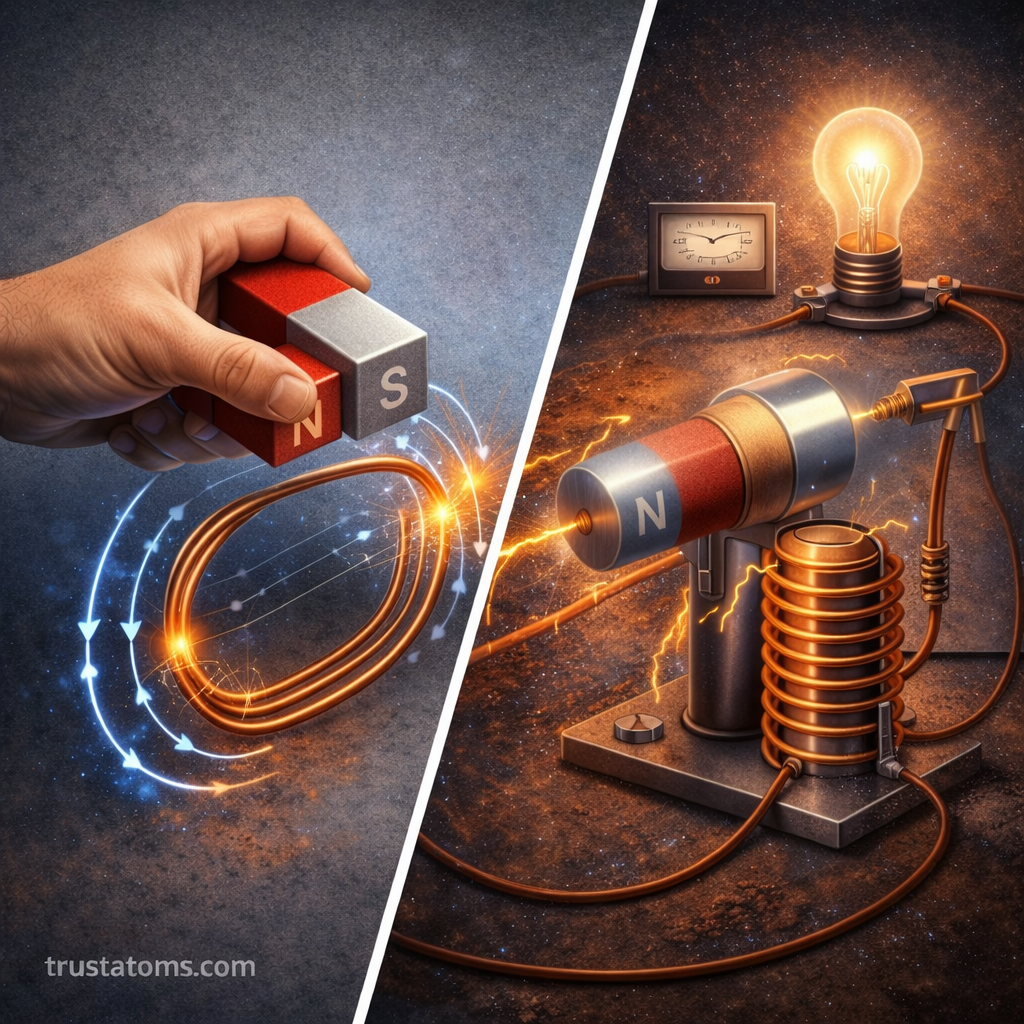
To understand induction, imagine three basic components:
- A magnet (source of magnetic field)
- A conductor (like a copper wire)
- Motion or change
Here’s what happens:
- When the magnet moves toward the coil, the magnetic field inside the coil changes.
- This change forces electrons in the wire to move.
- Moving electrons create an electric current.
No batteries are required. The energy comes from motion.
Faraday’s Law of Induction
Faraday’s Law explains induction mathematically, but conceptually it says:
The greater the change in magnetic field, the greater the induced current.
In practical terms, you get more electricity when:
- The magnet moves faster
- The magnetic field is stronger
- The coil has more loops of wire
This relationship governs how generators are designed.
Lenz’s Law: The Direction of Induced Current
Electromagnetic induction also follows Lenz’s Law.
Lenz’s Law states:
The induced current will flow in a direction that opposes the change that created it.
This means:
- If a magnet moves toward a coil, the induced current creates a magnetic field that pushes back.
- If a magnet moves away, the induced current tries to pull it back.
This is why moving a magnet quickly through a coil feels slightly resistant.
Real-World Applications of Electromagnetic Induction
Electromagnetic induction powers modern society.
1. Electric Generators
Power plants use turbines to spin magnets inside coils of wire. This motion generates electricity.
Energy sources that rely on induction include:
- Fossil fuels
- Nuclear power
- Wind turbines
- Hydroelectric dams
All large-scale electricity generation depends on electromagnetic induction.
2. Transformers
Transformers use changing magnetic fields to increase or decrease voltage.
They allow electricity to:
- Travel long distances efficiently
- Enter homes safely at lower voltages
Without transformers, modern power grids would not function.
3. Induction Cooktops
Induction stoves use rapidly changing magnetic fields to heat cookware directly.
Instead of heating the stove surface, they:
- Create electric currents in the metal pan
- Heat the pan through resistance
This makes induction cooking efficient and precise.
4. Wireless Charging
Wireless chargers use electromagnetic induction to transfer energy between coils without physical contact.
When you place a phone on a charging pad:
- A changing magnetic field is created in the pad
- That field induces current in the phone’s receiver coil
No exposed wires are needed.
The Energy Source Behind Induction
Electromagnetic induction does not create energy from nothing.
The electrical energy comes from mechanical energy:
- Spinning turbines
- Moving magnets
- Rotating coils
Induction simply converts motion into electricity.
This is a key principle of energy conservation.
Why Electromagnetic Induction Is So Important
Electromagnetic induction connects motion and electricity.
It explains:
- How power plants generate electricity
- How electrical energy is distributed
- How motors and generators operate
- How modern electronics are powered
It also helped unify electricity and magnetism into a single field known as electromagnetism — one of the four fundamental forces of nature.
Final Thoughts
Electromagnetic induction is the process by which a changing magnetic field produces electric current.
Discovered in the 19th century, it remains one of the most powerful ideas in physics. Every time electricity is generated on a large scale, electromagnetic induction is at work.
From turbines to wireless chargers, this principle turns motion into usable electrical energy — powering the modern world.