Enthalpy is a thermodynamic quantity that describes the total heat energy of a system under constant pressure. In chemistry, enthalpy helps scientists understand how much heat is absorbed or released during chemical reactions, phase changes, and other energy-related processes.
Because many chemical reactions occur at constant atmospheric pressure, enthalpy is one of the most useful concepts in thermochemistry. It allows chemists to measure energy changes in reactions such as combustion, dissolution, or phase transitions.
The Basic Idea of Enthalpy
Enthalpy (symbol H) represents the total heat content of a system. It combines two forms of energy:
- Internal energy within the molecules
- The energy required for the system to occupy space in its environment
In simpler terms, enthalpy tells us how much heat energy is present in a system and how that energy changes during a process.
Chemists are usually interested in enthalpy change, written as ΔH, rather than the absolute enthalpy value.
Enthalpy Change (ΔH)
Enthalpy change measures the difference in heat energy between the products and reactants of a reaction.
The basic relationship is:
ΔH = H(products) − H(reactants)
This value tells us whether heat is released or absorbed during the process.
Exothermic vs Endothermic Reactions
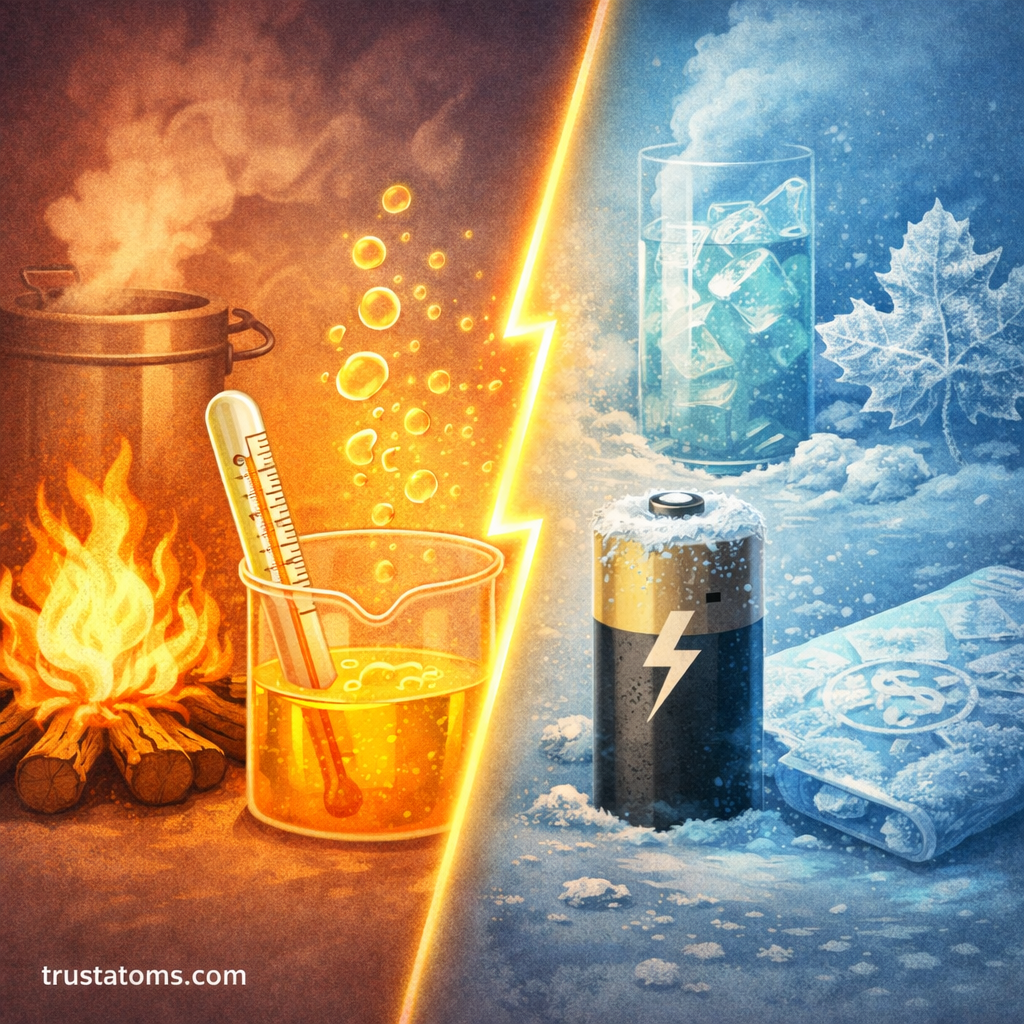
Chemical reactions are commonly classified based on their enthalpy change.
Exothermic Reactions
An exothermic reaction releases heat into the surroundings.
Characteristics include:
- ΔH is negative
- Heat energy is produced
- Surroundings become warmer
Common examples include:
- Burning fuel
- Combustion reactions
- Many oxidation reactions
Endothermic Reactions
An endothermic reaction absorbs heat from the surroundings.
Characteristics include:
- ΔH is positive
- Heat energy is required
- Surroundings become cooler
Examples include:
- Photosynthesis
- Melting ice
- Evaporation of water
Understanding whether a reaction is exothermic or endothermic helps scientists predict how energy flows during chemical changes.
Why Enthalpy Matters in Chemistry
Enthalpy plays a critical role in understanding how chemical reactions behave.
Chemists use enthalpy to:
- Determine whether a reaction releases or absorbs heat
- Compare energy changes between reactions
- Predict reaction feasibility and efficiency
- Design industrial chemical processes
- Study energy transfer in physical and chemical systems
Industries such as fuel production, materials science, and environmental chemistry rely heavily on enthalpy measurements.
Standard Enthalpy Change
To make energy comparisons consistent, chemists often use standard enthalpy change.
Standard conditions usually include:
- Pressure of 1 atmosphere
- Temperature of 25°C (298 K)
- Substances in their standard states
There are several types of standard enthalpy changes commonly used in chemistry.
Standard Enthalpy of Reaction
This measures the heat change when a chemical reaction occurs under standard conditions.
Standard Enthalpy of Formation
This represents the heat change when one mole of a compound forms from its elements in their standard states.
Standard Enthalpy of Combustion
This measures the heat released when one mole of a substance completely burns in oxygen.
These standardized values allow scientists to compare reactions and calculate energy changes accurately.
Measuring Enthalpy in Experiments
Enthalpy changes are typically measured using calorimetry, which involves observing temperature changes during a reaction.
A device called a calorimeter helps measure the heat released or absorbed.
The basic idea works like this:
- A reaction occurs inside a controlled container.
- The temperature of the surrounding liquid changes.
- The temperature change reveals how much heat was transferred.
From these measurements, scientists can calculate the enthalpy change of the reaction.
Enthalpy in Everyday Life
Although enthalpy is a scientific concept, its effects appear in many everyday processes.
Examples include:
- Fuel burning in engines
- Cooking food
- Freezing and melting ice
- Chemical reactions in batteries
- Energy release in hand warmers
Each of these processes involves heat being absorbed or released, which is directly related to enthalpy changes.
Enthalpy vs Internal Energy
Enthalpy is closely related to internal energy, but they are not exactly the same.
Internal energy refers to the total energy contained within a system’s molecules. Enthalpy adds another factor: the energy associated with pressure and volume in the surroundings.
This relationship makes enthalpy especially useful when studying reactions that occur at constant pressure, such as those happening in open containers or in the atmosphere.
Final Thoughts
Enthalpy is a key concept in thermochemistry that helps scientists track how heat energy moves during chemical reactions and physical changes. By measuring enthalpy changes, chemists can determine whether reactions release energy or require it, compare reaction efficiencies, and better understand how energy behaves in chemical systems.
From industrial manufacturing to everyday processes like cooking and fuel combustion, enthalpy provides a powerful way to analyze and predict how heat energy flows in the world around us.