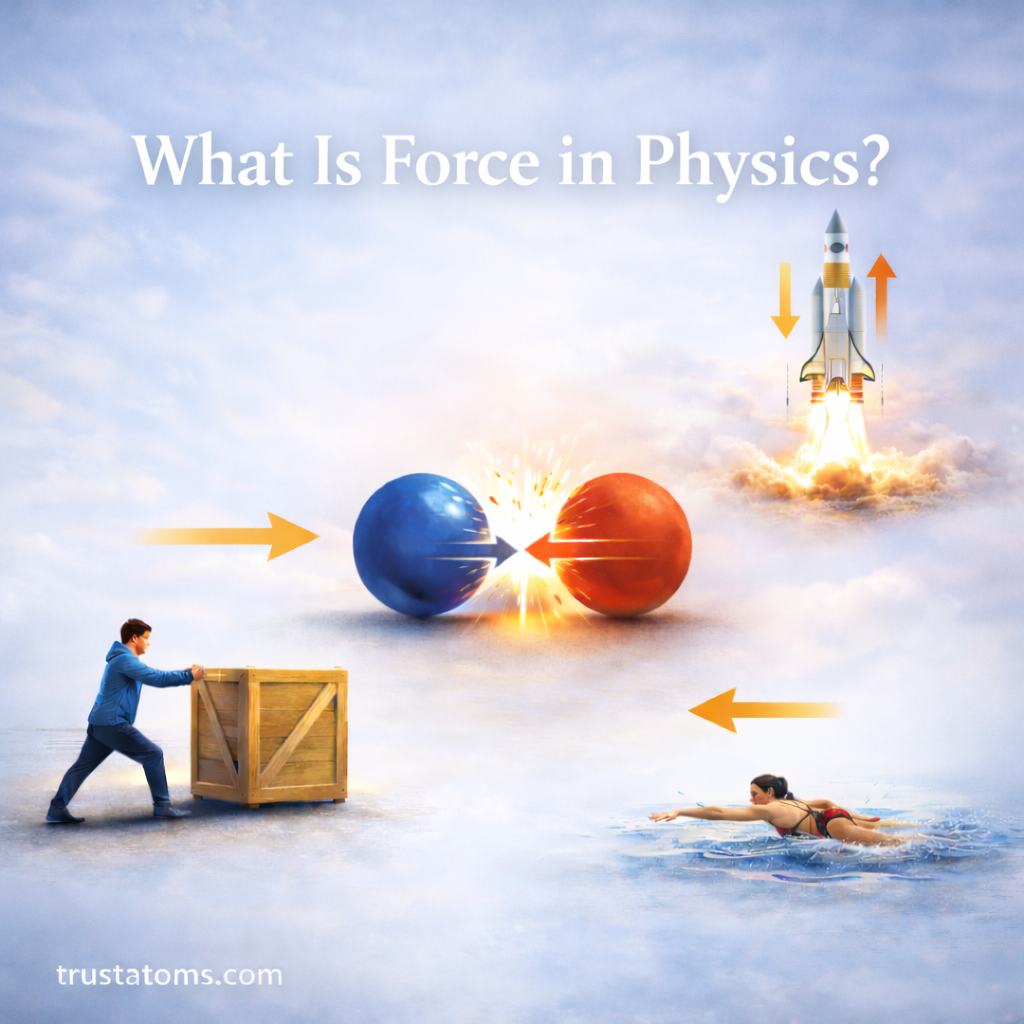
Force is one of the most fundamental concepts in physics. It explains why objects move, stop, accelerate, change direction, or even change shape.
In simple terms, a force is a push or a pull acting on an object. But in physics, force is more than just movement — it is the cause of acceleration.
In this guide, we’ll break down what force means in physics, how it’s measured, the different types of forces, and how it affects the world around us.
Definition of Force
In physics, force is any interaction that can change an object’s:
- Motion (speed or direction)
- Position
- Shape
If nothing changes, there is either no force acting or the forces are balanced.
Force is a vector quantity, which means it has:
- Magnitude (how strong it is)
- Direction (which way it acts)
The Formula for Force
Force is defined mathematically by Newton’s Second Law of Motion:
F = ma
Where:
- F = force (in newtons, N)
- m = mass (in kilograms, kg)
- a = acceleration (in meters per second squared, m/s²)
This formula tells us:
- More force produces more acceleration.
- More mass requires more force to achieve the same acceleration.
Units of Force
The standard unit of force in the International System (SI) is the newton (N).
One newton is defined as:
The force required to accelerate a 1-kilogram object by 1 meter per second squared.
So:
1 N = 1 kg × 1 m/s²
Balanced vs. Unbalanced Forces
Forces can act together in different ways.
Balanced Forces
Balanced forces occur when:
- Forces are equal in magnitude
- Forces act in opposite directions
- Net force equals zero
Result: No acceleration occurs.
Example:
- A book resting on a table
- Gravity pulls downward
- The table pushes upward
- The forces cancel out
Unbalanced Forces
Unbalanced forces occur when:
- Net force is not zero
Result: The object accelerates.
Acceleration can mean:
- Speeding up
- Slowing down
- Changing direction
Example:
- Kicking a soccer ball
- A car accelerating
- A rocket launching
Types of Forces in Physics
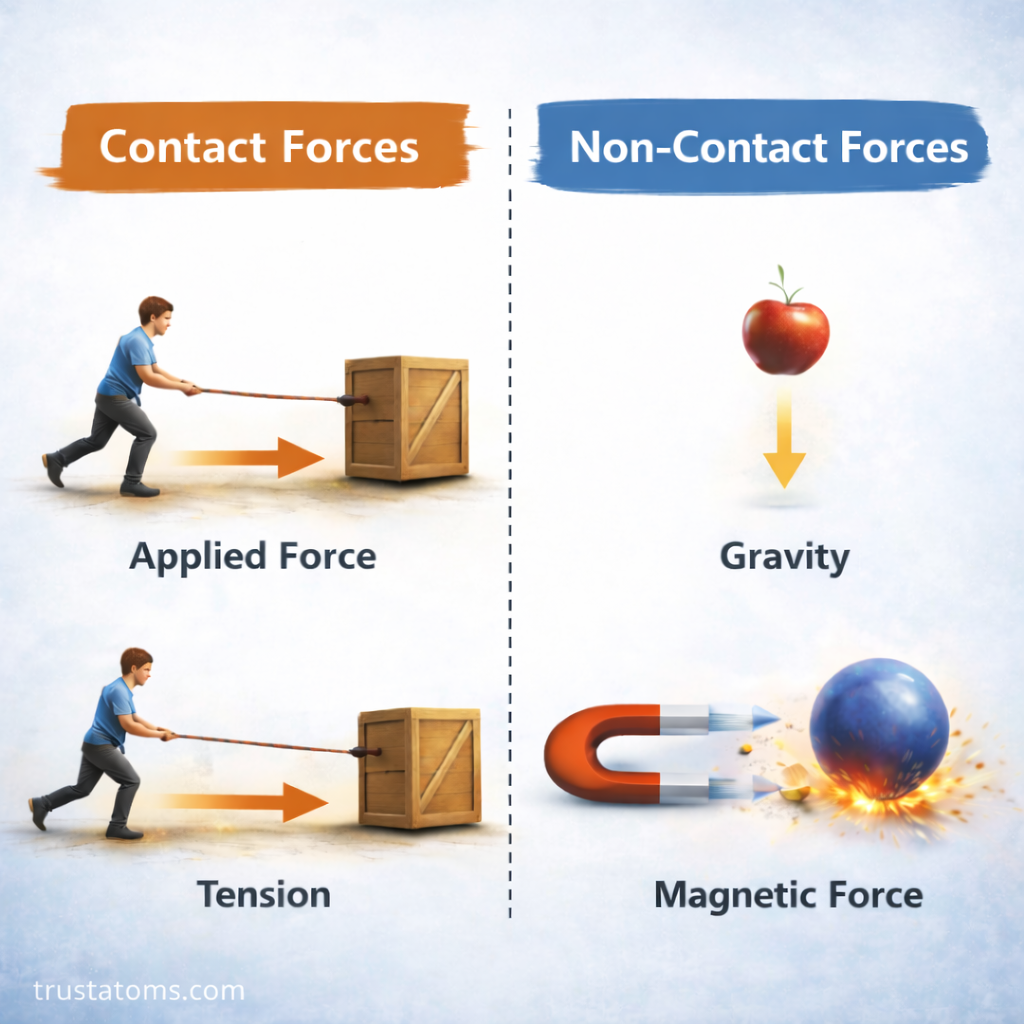
There are two main categories of forces:
- Contact forces
- Non-contact forces
Contact Forces
Contact forces occur when objects physically touch.
Examples include:
- Friction – resists motion between surfaces
- Normal force – support force from a surface
- Tension – pulling force through a rope or cable
- Applied force – a push or pull by a person or object
- Air resistance – force from air opposing motion
Non-Contact Forces
Non-contact forces act without physical contact.
Examples include:
- Gravitational force – attraction between masses
- Magnetic force – interaction between magnets
- Electric force – attraction or repulsion between charges
These forces act across distances.
Force and Motion
Force causes changes in motion.
According to Newton’s Laws:
- Without net force, motion does not change.
- With net force, acceleration occurs.
- Every force interaction produces an equal and opposite force.
Force explains:
- Why objects fall
- Why cars move
- Why rockets launch
- Why you feel pushed back in a moving vehicle
Net Force Explained
Net force is the total force acting on an object after adding all forces together.
If forces act in the same direction:
- Add them.
If forces act in opposite directions:
- Subtract them.
Example:
If 10 N pushes right and 4 N pushes left:
Net force = 6 N to the right.
The object accelerates in that direction.
How Force Changes Shape
Force does not only affect motion — it can also deform objects.
Examples:
- Squeezing a sponge
- Stretching a rubber band
- Compressing a spring
These changes occur because force is applied to the material.
Real-World Applications of Force
Understanding force is essential in:
- Engineering and construction
- Vehicle safety design
- Sports mechanics
- Space travel
- Robotics
- Structural stability
Every machine, structure, and moving system relies on force calculations.
Common Misconceptions About Force
“Force Always Means Movement”
Not true.
An object can have forces acting on it without moving if they are balanced.
“Heavier Objects Have More Force”
Mass and force are different.
Heavier objects require more force to accelerate, but mass itself is not a force.
“Force and Energy Are the Same”
Force causes acceleration.
Energy is the ability to do work.
They are related but not identical.
Why Understanding Force Matters
Force is the foundation of classical mechanics.
Without understanding force, we couldn’t:
- Build safe bridges
- Design vehicles
- Launch satellites
- Predict motion
- Understand planetary systems
Force connects mass and acceleration in a measurable way.
It explains how interactions shape the physical universe.
Final Thoughts
Force in physics is any push or pull that can change an object’s motion or shape.
It is measured in newtons and calculated using F = ma.
Whether you’re walking, driving, jumping, or launching a rocket, forces are constantly interacting around you.
Understanding force gives you a deeper understanding of how motion works — from everyday life to outer space.