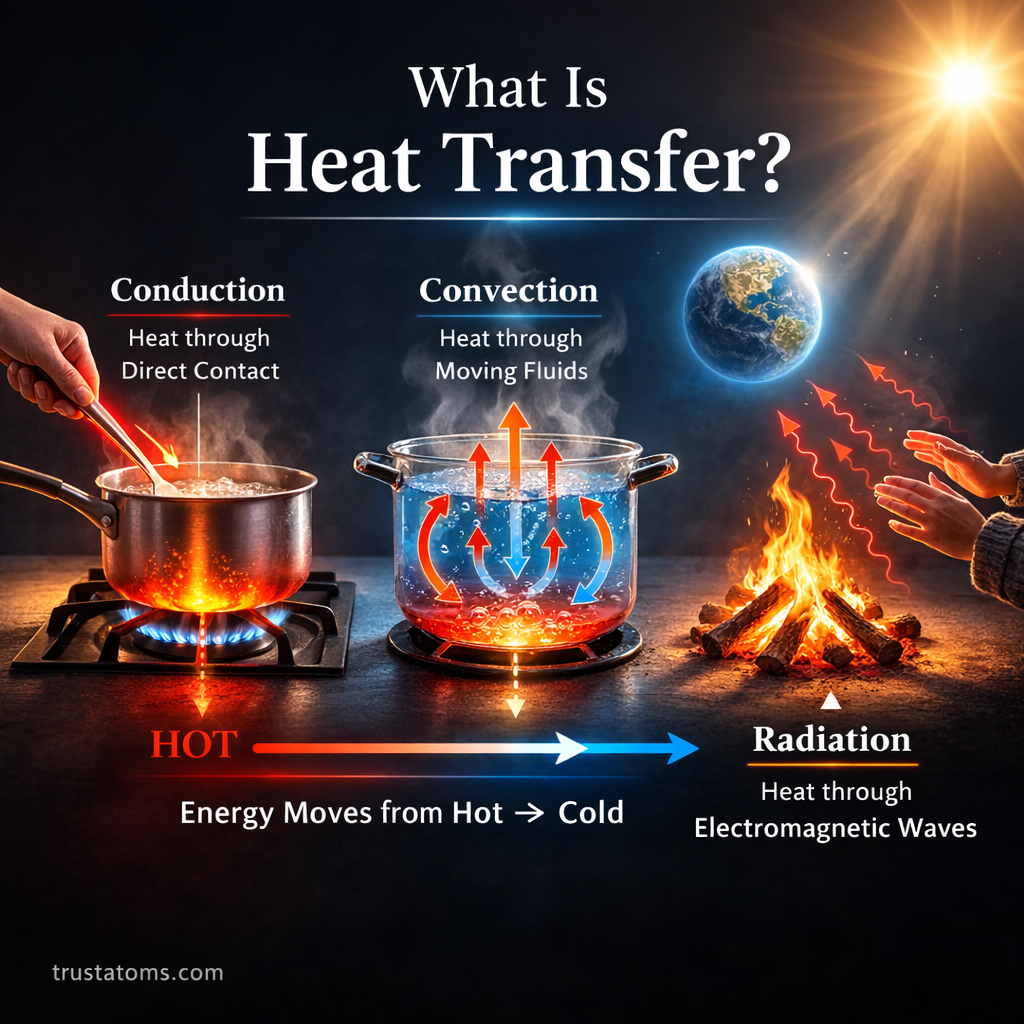
Heat transfer is the movement of thermal energy from one object or system to another due to a temperature difference. In simple terms, heat always flows from something warmer to something cooler until both reach the same temperature.
Understanding heat transfer is essential in physics because it explains everyday experiences — from why a metal spoon gets hot in soup to how the Sun warms Earth. It also plays a critical role in engineering, climate science, space exploration, and modern technology.
What Is Heat?
Before defining heat transfer fully, it helps to clarify what “heat” actually is.
Heat is not the same as temperature.
- Temperature measures how fast particles (atoms or molecules) are moving.
- Heat is the total energy transferred between objects because of a temperature difference.
If two objects are at different temperatures and touch (or interact), thermal energy moves from the hotter one to the cooler one. That movement is called heat transfer.
The Three Main Types of Heat Transfer
In physics, heat moves in three primary ways:
- Conduction
- Convection
- Radiation
Each works differently, but all follow the same rule: energy flows from hot to cold.
1. Conduction
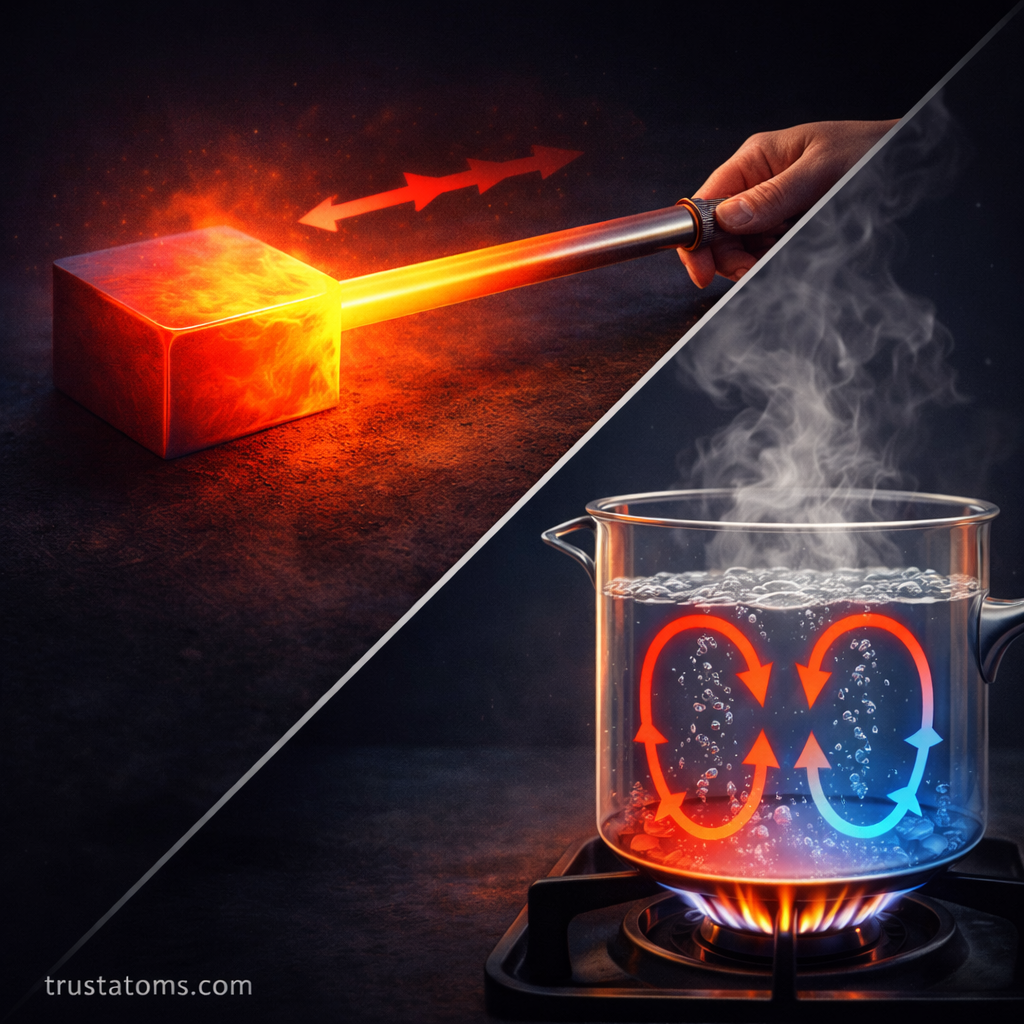
Conduction is heat transfer through direct contact between particles.
It happens when atoms or molecules bump into neighboring particles and pass along energy.
Everyday Examples of Conduction
- A metal spoon heating up in hot soup
- Walking barefoot on hot sand
- Touching a hot pan
Metals are excellent conductors because their particles and free electrons transfer energy quickly. Materials like wood and plastic are poor conductors — they are called insulators.
Why Conduction Matters
Conduction explains:
- Why cookware is made of metal
- Why oven mitts are insulated
- How heat travels through walls in a building
2. Convection
Convection is heat transfer through the movement of fluids — liquids or gases.
Unlike conduction, convection involves the bulk movement of matter.
When a fluid is heated:
- It expands
- Its density decreases
- It rises
- Cooler, denser fluid sinks
This creates a circular motion called a convection current.
Everyday Examples of Convection
- Boiling water in a pot
- Warm air rising from a heater
- Ocean currents
- Wind patterns
Why Convection Is Important
Convection plays a major role in:
- Weather systems
- Climate patterns
- Heating and cooling systems
- The movement of magma inside Earth
Without convection, Earth’s atmosphere and oceans would behave very differently.
3. Radiation
Radiation is heat transfer through electromagnetic waves.
Unlike conduction and convection, radiation does not require matter. It can travel through empty space.
That’s how energy from the Sun reaches Earth.
Examples of Radiation
- Sunlight warming your skin
- Feeling heat from a fire without touching it
- Infrared heat lamps
All objects emit some form of thermal radiation. The hotter the object, the more radiation it emits.
Comparing the Three Types of Heat Transfer
Here’s a simplified comparison:
- Conduction → Direct contact between particles
- Convection → Movement of liquids or gases
- Radiation → Energy carried by electromagnetic waves
In real life, these processes often happen together. For example, when cooking soup:
- The stove conducts heat to the pot
- The soup circulates through convection
- The pot emits heat through radiation
The Physics Behind Heat Transfer
Heat transfer is driven by the Second Law of Thermodynamics, which states that energy naturally spreads out over time.
In physics terms:
- Energy moves toward equilibrium
- Systems tend toward balance
- Temperature differences decrease over time
Heat transfer continues until thermal equilibrium is reached — meaning both objects have the same temperature.
Why Heat Transfer Is Important in Science and Engineering
Heat transfer is fundamental to many technologies and natural systems.
In Engineering
- Designing engines
- Building insulation
- Developing refrigeration systems
- Creating heat shields for spacecraft
In Environmental Science
- Understanding global warming
- Studying ocean circulation
- Predicting weather patterns
In Human Biology
- Regulating body temperature
- Sweating and evaporation
- Heat loss in cold environments
Without understanding heat transfer, modern engineering and environmental science would not function.
Heat Transfer in Everyday Life
You experience heat transfer constantly:
- Ice melting in your drink
- Coffee cooling down
- Air conditioning in summer
- Wearing a jacket in winter
Even your body uses conduction, convection, and radiation to maintain a stable internal temperature.
Physics is not abstract — it’s happening all around you.
Key Takeaways
- Heat transfer is the movement of thermal energy from hot to cold.
- It occurs through conduction, convection, and radiation.
- Conduction requires contact.
- Convection requires moving fluids.
- Radiation does not require matter.
- Heat transfer continues until thermal equilibrium is reached.
Understanding heat transfer helps explain everything from cooking food to climate systems to space travel.
Final Thoughts
Heat transfer is one of the most fundamental concepts in physics. It connects microscopic particle motion to massive global systems.
Whether you’re studying physics formally or simply curious about how the world works, mastering heat transfer gives you a powerful lens for understanding energy in motion.
And once you start noticing it, you’ll see it everywhere.