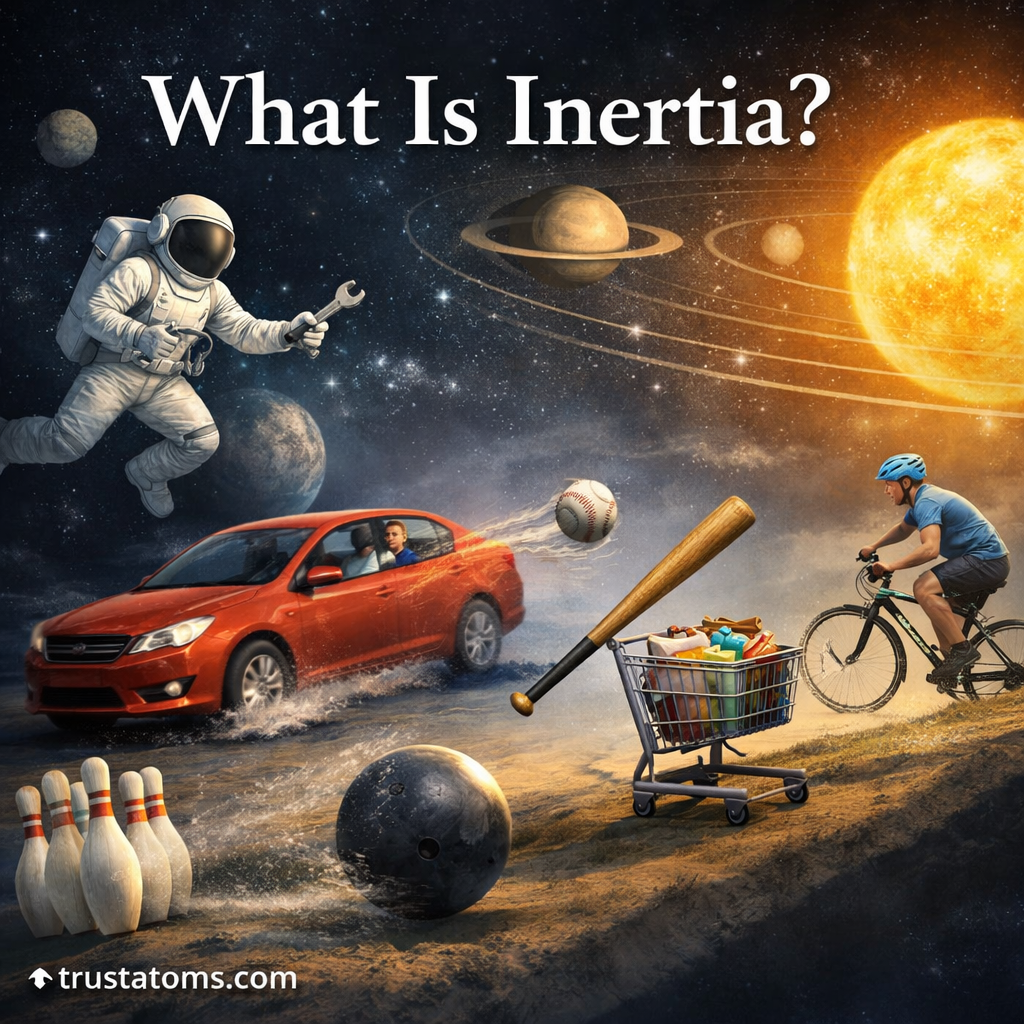
Inertia is the natural tendency of an object to resist changes in its motion. If something is at rest, it wants to stay at rest. If it’s moving, it wants to keep moving at the same speed and in the same direction—unless something forces it to change.
This simple but powerful concept explains everything from why passengers lurch forward when a car brakes to why planets stay in motion around the sun.
In this guide, you’ll learn what inertia is, why it happens, and how it shapes everyday life.
The Basic Definition of Inertia
In physics, inertia is the resistance of any physical object to a change in its velocity.
Velocity includes:
- Speed
- Direction of motion
If either changes, the object’s motion has changed.
Inertia is not a force. It is a property of matter.
The more mass an object has, the more inertia it has.
Newton’s First Law of Motion
Inertia is formally described in Newton’s First Law of Motion, which states:
An object at rest stays at rest, and an object in motion stays in motion at a constant velocity unless acted upon by a net external force.
This law is often called the Law of Inertia.
It explains why motion does not require continuous force. Instead, force is only required to change motion.
For example:
- A hockey puck slides across ice because there is very little friction to slow it down.
- A book stays on a table until someone pushes it.
- A car continues moving after the engine stops—until friction and air resistance slow it.
Why Does Inertia Exist?
Inertia exists because mass resists acceleration.
Acceleration means any change in velocity, including:
- Starting
- Stopping
- Speeding up
- Slowing down
- Turning
Mass is a measure of how much matter something contains. The greater the mass, the harder it is to change its motion.
For example:
- It’s easier to push a bicycle than a truck.
- A tennis ball stops quickly after being thrown.
- A bowling ball is harder to stop once it’s rolling.
All of these differences are due to inertia.
Types of Inertia
Inertia can be grouped into three categories.
Inertia of Rest
An object at rest tends to stay at rest.
Example:
- A coin remains on a table until someone moves it.
- When a car suddenly accelerates, passengers feel pushed backward because their bodies resist the change in motion.
Inertia of Motion
An object in motion tends to stay in motion.
Example:
- A rolling skateboard keeps moving until friction slows it.
- Passengers move forward when a car suddenly stops.
Inertia of Direction
An object moving in one direction resists changes in direction.
Example:
- When a car turns sharply, passengers lean sideways.
- A ball thrown forward doesn’t naturally curve unless a force changes its direction.
Everyday Examples of Inertia

Inertia explains many common experiences:
- Seat belts prevent your body from continuing forward during sudden braking.
- Tablecloth tricks work because dishes resist motion.
- Sports movements rely on controlling inertia (like swinging a bat or racket).
- Spacecraft continue moving through space with minimal fuel once launched.
Without inertia, motion would behave unpredictably.
Inertia in Space
In space, inertia becomes especially noticeable because there is very little friction.
If an astronaut pushes a tool, it keeps floating at constant speed until another force acts on it.
Similarly, planets orbit stars because gravitational force continually changes their direction while inertia keeps them moving forward.
Without inertia, stable orbits would not exist.
The Relationship Between Inertia and Mass
Mass is directly proportional to inertia.
This means:
- More mass = more inertia
- Less mass = less inertia
Weight is not the same as inertia.
Weight depends on gravity.
Inertia depends only on mass.
An astronaut on the Moon weighs less than on Earth but still has the same inertia.
Why Inertia Matters
Understanding inertia helps explain:
- Car safety systems (seat belts, airbags)
- Engineering design
- Sports performance
- Rocket launches
- Planetary motion
- Everyday object behavior
It forms the foundation of classical mechanics.
Without inertia, physics as we understand it would not function.
Common Misconceptions About Inertia
“Inertia Is a Force”
It’s not. Inertia is a property of matter.
“Objects Stop Because Inertia Runs Out”
Objects stop because of opposing forces like friction—not because inertia disappears.
“Heavier Objects Fall Faster Because of Inertia”
In the absence of air resistance, objects fall at the same rate regardless of mass.
Final Thoughts
Inertia is one of the most fundamental principles in physics. It explains why objects resist changes in motion and why mass matters when applying force.
From the motion of cars and sports equipment to the orbits of planets, inertia plays a central role in how the universe behaves.
Once you understand inertia, you start to see it everywhere.