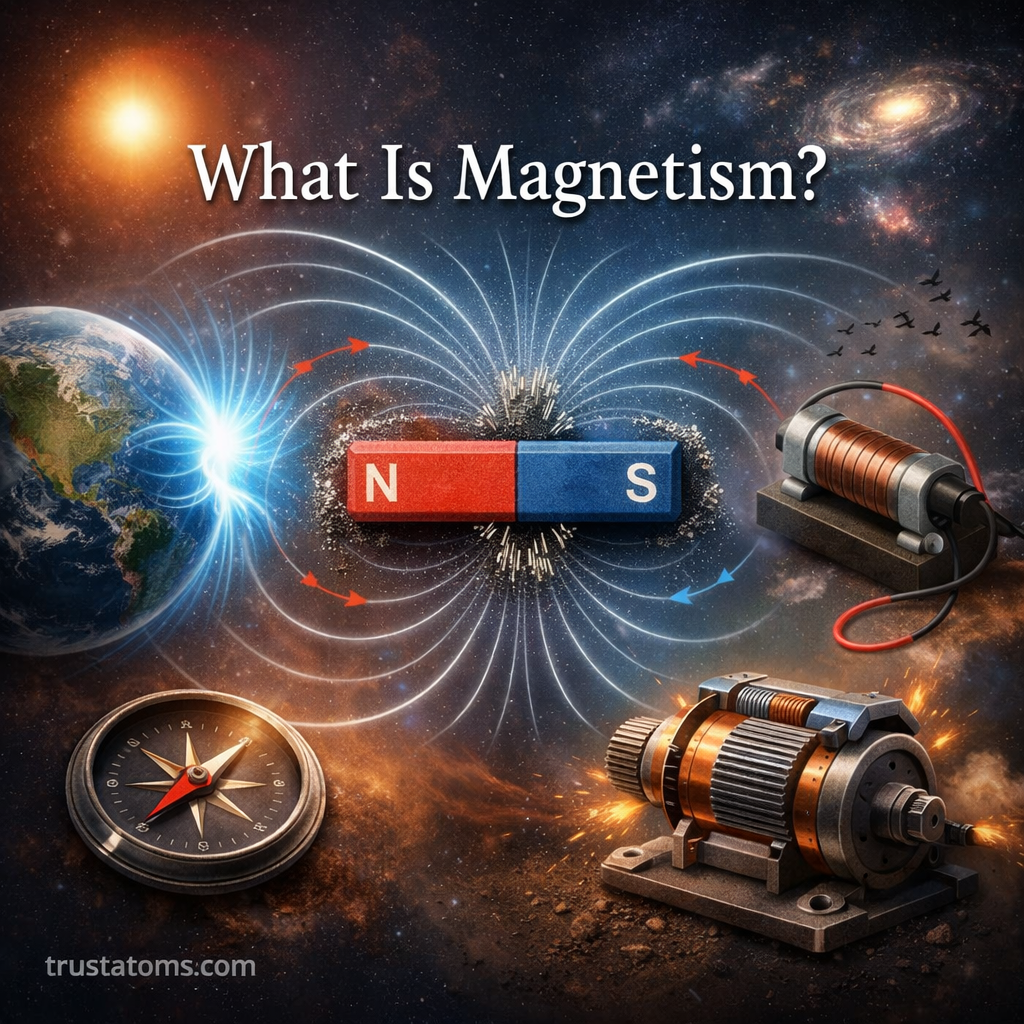
Magnetism is one of the fundamental forces of nature. It explains why certain materials attract or repel each other and how electric motors, generators, compasses, and even Earth’s protective magnetic shield work.
At its core, magnetism is the result of moving electric charges. From tiny electrons inside atoms to massive magnetic fields around planets, magnetism shapes both everyday technology and cosmic phenomena.
In this guide, you’ll learn what magnetism is, how it works, and why it’s essential in physics.
What Is Magnetism in Simple Terms?
Magnetism is a physical phenomenon produced by the motion of electric charges. It creates forces that can:
- Pull objects together (attraction)
- Push objects apart (repulsion)
- Generate magnetic fields around materials
Magnets have two poles:
- North pole
- South pole
Opposite poles attract.
Like poles repel.
This simple rule governs all magnetic interactions.
Where Does Magnetism Come From?
Magnetism originates at the atomic level.
Inside every atom are:
- Protons (positively charged)
- Neutrons (neutral)
- Electrons (negatively charged)
Electrons do two important things:
- They spin on their axes.
- They orbit the nucleus.
Because electrons carry electric charge, their motion creates tiny magnetic fields. In most materials, these tiny fields cancel each other out.
But in certain materials — like iron, nickel, and cobalt — many electron spins align in the same direction. When this happens, their magnetic effects add up, creating a strong overall magnetic field.
That’s how permanent magnets are formed.
What Is a Magnetic Field?
A magnetic field is the invisible region around a magnet where magnetic forces can be detected.
You can visualize it using iron filings sprinkled around a magnet. The filings form curved lines that show the shape of the magnetic field.
Key characteristics of magnetic fields:
- Field lines travel from north to south outside the magnet.
- The field is strongest near the poles.
- Magnetic fields are vector fields (they have direction and magnitude).
Magnetic fields are measured in units called teslas (T).
Types of Magnetism
Not all magnetic behavior is the same. There are three primary types in physics:
1. Ferromagnetism
This is the strongest type of magnetism.
- Found in iron, cobalt, and nickel
- Materials can become permanent magnets
- Electron spins align strongly
This is the type used in fridge magnets and bar magnets.
2. Paramagnetism
- Weak attraction to magnetic fields
- Electron spins don’t permanently align
- Only magnetic when an external field is present
3. Diamagnetism
- Very weak repulsion from magnetic fields
- Present in almost all materials
- Caused by small changes in electron motion
Diamagnetism is usually so weak it’s hard to observe without special equipment.
The Connection Between Electricity and Magnetism
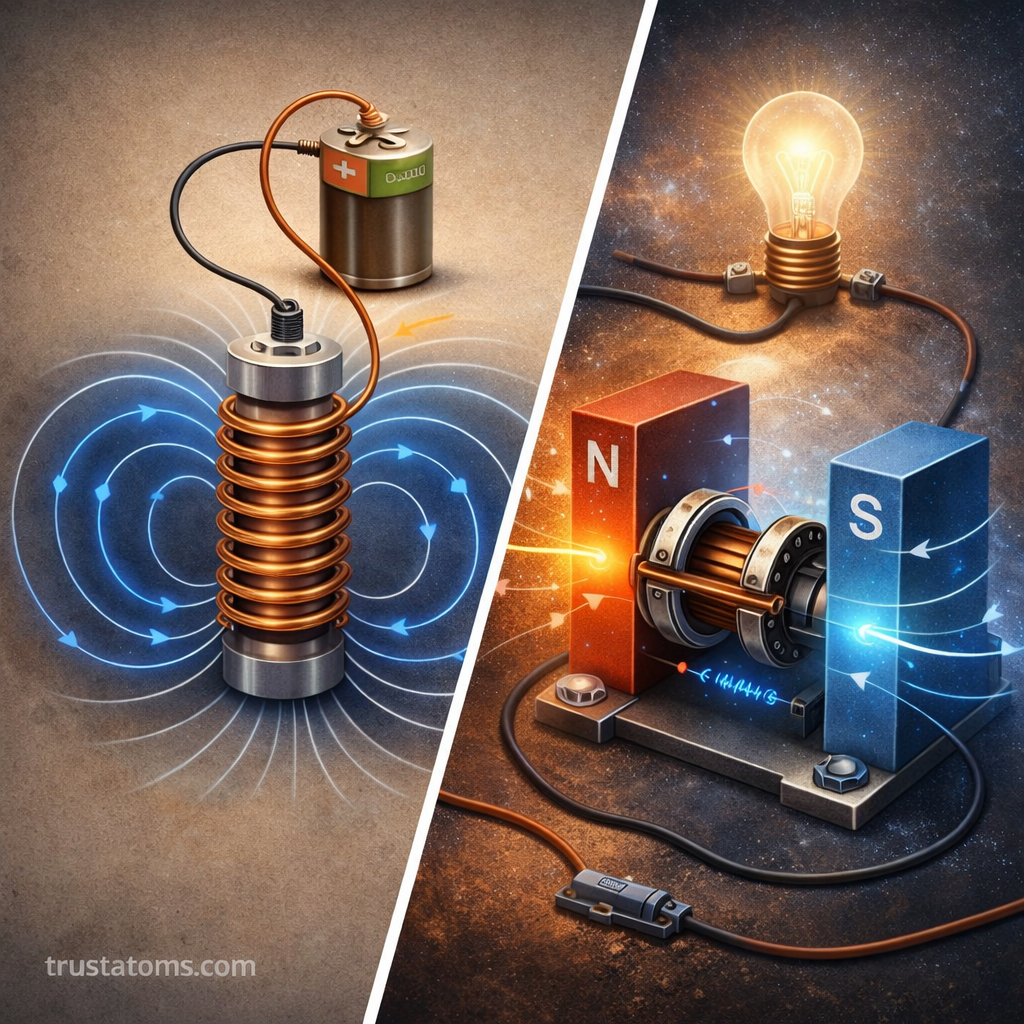
Magnetism and electricity are deeply connected.
In the 1800s, scientists discovered:
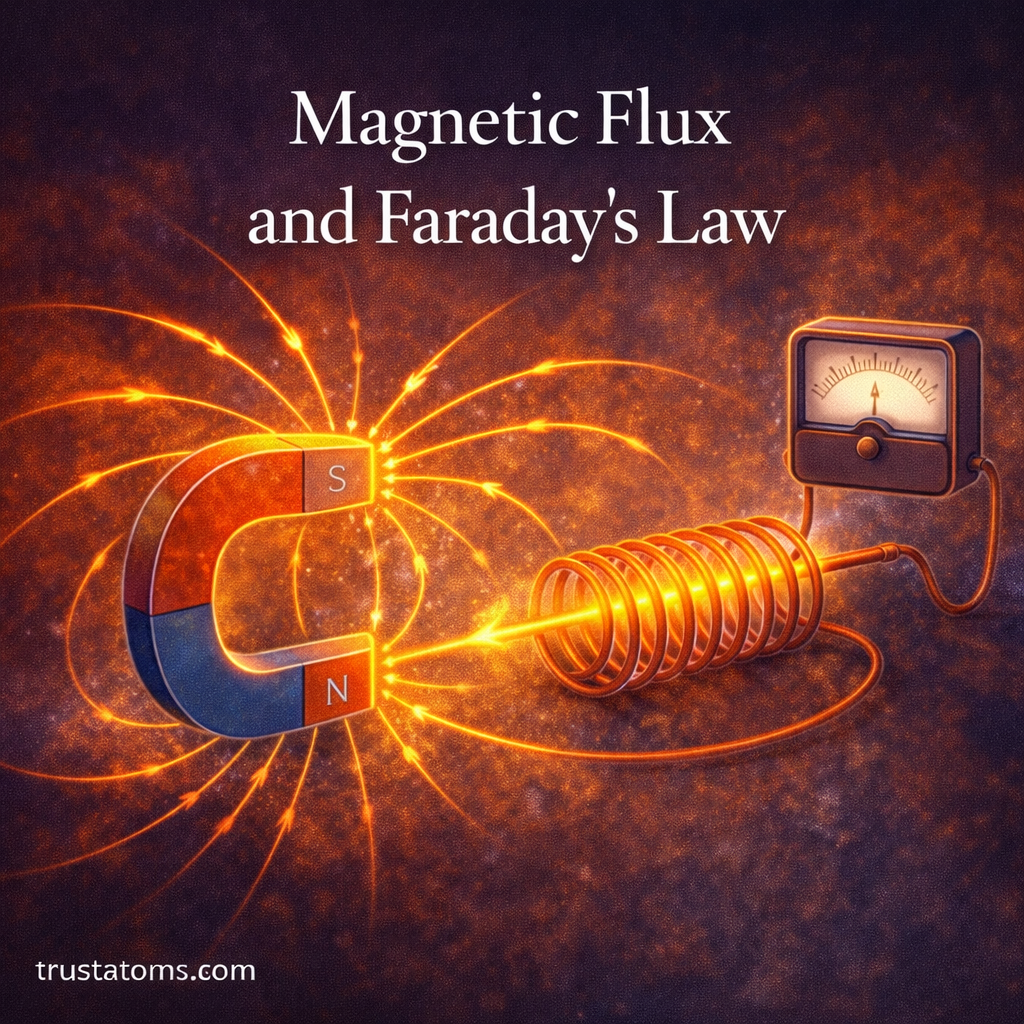
- Moving electric charges create magnetic fields.
- Changing magnetic fields can generate electric currents.
This relationship forms the basis of electromagnetism — one of the four fundamental forces of nature.
Electromagnetism powers:
- Electric motors
- Generators
- Transformers
- Wireless communication
- MRI machines
Without magnetism, modern civilization wouldn’t function.
What Is an Electromagnet?
An electromagnet is a magnet created by electric current.
When electricity flows through a wire, it produces a magnetic field. Wrapping the wire into a coil strengthens the field. Placing an iron core inside the coil makes it even stronger.
Electromagnets are useful because:
- They can be turned on and off.
- Their strength can be adjusted.
- They are used in cranes, speakers, and electric bells.
Earth’s Magnetic Field
Earth itself acts like a giant magnet.
The planet’s outer core contains molten iron and nickel. As this liquid metal moves, it generates electric currents. These currents create Earth’s magnetic field.
This magnetic field:
- Protects Earth from harmful solar radiation
- Guides compasses
- Helps many animals navigate
Without Earth’s magnetism, life as we know it would be very different.
Why Magnetism Matters in Physics
Magnetism plays a central role in:
- Quantum mechanics (electron spin)
- Relativity (electromagnetic fields)
- Plasma physics
- Astrophysics
- Engineering and materials science
It helps scientists understand everything from atomic behavior to galaxy formation.
Common Everyday Examples of Magnetism
You interact with magnetism more than you realize:
- Refrigerator magnets
- Headphones and speakers
- Credit card strips
- Electric fans
- Hard drives
- Compasses
Nearly all electrical devices rely on magnetic principles.
Final Thoughts
Magnetism is not just about magnets sticking to metal. It is a fundamental physical force rooted in the motion of electric charges. From the atomic scale to planetary protection, magnetism shapes both technology and the natural world.
Understanding magnetism opens the door to deeper topics in physics, including electromagnetism, quantum theory, and energy generation.
It’s invisible — but it powers the modern world.