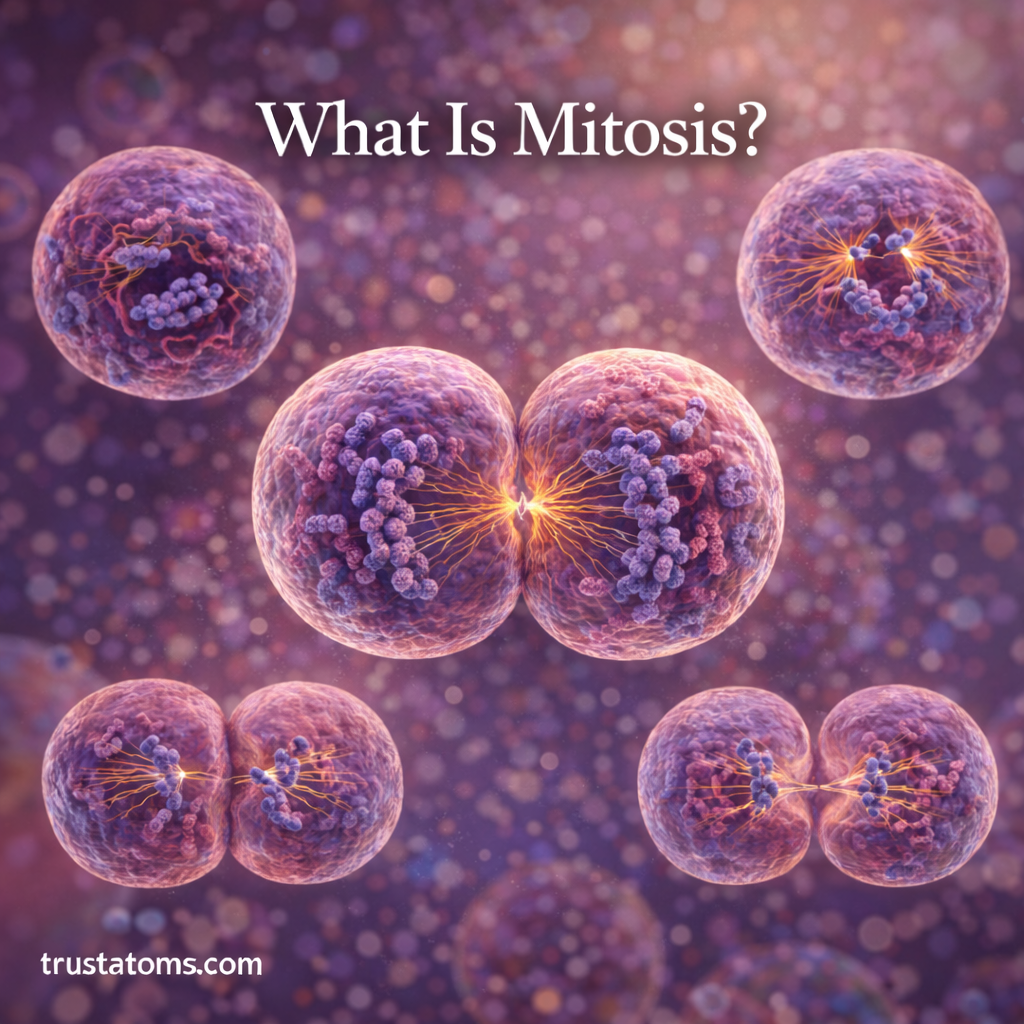
Mitosis is a process of cell division that allows a single cell to produce two identical daughter cells. This process is essential for growth, tissue repair, and maintaining healthy cells in multicellular organisms.
Every time your body grows, heals a wound, or replaces worn-out cells, mitosis is happening inside your tissues. By ensuring that each new cell receives an identical copy of genetic material, mitosis maintains stability in an organism’s DNA.
Understanding mitosis helps explain how organisms develop, maintain their bodies, and keep cells functioning properly.
The Basic Definition of Mitosis
Mitosis is a type of cell division that produces two genetically identical cells from one original cell.
Each new cell contains the same number of chromosomes as the parent cell. This ensures that genetic information is accurately preserved.
Mitosis occurs in somatic cells, which are the body’s non-reproductive cells.
Examples of somatic cells include:
- Skin cells
- Muscle cells
- Blood cells
- Liver cells
This process allows organisms to grow and replace damaged or old cells.
Why Mitosis Is Important
Mitosis plays several critical roles in living organisms.
Growth and Development
During early development, organisms grow rapidly through repeated rounds of mitosis. A single fertilized cell divides many times to form the trillions of cells that make up the human body.
Tissue Repair
When tissues are damaged, mitosis helps replace injured or dead cells.
Examples include:
- Healing cuts or wounds
- Replacing skin cells
- Regenerating certain tissues
Cell Replacement
Many cells have limited lifespans and must be replaced regularly.
Mitosis ensures that new cells are created to maintain healthy tissues and organs.
The Cell Cycle and Mitosis
Mitosis is one stage within a larger process called the cell cycle.
The cell cycle includes several phases that prepare a cell for division.
1. Interphase
Before mitosis begins, the cell undergoes interphase, which is the longest stage of the cell cycle.
During interphase, the cell:
- Grows in size
- Produces proteins and organelles
- Replicates its DNA
DNA replication ensures that each daughter cell will receive a complete set of chromosomes.
2. Mitosis Phase
After interphase, the cell enters mitosis, where the nucleus divides and genetic material is separated into two identical sets.
3. Cytokinesis
Following mitosis, the cell completes division through cytokinesis, where the cytoplasm splits and two separate cells form.
The Stages of Mitosis
Mitosis occurs in several carefully controlled stages. Each stage ensures chromosomes are accurately divided between the new cells.
The main stages of mitosis are:
- Prophase
- Metaphase
- Anaphase
- Telophase
These stages occur in a precise sequence.
Prophase
During prophase, chromosomes become visible as they condense into tightly coiled structures.
Other important changes occur:
- The nuclear membrane begins to break down
- Spindle fibers start forming
- Chromosomes prepare to move within the cell
Spindle fibers are structures that help guide chromosomes during division.
Metaphase
During metaphase, chromosomes align in the middle of the cell along a region called the metaphase plate.
Key events include:
- Spindle fibers attach to chromosomes
- Chromosomes line up at the cell’s center
This alignment ensures each daughter cell receives the correct number of chromosomes.
Anaphase
During anaphase, the sister chromatids (identical copies of chromosomes) are pulled apart.
Important events include:
- Chromatids separate
- Spindle fibers pull them toward opposite sides of the cell
This step ensures each new cell receives an identical set of chromosomes.
Telophase
During telophase, the separated chromosomes reach opposite ends of the cell.
Several changes occur:
- New nuclear membranes form
- Chromosomes begin to unwind
- The cell prepares for final separation
At this point, two distinct nuclei have formed.
Cytokinesis: Completing Cell Division
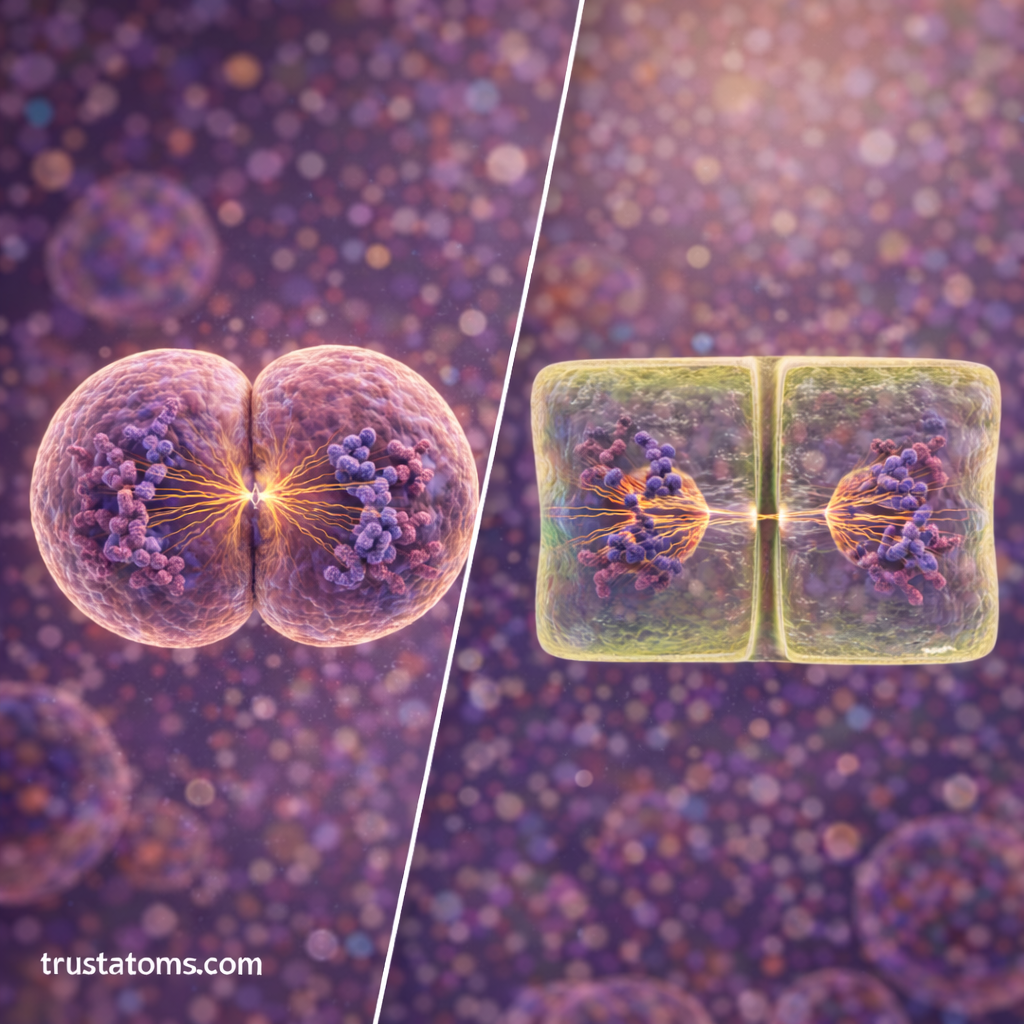
After mitosis finishes, the cell undergoes cytokinesis, which divides the cytoplasm.
In animal cells:
- The cell membrane pinches inward
- Two separate cells form
In plant cells:
- A cell plate forms between the two nuclei
- A new cell wall develops
Once cytokinesis is complete, two genetically identical daughter cells exist.
Mitosis vs Meiosis
Mitosis is often compared with meiosis, another form of cell division.
However, the two processes serve different purposes.
Mitosis:
- Produces two identical cells
- Maintains chromosome number
- Occurs in body (somatic) cells
- Supports growth and repair
Meiosis:
- Produces four genetically different cells
- Reduces chromosome number by half
- Occurs in reproductive cells
- Creates sperm and egg cells
These differences are essential for reproduction and genetic diversity.
Why Accurate Mitosis Matters
Mitosis must occur with great precision. Errors during chromosome separation can lead to genetic abnormalities.
Problems with cell division may contribute to diseases such as:
- Cancer
- Genetic disorders
- Abnormal cell growth
Because of this, cells contain many regulatory mechanisms that monitor and control the mitosis process.
Final Thoughts
Mitosis is one of the most fundamental processes in biology. By producing two identical cells from a single parent cell, mitosis supports growth, tissue repair, and the continuous maintenance of living organisms.
Through carefully regulated stages, mitosis ensures that genetic information is accurately distributed to new cells. This precise process allows organisms to grow, heal, and maintain healthy tissues throughout life.
Understanding mitosis provides valuable insight into how cells function and how life continues at the cellular level.