If you’ve ever mixed a sports drink, brewed coffee, or diluted a cleaning solution, you’ve adjusted concentration — even if you didn’t call it that.
In chemistry, one of the most common ways to measure concentration is molarity.
Molarity tells us how much of a substance is dissolved in a specific amount of liquid. It’s a precise and standardized way scientists describe the strength of a solution.
Let’s break it down clearly and step by step.
The Basic Definition of Molarity
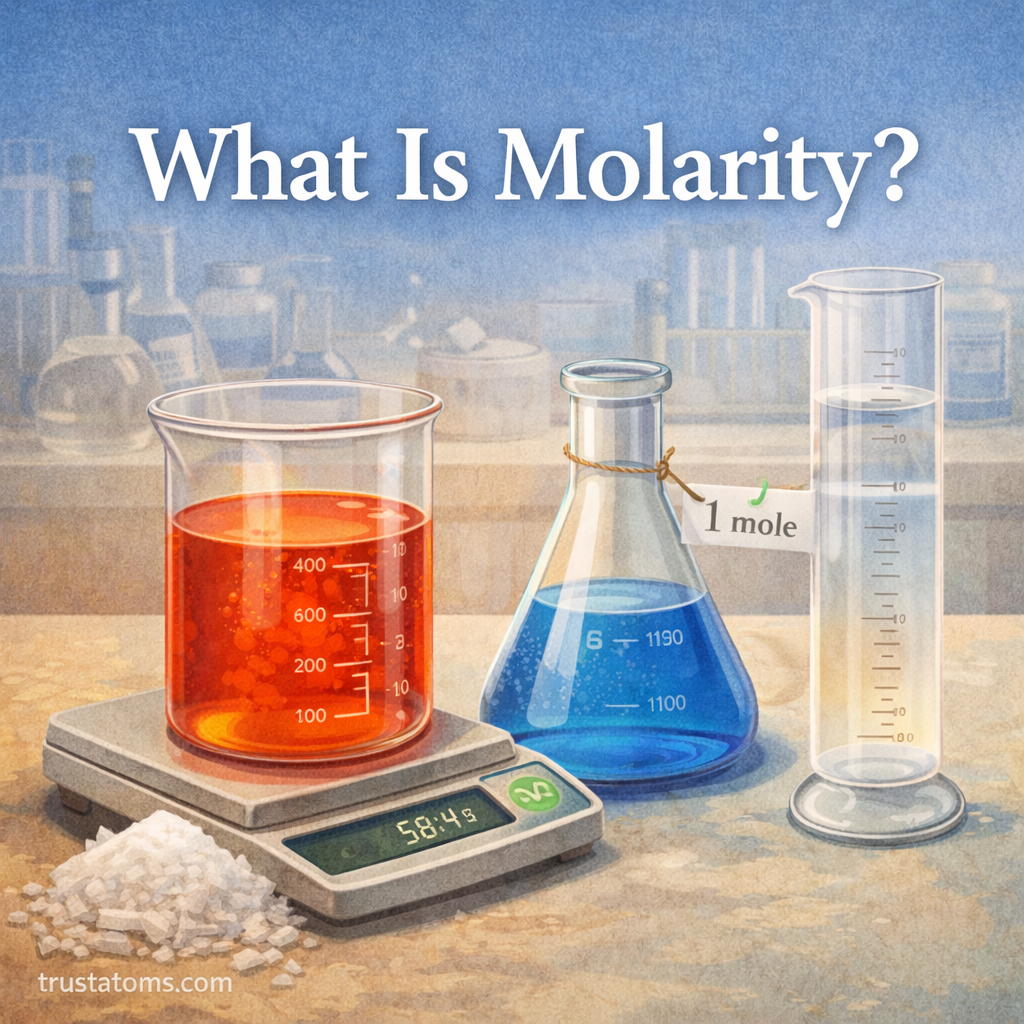
Molarity is the number of moles of a solute dissolved per liter of solution.
In simpler terms:
- Solute = the substance being dissolved
- Solvent = the liquid doing the dissolving
- Solution = the final mixture
Molarity measures how many chemical particles are present in a fixed volume of liquid.
For example:
If one mole of salt is dissolved in one liter of water, the solution has a molarity of 1 mole per liter (often written as 1 M).
What Is a Mole?
To understand molarity, you need to understand the concept of a mole.
A mole is a standard unit in chemistry that represents a specific number of particles (atoms, molecules, or ions).
One mole contains:
6.022 × 10²³ particles
This number is known as Avogadro’s number.
Why use moles instead of counting atoms directly?
Because atoms and molecules are incredibly small. The mole gives chemists a practical way to measure large quantities of microscopic particles.
The Formula for Molarity
Molarity is calculated using a simple relationship:
Molarity = moles of solute ÷ liters of solution
This means:
- If you increase the amount of solute, molarity increases
- If you increase the volume of solution, molarity decreases
It’s a direct relationship between amount and volume.
Example of Molarity in Action
Let’s say you dissolve:
- 2 moles of sugar
- Into 1 liter of water
The molarity would be:
2 moles ÷ 1 liter = 2 M
If you instead dissolved 2 moles into 2 liters of water:
2 moles ÷ 2 liters = 1 M
Same amount of solute, but diluted into more liquid — so the concentration decreases.
Why Molarity Matters
Molarity is essential in chemistry because reactions depend on concentration.
1. Chemical Reactions
The speed and outcome of reactions often depend on how concentrated reactants are.
Higher molarity:
- More particles in a given space
- More frequent collisions
- Faster reaction rates (in many cases)
2. Laboratory Experiments
Scientists prepare solutions with exact molarity to:
- Ensure reproducible results
- Maintain consistent reaction conditions
- Compare results across different experiments
3. Medicine and Biology
In medical and biological settings:
- IV fluids must have precise concentrations
- Blood chemistry depends on carefully balanced molarity levels
- Drug dosages often depend on solution concentration
Small changes can have large effects.
Molarity vs Other Concentration Units
Molarity is not the only way to measure concentration. Here’s how it compares:
Molarity (M)
- Moles per liter of solution
- Depends on total solution volume
- Most common in laboratory chemistry
Molality (m)
- Moles per kilogram of solvent
- Does not depend on total solution volume
- Used when temperature changes matter
Percent Concentration
- Percentage of solute in a solution
- Often used in everyday products
Molarity is especially useful because it directly connects to chemical equations and reaction calculations.
What Affects Molarity?
Several factors influence molarity:
- Amount of solute added
- Total volume of the solution
- Temperature (since liquids expand or contract slightly)
Because molarity depends on volume, temperature changes can slightly affect it.
Dilution and Molarity
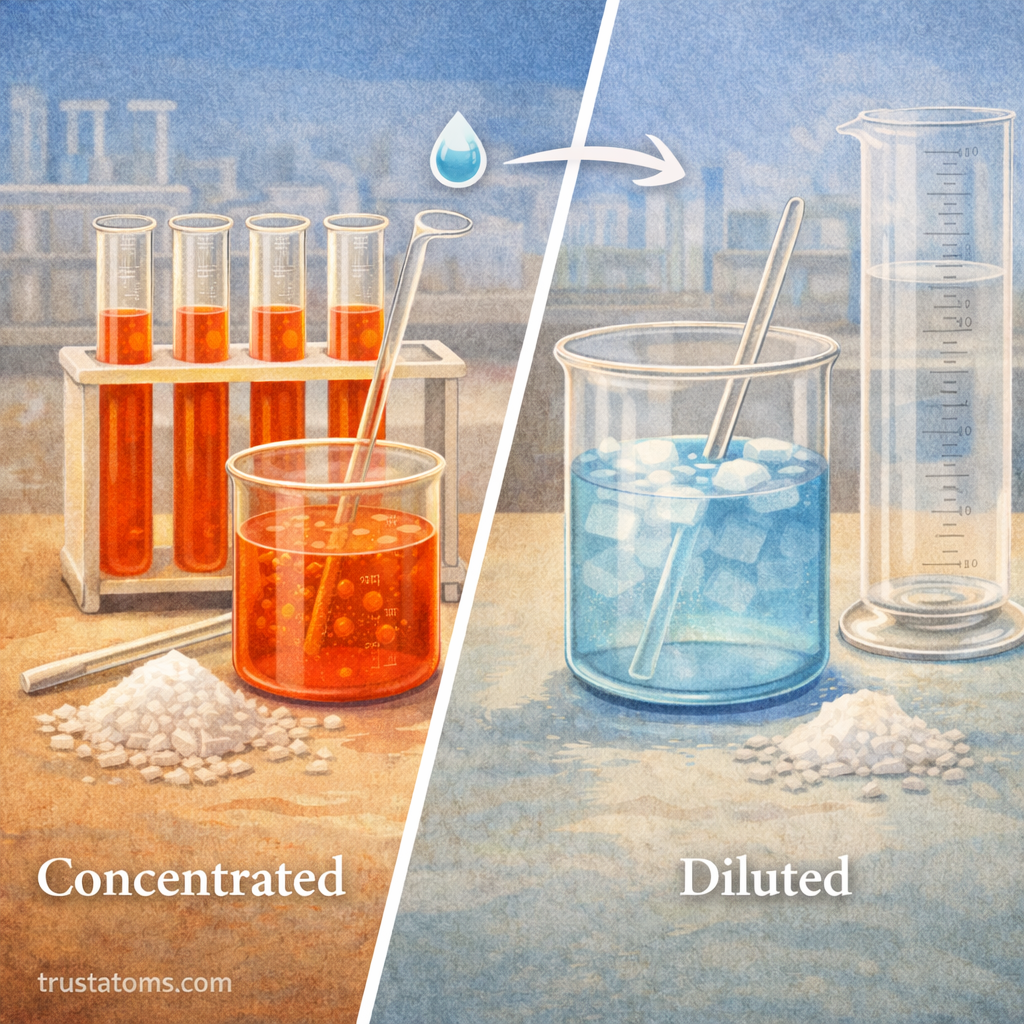
When you dilute a solution:
- The number of moles stays the same
- The volume increases
- The molarity decreases
This relationship is used constantly in labs.
For example:
If you start with a concentrated solution and add water, you lower the molarity without changing the amount of solute.
Common Real-World Examples
Molarity shows up in many places:
- Household bleach solutions
- Swimming pool treatments
- Industrial chemical processing
- Food preservation
- Pharmaceutical manufacturing
Even if we don’t label them in moles per liter, many products rely on carefully controlled concentrations.
Key Takeaways About Molarity
Here’s a quick summary:
- Molarity measures concentration
- It equals moles of solute per liter of solution
- It is written as “M”
- Increasing solute increases molarity
- Increasing volume decreases molarity
- It plays a critical role in chemical reactions and lab work
Understanding molarity helps you understand how strong a solution is and how it will behave in a reaction.
Final Thoughts
Molarity may seem like a technical chemistry term, but it represents a simple and powerful idea: how much of something is dissolved in a specific amount of liquid.
From scientific research to medicine and industry, molarity allows chemists to measure, compare, and control chemical behavior with precision.
Once you understand molarity, you understand one of the core tools of chemistry.