Nuclear energy is the energy stored in the nucleus of an atom. It is released when atomic nuclei change through processes such as fission, fusion, or radioactive decay.
Unlike chemical energy — which comes from electron interactions — nuclear energy comes from changes inside the atom’s core. Because the nucleus holds enormous binding energy, even small changes can release massive amounts of power.
Nuclear energy plays a major role in electricity generation, medicine, and scientific research.
What Is Nuclear Energy in Simple Terms?
Nuclear energy is the energy that holds the nucleus of an atom together.
When the nucleus is split apart or combined with another nucleus, part of its mass can convert into energy.
This mass-to-energy conversion follows the principle of mass–energy equivalence.
Even tiny amounts of mass can produce large amounts of energy.
Where Does Nuclear Energy Come From?
Inside every atomic nucleus:
- Protons repel each other due to positive charge.
- The strong nuclear force holds them together.
- Neutrons help stabilize the nucleus.
The balance between these forces stores energy.
When that balance changes, energy can be released.
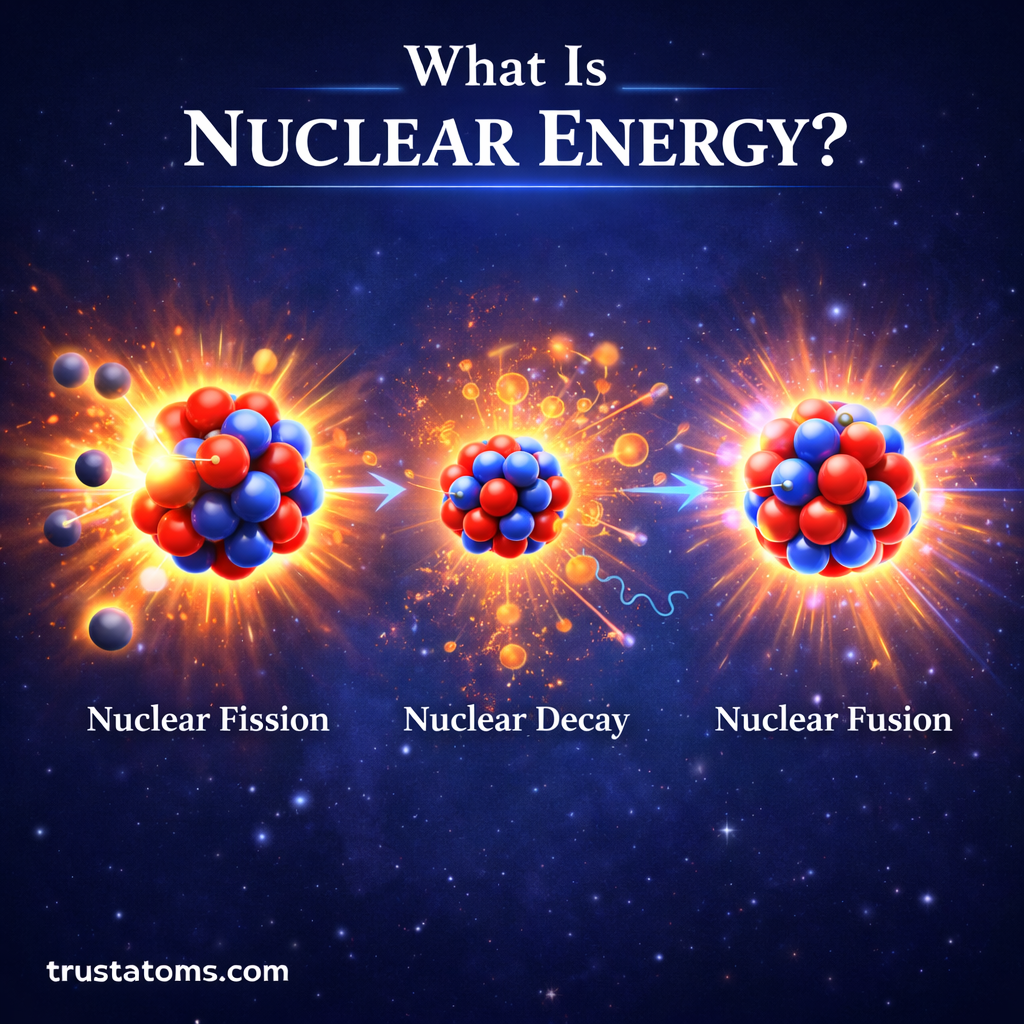
Types of Nuclear Reactions
There are three primary processes that release nuclear energy.
1. Nuclear Fission
Fission occurs when a heavy atomic nucleus splits into two smaller nuclei.
This process:
- Releases energy
- Produces additional neutrons
- Can trigger a chain reaction
Fission is used in nuclear power plants.
2. Nuclear Fusion
Fusion occurs when two light nuclei combine to form a heavier nucleus.
This process:
- Releases enormous energy
- Powers the Sun and other stars
- Requires extremely high temperatures
Fusion is considered a potential future clean energy source.
3. Radioactive Decay
Some unstable nuclei release energy naturally over time.
They emit:
- Alpha particles
- Beta particles
- Gamma radiation
Radioactive decay occurs without external triggering.
How Nuclear Power Plants Work
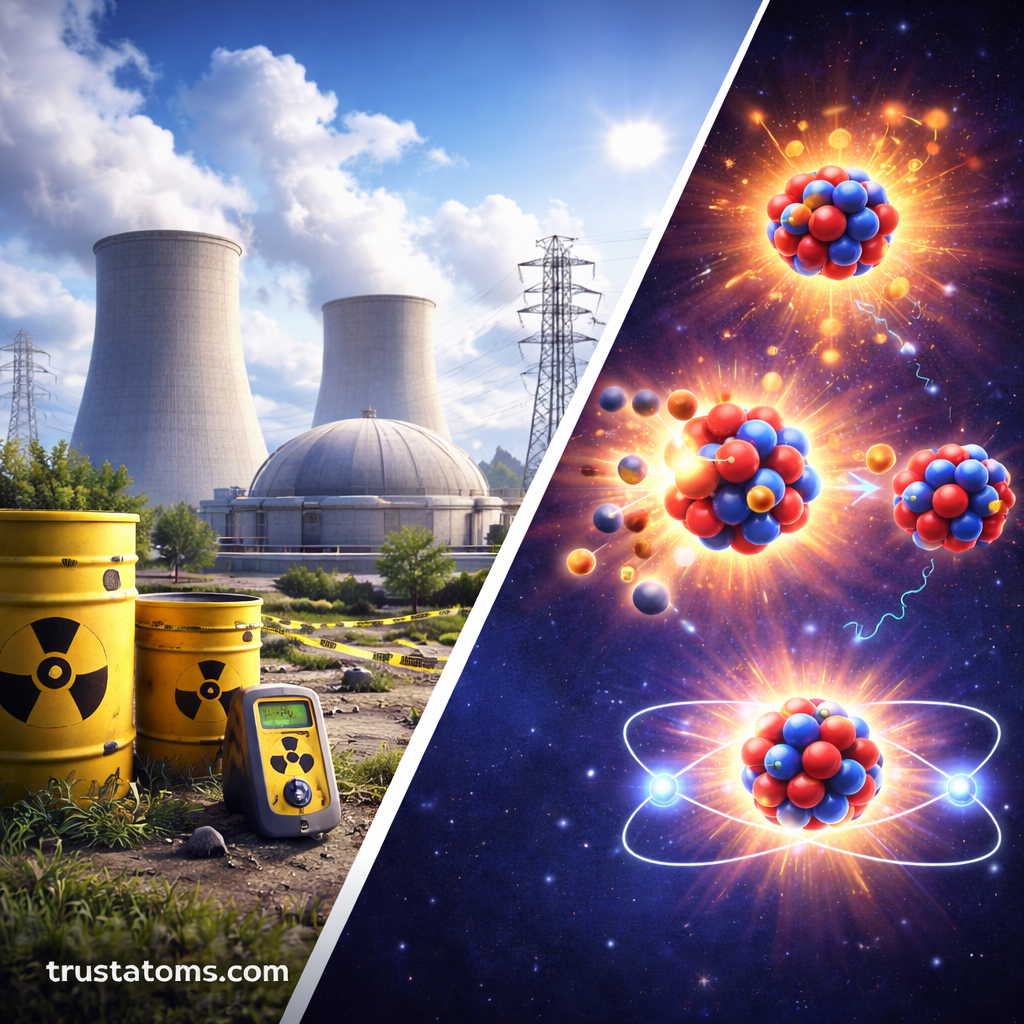
Most nuclear power plants use fission to generate electricity.
The basic steps include:
- Uranium fuel undergoes controlled fission.
- Heat is produced.
- Water is heated into steam.
- Steam spins a turbine.
- The turbine generates electricity.
The process is similar to fossil fuel plants — but the heat source is nuclear rather than chemical combustion.
Advantages of Nuclear Energy
Nuclear energy has several benefits.
High Energy Output
A small amount of nuclear fuel produces far more energy than fossil fuels.
Low Greenhouse Gas Emissions
Nuclear power plants emit very little carbon dioxide during operation.
Reliable Energy Supply
Nuclear plants operate continuously and are not dependent on weather conditions.
Challenges and Concerns
Despite its advantages, nuclear energy presents challenges.
Radioactive Waste
Spent nuclear fuel remains radioactive and must be carefully stored.
Accidents
Although rare, nuclear accidents can have serious environmental impacts.
High Initial Costs
Building nuclear plants requires significant investment.
Nuclear Energy vs. Fossil Fuels
Key differences include:
Nuclear Energy:
- Energy from atomic nuclei
- Low carbon emissions during operation
- Produces radioactive waste
Fossil Fuels:
- Energy from chemical reactions
- High carbon emissions
- Contribute to climate change
Both produce heat to generate electricity, but the source of energy differs fundamentally.
Nuclear Energy and the Sun
The Sun produces energy through nuclear fusion.
Hydrogen nuclei combine to form helium, releasing enormous energy in the process.
This fusion process:
- Provides sunlight
- Drives Earth’s climate
- Sustains life
Without nuclear energy in the Sun, life on Earth would not exist.
Is Nuclear Energy Renewable?
Nuclear energy is not considered renewable in the traditional sense because uranium fuel is finite.
However:
- It produces long-term energy from small fuel amounts.
- Advanced reactor designs may improve efficiency.
- Fusion, if mastered, could provide abundant energy.
Safety and Regulation
Modern nuclear facilities include multiple safety systems:
- Control rods to manage reactions
- Cooling systems to prevent overheating
- Containment structures to prevent radiation release
Strict international standards govern nuclear operations.
Why Nuclear Energy Matters
Nuclear energy is significant because it:
- Provides large-scale electricity
- Reduces reliance on fossil fuels
- Advances medical treatments (such as radiation therapy)
- Supports scientific research
It remains one of the most debated energy sources in the world.
Final Thoughts
Nuclear energy is the energy stored in atomic nuclei and released through fission, fusion, or decay.
It powers cities, fuels the Sun, and supports medical technology. While it offers high energy output and low emissions, it also presents challenges related to waste and safety.
Understanding nuclear energy helps explain how matter holds immense power within its smallest building blocks — and how humanity harnesses that power responsibly.