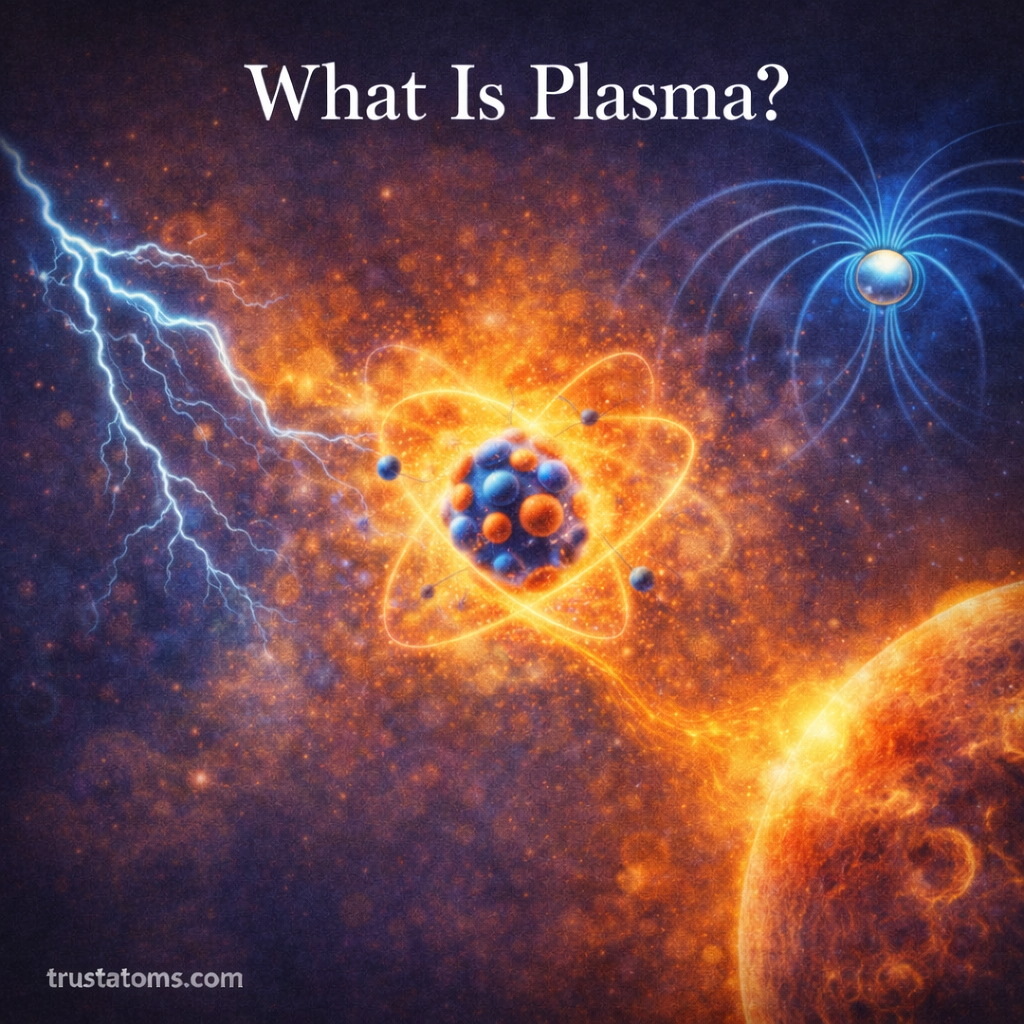
Plasma is often called the fourth state of matter. While most people are familiar with solids, liquids, and gases, plasma is just as important — and far more common in the universe.
Plasma forms when a gas becomes so energized that its atoms lose electrons. This creates a mixture of positively charged ions and free electrons.
Unlike ordinary gases, plasma conducts electricity and responds strongly to magnetic fields.
The Four States of Matter
To understand plasma, it helps to review the traditional states of matter.
Solid
- Fixed shape
- Fixed volume
- Particles tightly packed
Liquid
- Fixed volume
- Takes the shape of its container
- Particles can move past one another
Gas
- No fixed shape
- No fixed volume
- Particles move freely and rapidly
Plasma
- No fixed shape
- No fixed volume
- Made of charged particles
- Electrically conductive
Plasma behaves differently from a gas because its particles are electrically charged.
How Plasma Forms
Plasma forms when enough energy is added to a gas.
This energy can come from:
- Extremely high temperatures
- Strong electrical currents
- Powerful radiation
When energy is high enough:
- Electrons break free from atoms.
- Atoms become positively charged ions.
- A cloud of charged particles forms.
This ionized gas is plasma.
Why Plasma Is Unique
Plasma has properties that make it very different from other states of matter.
It Conducts Electricity
Because plasma contains free-moving charged particles, it allows electrical currents to flow.
It Responds to Magnetic Fields
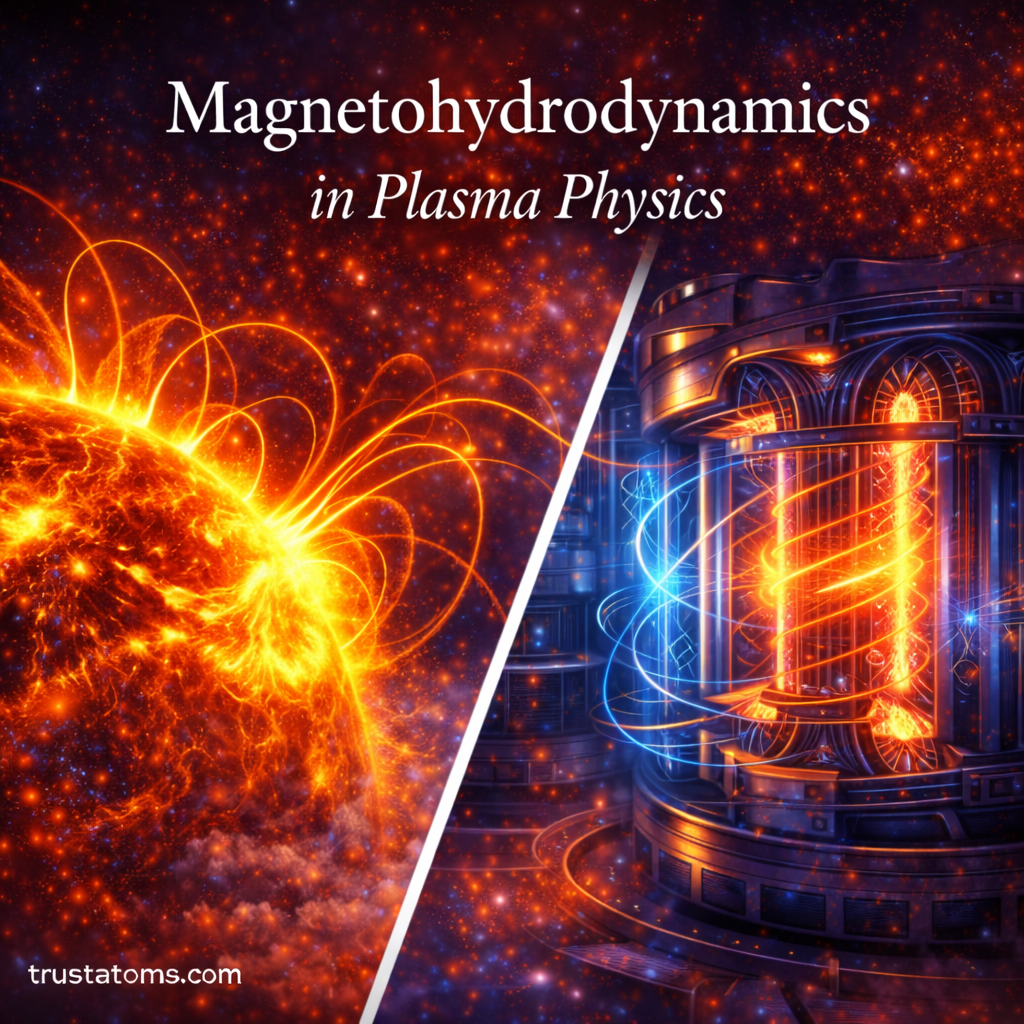
Plasma can be shaped and controlled using magnetic fields.
This is critical in:
- Fusion research
- Astrophysics
- Industrial plasma devices
It Emits Light
When electrons recombine with ions, they release energy as light.
This is why plasma often glows.
Examples of Plasma in Everyday Life
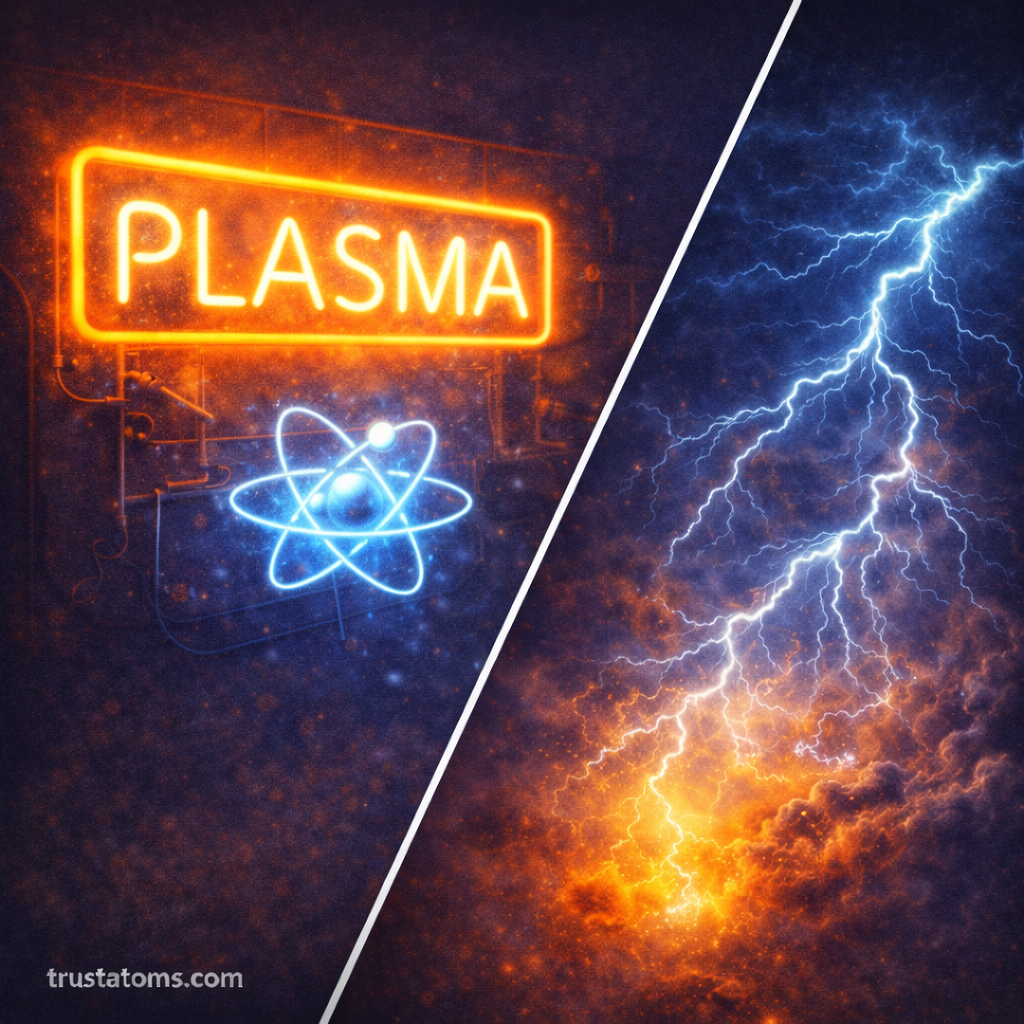
Even though plasma sounds exotic, you encounter it more often than you might think.
Lightning
Lightning is a massive electrical discharge that superheats air, turning it into plasma.
Neon Signs
Neon and fluorescent lights contain ionized gases that glow when electricity passes through them.
Plasma TVs (Older Technology)
These screens used tiny cells of ionized gas to produce light.
Plasma in the Universe
Plasma is the most common state of matter in the universe.
It makes up:
- The Sun
- Other stars
- The solar wind
- Much of interstellar space
Inside stars, extreme temperatures keep matter in a plasma state.
In fact, nearly all visible matter in the cosmos exists as plasma.
Plasma and Nuclear Fusion
One of the most exciting areas of physics involves plasma and nuclear fusion.
Fusion occurs when:
- Atomic nuclei combine
- Enormous energy is released
To achieve fusion on Earth, scientists must heat hydrogen gas to extremely high temperatures — so high that it becomes plasma.
Magnetic fields are then used to confine and control this plasma.
If fusion becomes commercially viable, it could provide:
- Clean energy
- Vast fuel supply
- Minimal radioactive waste
Differences Between Plasma and Gas
Although plasma begins as a gas, it behaves very differently.
Key differences include:
- Plasma contains charged particles; gas does not.
- Plasma interacts with magnetic fields; gas does not.
- Plasma can carry electric currents; gas typically cannot.
This difference in electrical behavior is what defines plasma as a distinct state of matter.
Types of Plasma
There are two main categories of plasma.
Thermal (Hot) Plasma
- All particles are at extremely high temperatures.
- Found in stars and lightning.
Non-Thermal (Cold) Plasma
- Electrons are very energetic.
- Heavy particles remain relatively cool.
- Used in medical sterilization and surface treatments.
Cold plasma has growing applications in:
- Wound healing
- Cancer research
- Environmental cleanup
Why Plasma Matters
Plasma research impacts many scientific fields.
It helps us understand:
- Solar flares
- Space weather
- Magnetic storms
- Energy production
It also plays a role in cutting-edge technologies.
From the glow of neon lights to the power of stars, plasma connects everyday experiences with the physics of the universe.
The Big Picture
Plasma is an ionized gas made of free electrons and positive ions.
It:
- Conducts electricity
- Responds to magnetic fields
- Emits light
- Dominates the visible universe
Although less familiar than solids, liquids, and gases, plasma is essential to understanding both modern technology and cosmic phenomena.
It is not just another state of matter — it is the state of matter that powers the stars.