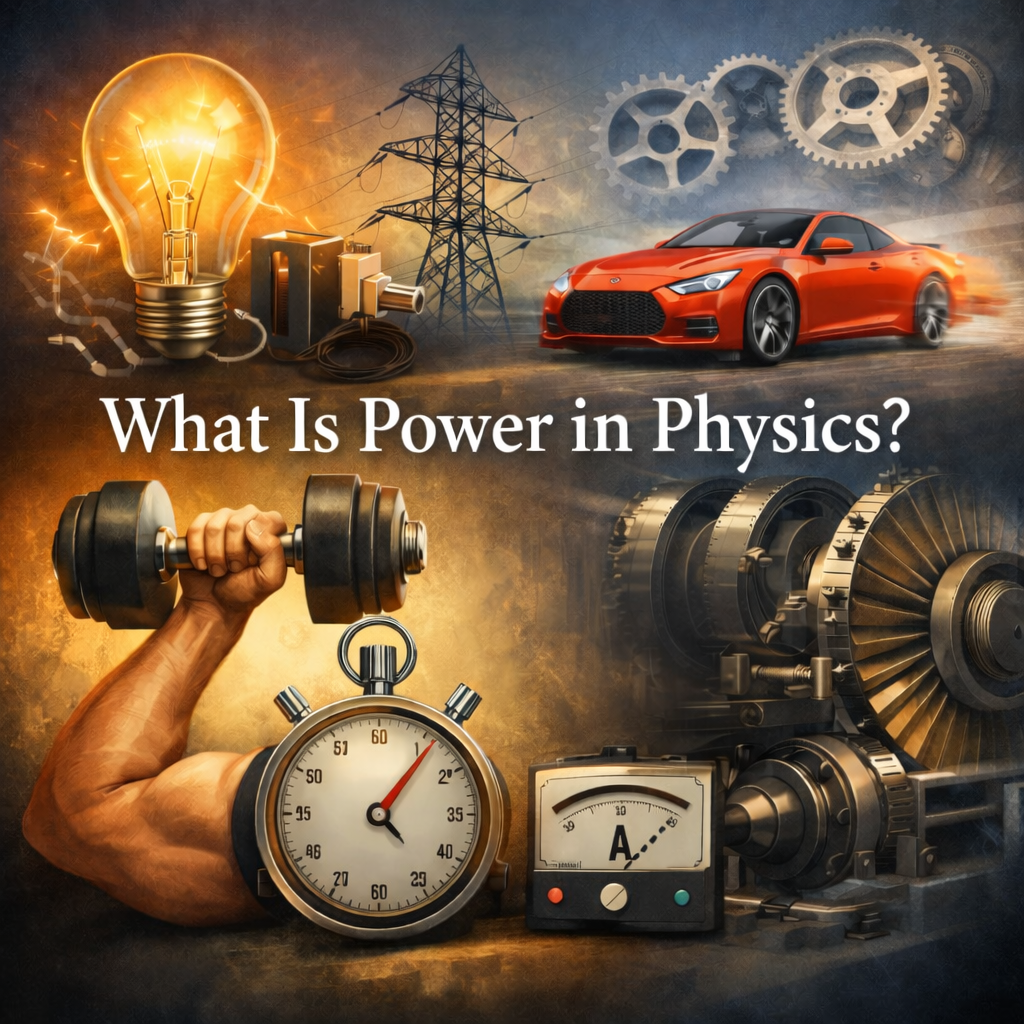
Power is one of the most important concepts in physics — and one of the most misunderstood.
When people hear the word “power,” they often think of strength or force. But in physics, power has a very specific meaning. It describes how fast work is done or energy is transferred.
Understanding power helps explain everything from how engines work to how quickly your phone charges.
The Definition of Power in Physics
In physics, power is the rate at which work is done or energy is transferred.
In simple terms:
- Work tells us how much energy is used.
- Power tells us how fast that energy is used.
Mathematical Formula for Power
The basic formula for power is:
P = W / t
Where:
- P = Power
- W = Work (or energy transferred)
- t = Time
This means:
Power equals work divided by time.
If you do the same amount of work in less time, you produce more power.
Units of Power
The standard unit of power in the International System of Units (SI) is the watt (W).
One watt equals:
1 joule per second
So if a device uses 100 joules of energy in 1 second, it has a power rating of 100 watts.
Other Common Units of Power
- Kilowatt (kW) = 1,000 watts
- Megawatt (MW) = 1,000,000 watts
- Horsepower (hp) — often used for engines
For example, car engines are often rated in horsepower, while light bulbs are rated in watts.
Work, Energy, and Power: What’s the Difference?
These terms are closely related but not identical.
Work
Work happens when a force moves an object over a distance.
Energy
Energy is the ability to do work.
Power
Power measures how quickly energy is used or work is done.
You can think of it like this:
- Lifting a heavy box slowly requires the same amount of work as lifting it quickly.
- But lifting it quickly requires more power.
Everyday Examples of Power
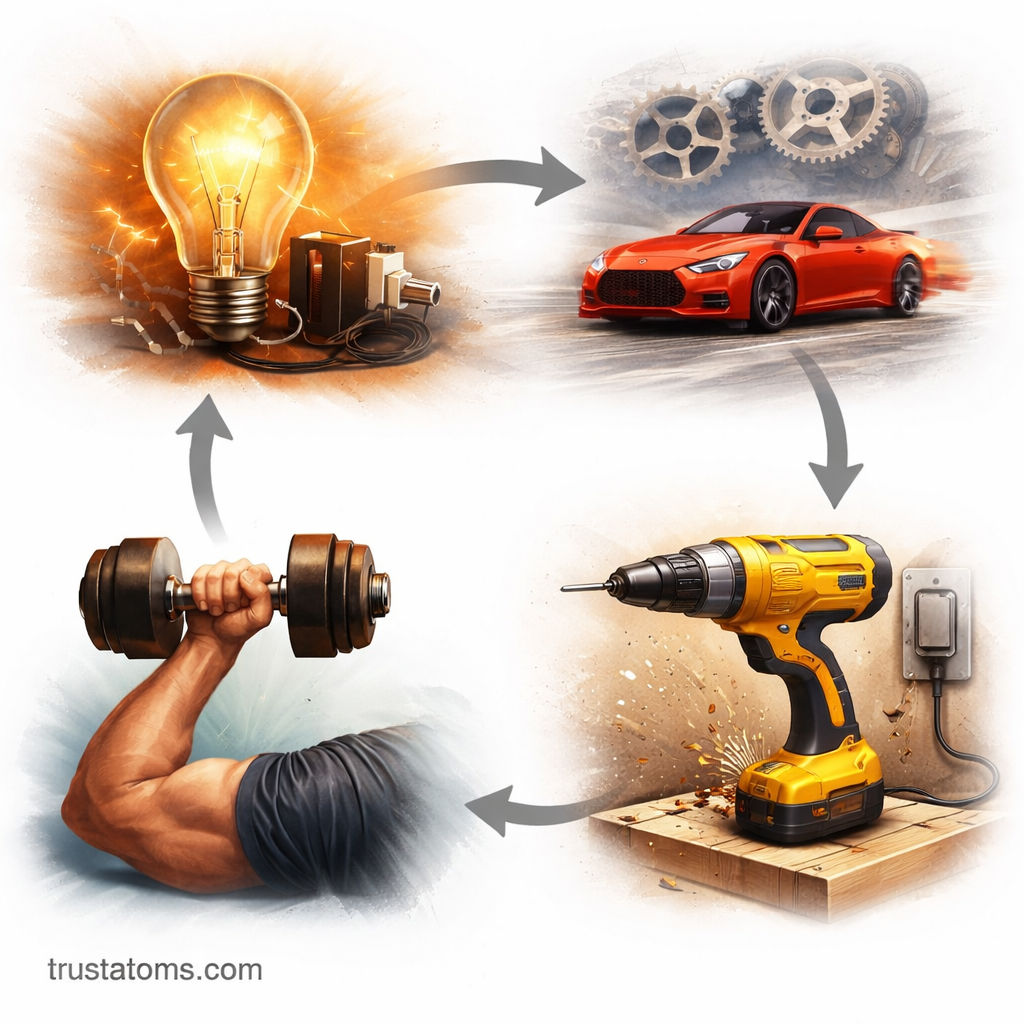
Power is everywhere in daily life.
1. Light Bulbs
A 100-watt bulb uses energy faster than a 40-watt bulb.
2. Car Engines
A more powerful engine accelerates faster because it transfers energy to the wheels more quickly.
3. Charging Your Phone
Fast charging works because higher electrical power transfers energy to the battery more rapidly.
4. Human Muscles
Two people may lift the same weight. The one who lifts it faster produces more power.
Electrical Power
In electrical systems, power has a slightly different formula:
P = V × I
Where:
- P = Power (watts)
- V = Voltage (volts)
- I = Current (amps)
This formula explains how electrical devices consume energy.
For example, if a device uses 10 volts and 2 amps:
Power = 10 × 2 = 20 watts
Mechanical Power
Mechanical power often involves force and velocity.
Another useful formula is:
P = F × v
Where:
- F = Force
- v = Velocity
This formula is especially useful in physics problems involving engines, motors, and moving objects.
Why Power Matters in Physics
Power helps us understand efficiency and performance.
It allows scientists and engineers to:
- Compare machines
- Design engines and generators
- Improve electrical systems
- Measure athletic performance
- Optimize energy usage
Without power, we would only know how much energy is used — not how quickly it is delivered.
Power vs Energy: A Common Confusion
A common mistake is mixing up power and energy.
Energy is the total amount used.
Power is the rate at which it is used.
For example:
- A 100-watt light bulb uses energy faster than a 50-watt bulb.
- But if the 50-watt bulb stays on twice as long, both use the same total energy.
This difference is crucial in electricity bills, engineering design, and physics calculations.
Key Takeaways
- Power measures how fast work is done or energy is transferred.
- The basic formula is P = W / t.
- The SI unit of power is the watt (W).
- Higher power means energy is transferred more quickly.
- Power is used in mechanical systems, electrical systems, and everyday technology.
Understanding power makes it easier to grasp how machines operate, how energy systems function, and why speed matters in physical processes.
Final Thoughts
Power is not about strength alone — it’s about speed.
In physics, what matters isn’t just how much work you do, but how quickly you do it. Whether you’re lifting weights, driving a car, or charging a phone, power determines performance.
Once you understand power, you unlock a deeper understanding of energy, motion, and the physical world around you.